


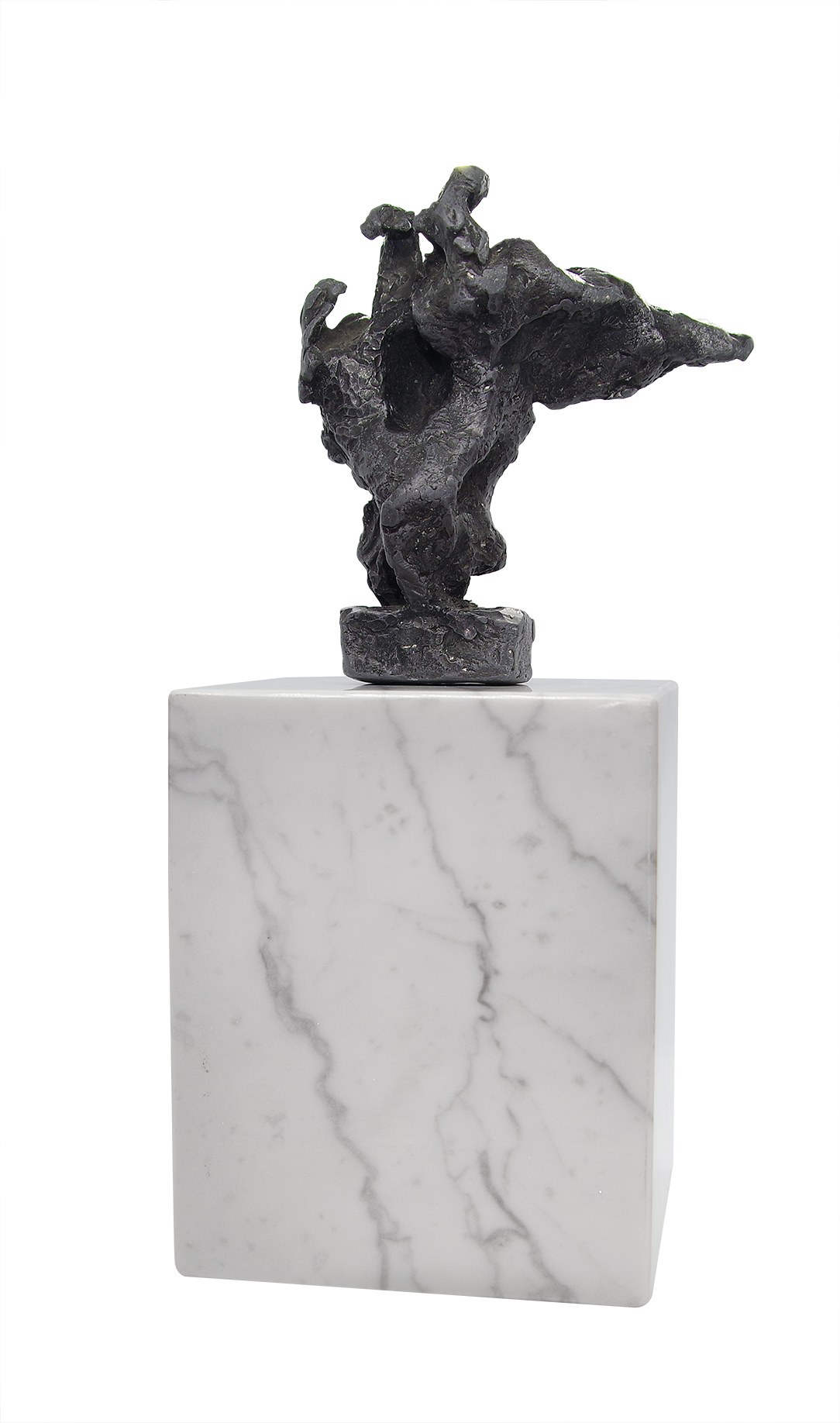
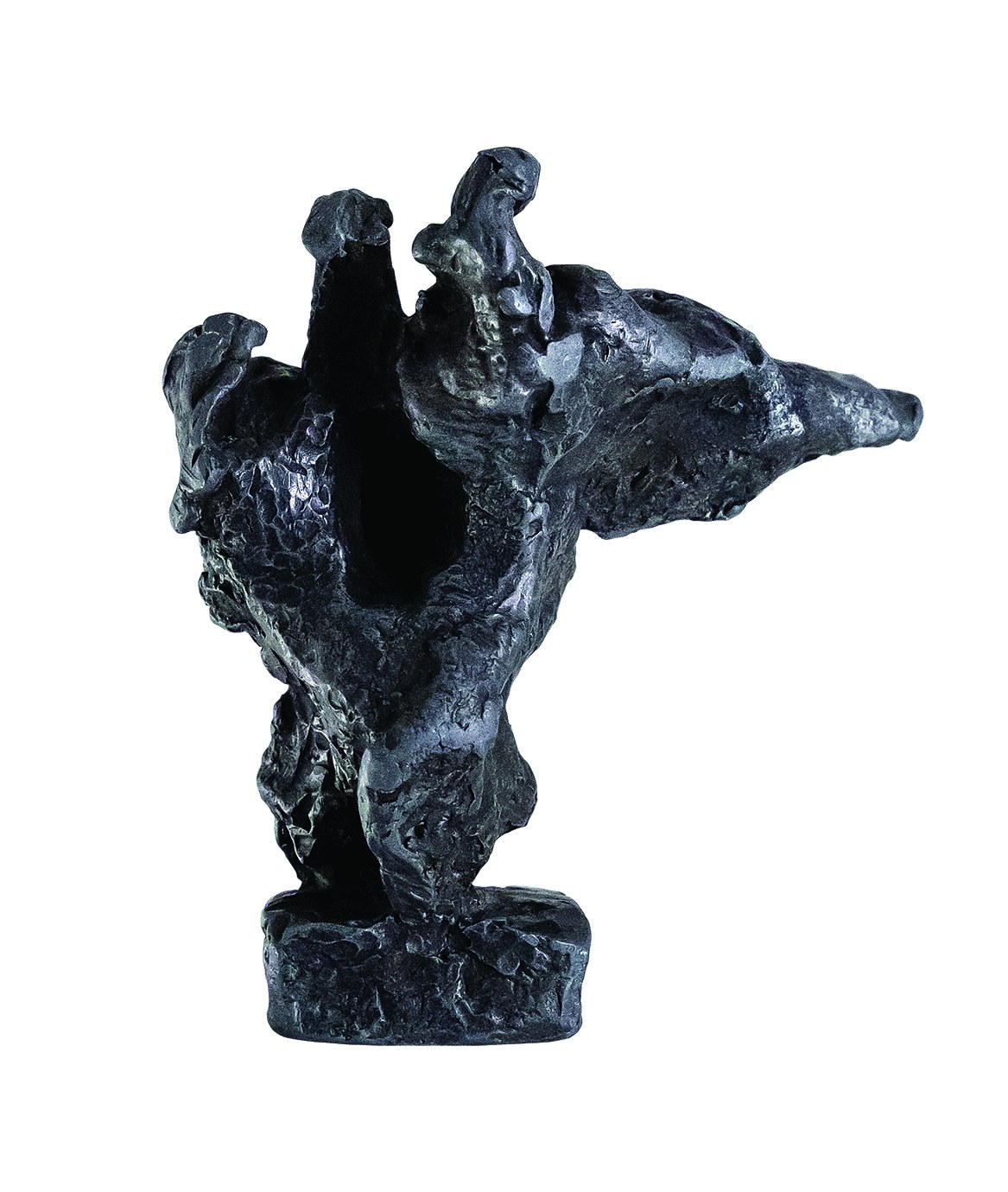
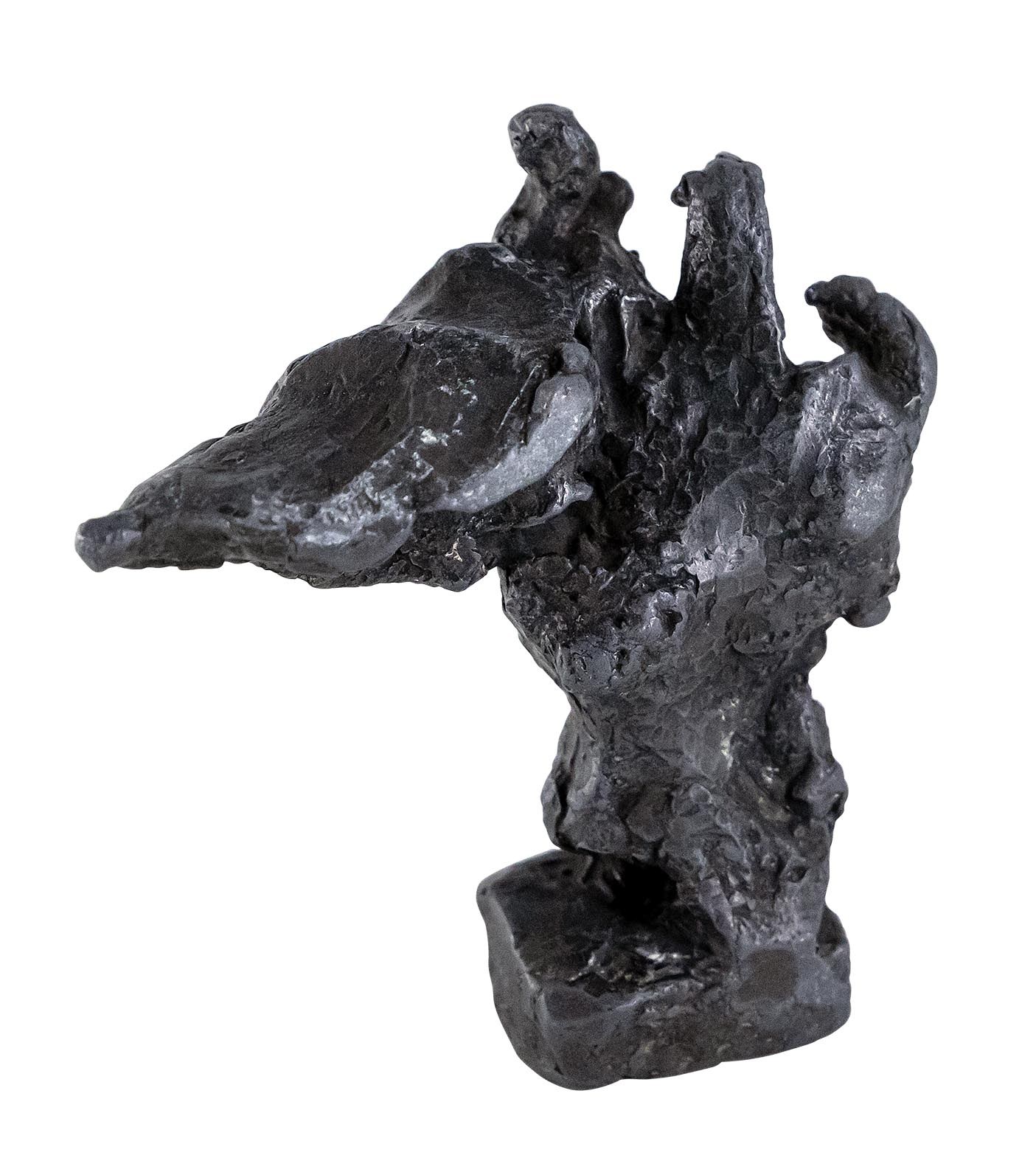
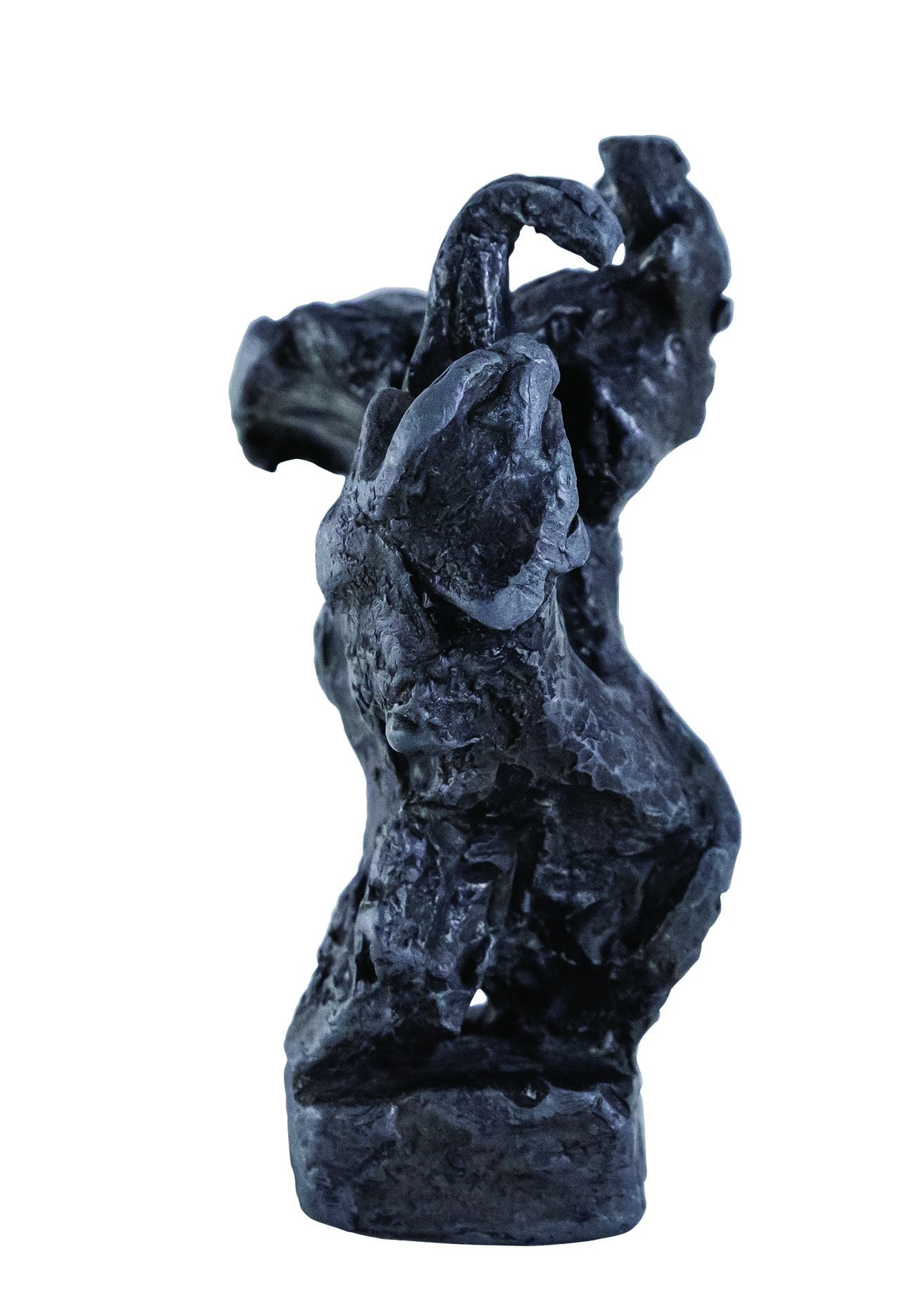
lead, 10 x 9 x 4 cm
signed on the side plane of the base with the monogram AS in a circle
ORIGIN:
- private collection
LITERATURE:
- Agata Jakubowska, Multiple Portrait of the Works of Alina Szapocznikow, Poznan 2008
- Jola Gola, Catalogue of the sculptures of Alina Szapocznikow, Cracow 2001.
- Alina Szapocznikow 1926- 1973, sculpture, drawing, National Museum in Warsaw, 1974 (exhibition catalog).
- Second Exhibition of the Sculpture of Alina Szapocznikow, exhibition catalog at the BWA, Poznan 1960
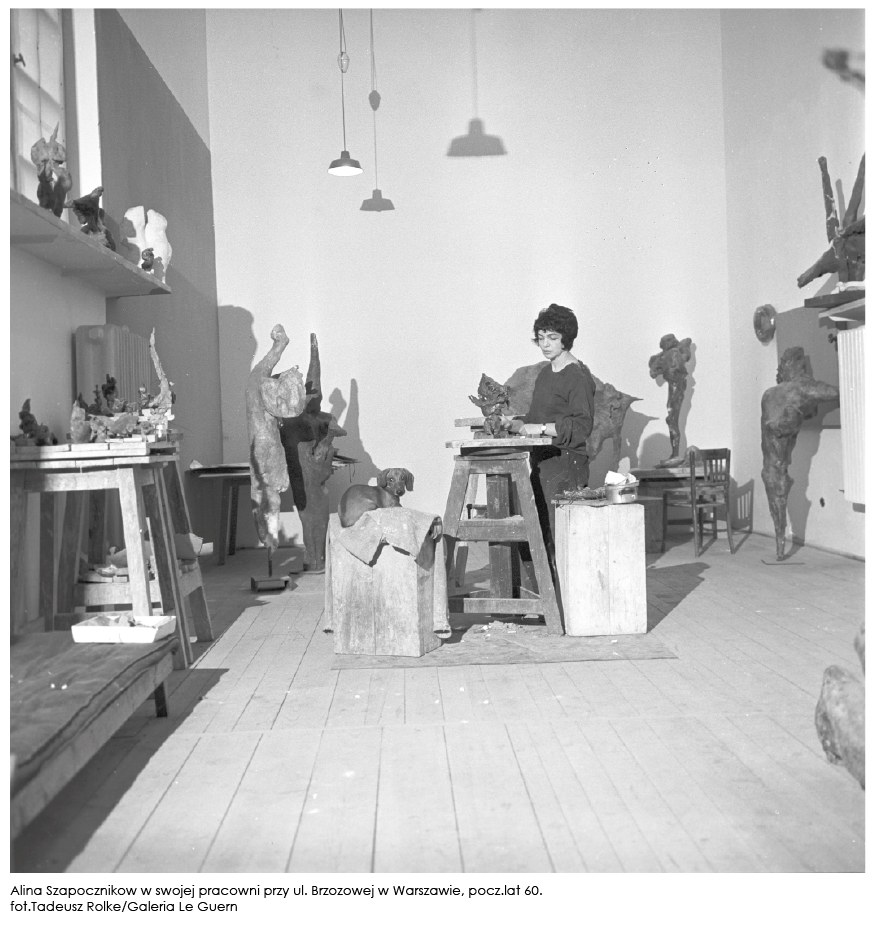
Alina Szapocznikow, after her return to Poland in 1951, joined artistic life within the framework of socialist realism then in force. Among other things, she completed a project for a monument to Polish-Soviet friendship, which later stood in the main lobby of the Palace of Culture. Given up for scrap in 1992, it returned - damaged - without hands, to the just-opened Museum of Modern Art and may remind some of the story of the marble heroes from Andrzej Wajda's film. Monument projects are that element of sculptural work in which artists - measuring themselves against the subject and the requirements imposed by the organizers for the work - can show their art in public space. The monument becomes an element of the city, accessible to all, viewed and growing into the landscape of the place for which it was designed. A special theme, especially in the case of Warsaw, was the war and the memory of it, the heroes and victims. Alina Szapocznikow, already creating her own artistic language based on her own experiences, participated in competitions where, as Agata Jakubowska writes: "[...] the issue of wartime experience is shifted to a more public area" and "parallel to the first sculptures, which are representations of 'beautiful women' [...] the artist makes designs for monuments." (Agata Jakubowska, Multiple Portraits of Alina Szapocznikow, UAM Poznań Publishing House 2008, p. 109). These will be primarily two competitions for the Monument to the Heroes of Warsaw and the monument in Auschwitz. The motifs of hands, wings and "body-ruins" recur in these projects, which do not attempt to describe an anonymous collective, but always belong to a specific person.
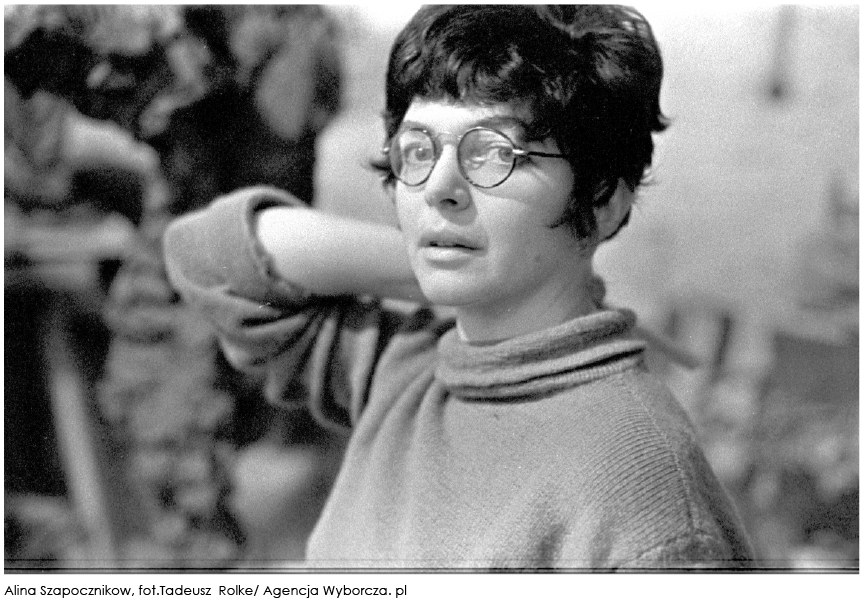
The experiences of the war are remembered in them - as well as in other "private" works by the artist - with the body, but this physicality is transformed into a sign - a monument dedicated to the heroes and at the same time victims of the war. The sculpted form, the shape of which consists of a suggestion of an upraised hand, a wing, is captured in a particular moment of rising to flight. It is movement, soaring, rising to flight as a way to live, to arise, that are the common hallmark of Alina Szapocznikow's sculptural projects. The changeability, jitteriness or incompleteness of the figure makes it possible to view it from different perspectives, to discover its various facets. The artist herself, making a constant attempt to struggle with the hardship of work that outgrew her fragility and physicality, may be a symbolic figure of such rebirth. While creating her works, casting her shattered body in various materials, she did not give up on beauty. Just as she did not give up on the fullness of life, but understood it similarly to other artists of the generation that experienced the war. As early as 1949, in a letter to Richard Stanislawski, she wrote:
"But the notions have not fundamentally changed for you as they did for me, so that instead of 'nice, cultured, polite', it remained 'beautiful, human, true, to the bottom'."
Elsewhere, Alina Szapocznikow said this about her work: "The roots of my work grow out of my profession as a sculptor. For years I have been busily exploring the issues of balance, solid, space, light and shadow. To arrive at what I have become today: nothing less than a sculptor looking at the bankruptcy of his vocation, facing an insurmountable obstacle. For I decided to be conscious of the time we live in. I called to the succor of my professional skills, all my intuition and intelligence, to realize with all the more clarity of mind the poverty of my artistic means compared to the means of modern technology. I was won over by the hero-miracle of our time, the machine.
To her today belongs beauty, discoveries, the testimony of time, the recording of history. To it belong real dreams, to it belongs the applause of the public. I produce these clumsy objects.
This absurd and shrinking mania testifies to the existence of some hitherto unknown gland, essential to life. I will agree that this mania can be reduced to a single gesture, within the reach of everyone's hand. And this gesture is sufficient in itself, an acknowledgment of our human presence. My gesture is directed toward the human body, that "completely erogenous zone," toward its most indefinable and most volatile sensations. To glorify the impermanence in the nooks and crannies of our bodies, in the traces of our steps on this earth." (Alina Szapocznikow 1926- 1973,sculpture, drawing, National Museum in Warsaw, 1974).
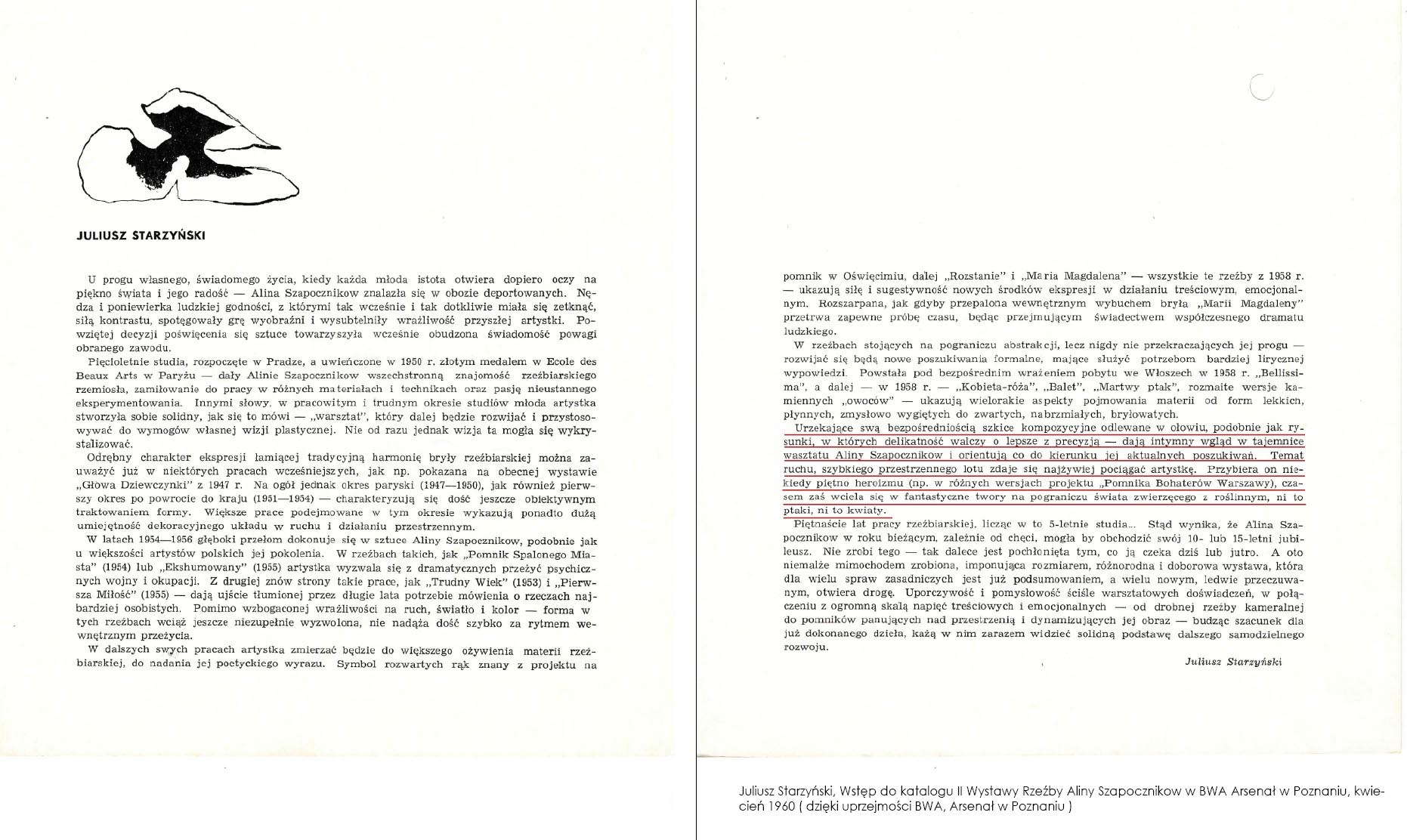
The presented sketch for the monument, donated to Prof. Juliusz Starzynski, was described by him as follows: "Charming in their directness, the composition sketches cast in lead, like the drawings in which delicacy struggles for the better with precision - give an intimate insight into the secrets of Alina Szapocznikow's workshop and orient as to the direction of her current search. The subject of movement, of rapid spatial flight, seems to attract the artist at most. It sometimes takes on the stigma of heroism (e.g., in the various versions of the design of the "Monument to the Heroes of Warsaw"), while sometimes it is embodied in fantastic creations on the borderline between the animal and plant worlds, neither birds nor flowers." Prof.Juliusz Starzynski.
In her expert report presenting the design for the monument, Hanna Kotkowska-Bareja described the sculpture as follows: "Vertical form, split at the bottom, supported on a square plinth. The whole is flattened, concave in the middle, with short outgrowths growing from it upward and sideways and a triangular wing on the right. The whole contains suggestions of a hand shape with fragments of fingers and a bird wing. The matter of the sculpture is soft, uneven and sketchy, which gives it a special variability at the slightest change of viewpoint. Despite its small size, it has a monumental character, and the apparent randomness of the shapes combines into symbolic meanings and the possibility of different interpretations. Among the small forms that appeared in Alina Szapocznikow's work in three projections - in 1958-59, in 1964 and in 1965, and which she supposedly cast in lead herself, this sketch for a monument seems to contain a full catalog of explorations that found realization in large sculptures ("Hands" from the Auschwitz project, "Żagiew", Poznań's Nike). In addition, the creation of this sketch is related to several other sculptures from the same time, also attempts to design a monument to the Warsaw Uprising ("Nike", plaster, 1959, 22 x 10 x 10 cm; "Wing" 1959, lead, height 18 cm).
It can be assumed that the synthetic nature of the sketch caused the author to give this particular sculpture to Prof. Juliusz Starzynski in gratitude for the text of the introduction to the catalog of her exhibition, held in Warsaw and Poznan in 1960.
In the introduction to the catalog, the professor's thorough, professional assessment of the sculptor's early achievements is accompanied by a conviction about her further independent development. Alina Szapocznikow later approached Professor Starzynski for another text in preparation for her exhibition at the Museum of Architecture in Wroclaw in 1969, but neither the text nor the exhibition came into being. "The 'sketch' remained in private hands since 1960 (Prof. Starzynski died in 1974) was never exhibited, and as a result is not mentioned in any, numerous publications devoted to Alina Szapocznikow."
The discovery of an unknown work by such an outstanding world-renowned sculptor 51 years after her death is an extraordinary rarity, which is worth appreciating because of its role in the whole set of Alina Szapocznikow's works related to the Warsaw Uprising monument projects.
Hanna Kotkowska-Bareja former curator of the Sculpture Collection of the National Museum in Warsaw Commissioner of the exhibition "Alina Szapocznikow". 1926 -1973, sculpture, drawing, at the National Museum in Warsaw, 1974.







Utoljára megtekintett
A tételek listájának megtekintéséhez jelentkezz be
Kedvencek
A tételek listájának megtekintéséhez jelentkezz be