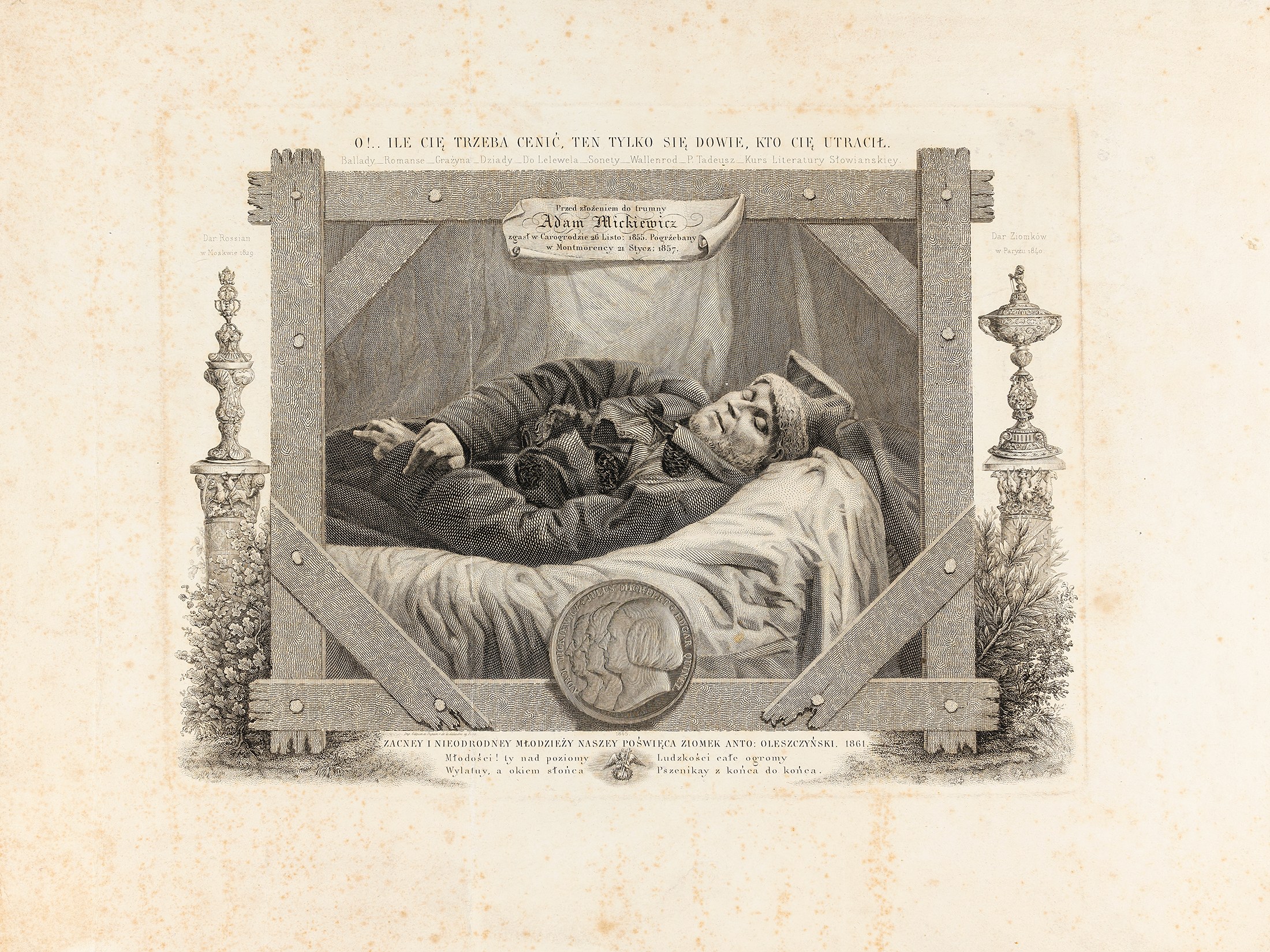
Steel engraving; print: 215 × 282 mm; Graphic glued on thick cardboard; traces of foxing. Lit.: Katalog portretów..., T. III (Warsaw 1992), pp. 180-181, item 3437; Graphic based on a photograph, described in the BJ collection as: phot. Antoni Oleszczyński, Istanbul, November 28, 1855.
Oleszczynski most likely did not take the photograph personally, but he is the author of the offered intaglio, based on the aforementioned daguerreotype.
The work was created six years after the death of Adam Mickiewicz (d. 1855 in Constantinople) and is part of the trend of posthumous iconography, which in the 19th century was an element of building national memory. The "deathbed" images acted as almost visual relics - they perpetuated the last image of a great figure and incorporated it into the symbolic order of the community. In the context of Polish emigration, this was of particular importance: the image became a carrier of memory and identity.
Oleszczynski, active mainly in France, was a highly regarded engraver of portraits and historical compositions. His works are characterized by careful technique and a high editorial level. Also important in the case of this print is its functioning as a reproduced image - reproduced in albums, publications and patriotic collections. This is an example of graphic art that transcends the purely artistic dimension and becomes an element of the culture of memory.