


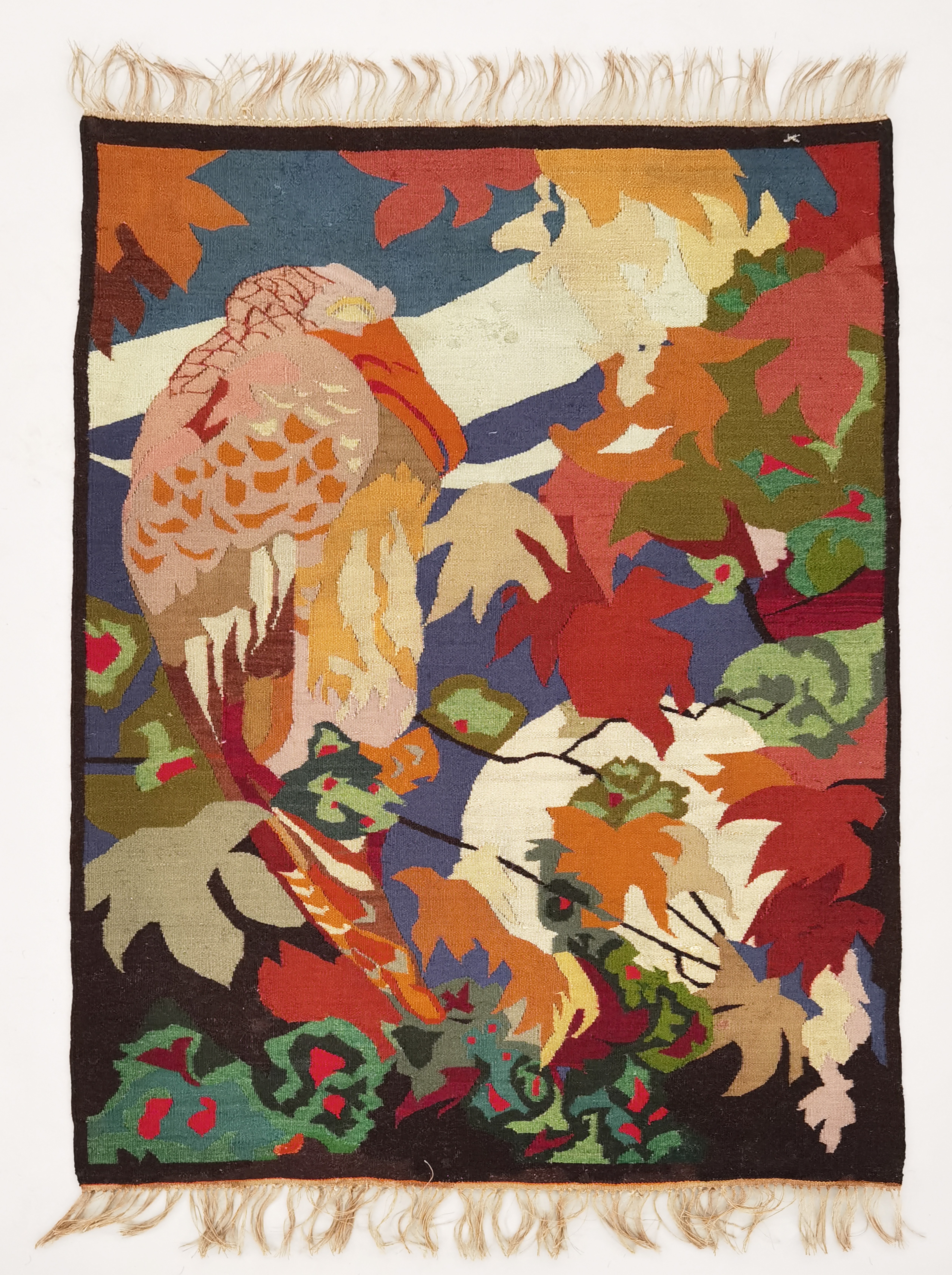
wool, warp - linen; 165 x 113 cm;
Embroidered monogram on border: BT.
Poland, Zakopiańska Spółdzielnia "Kilim", 1920s-1930s.
Condition: after restoration in 2024 (information label sewn on the underside).
Rectangular, multicolored kilim with depiction of a bird in a landscape; shorter sides finished with tassels (tassels completed during restoration).
Reproduced in:
"Polish Kilims from the Eighteenth to the Twentieth Century from the Collection of the National Museum in Poznan" [exhibition: March 16-April 27, 2008], National Museum in Poznan, 2008, p. 50, il. 11-8.
Lit:
"Kilim" STOW. ZAR. ZOGR. POR. [Registered Association with Limited Hand]" Zakopane Protective Signs, Krakow 1913.
Bogdan Treter (1886-1945) was one of the most important figures associated with the Zakopane "Kilim" Association, which played a huge role in the development of Polish decorative arts in the early 20th century. He was an architect, art historian, critic and designer, and his activities combined his interest in modern design with his fascination with Podhale culture and folk art. He studied architecture and art history, which gave him a broad artistic knowledge. After arriving in Zakopane, he became associated with the community of artists centered around the idea of the Zakopane style, previously developed by Stanislaw Witkiewicz. In the activities of the "Kilim" Association, it was important to combine a high artistic level with traditional Podhale craftsmanship. The artists designed textiles, furniture and utilitarian objects inspired by folk motifs, but adapted to modern interiors.
Treter was a close friend of Kazimierz Brzozowski (director of Zakopane's "Kilim"), from whom he learned the technical secrets of looms. He believed that a designer must have a perfect understanding of the fabric structure, so that the lines and colors perfectly harmonize with the woolen thread. Critics praised his work for its "exquisiteness expressed through modest means" and avoidance of banal, literal folklore.
B. Treter were distinguished by geometrization of forms, clear rhythm of composition and harmonious juxtaposition of colors. He drew inspiration from highland ornamentation - sarees, floral motifs and woodcarving decorations - but did not copy them literally. He transformed traditional patterns into more modern decorative arrangements. As a result, the kilims he designed combined the character of folk art with the aesthetics of modernism and art déco.
"The character of B. Treter's work is characterized by simplicity, not falling into cheap, recycled folklore, geometric stiffness, eccentricity or banality, but precisely, thanks to the subtle arrangement of rhythms and harmonization of colors, into exquisiteness, always expressed by the most modest means possible. Each of his designs, translated into the language of the loom, amazes with this sincere simplicity, the charm of which is felt in all its fullness only after a longer exposure to it in a quiet room. These ideas are so "kilim-like" that their genesis should be sought rather in the mechanics of a horizontally weaving thread along a vertical warp, not in watercolor or graphic plans" (after: "Rzeczy Piękne", 1929, 8, no. 4, p. 129).
The offered kilim is characterized by rich, vivid colors and inspiration from nature with visible influences from the work of Wladyslaw Skoczylas. The centerpiece of the composition is a stylized, majestic bird sitting on a branch. The design is strongly geometric, with clear contours and a decorative, poster-like depiction of nature. The artist brilliantly operates contrast - the bright silhouette of the moon in the background brings out the deep, saturated colors of the bird's leaves and plumage.
Fabrics created according to Bogdan Treter's designs had not only a decorative function, but also a representative one. They decorated boarding houses, villas and public interiors, becoming a symbol of elegant Polish applied art of the interwar period. His works represented Poland at prestigious international exhibitions, including the famous Exhibition of Decorative Arts in Paris in 1925.
These designs contributed to the growing prestige of Zakopane artistic weaving and the popularization of kilim as an important element of modern interior design.








Utoljára megtekintett
A tételek listájának megtekintéséhez jelentkezz be
Kedvencek
A tételek listájának megtekintéséhez jelentkezz be