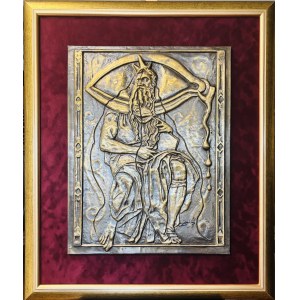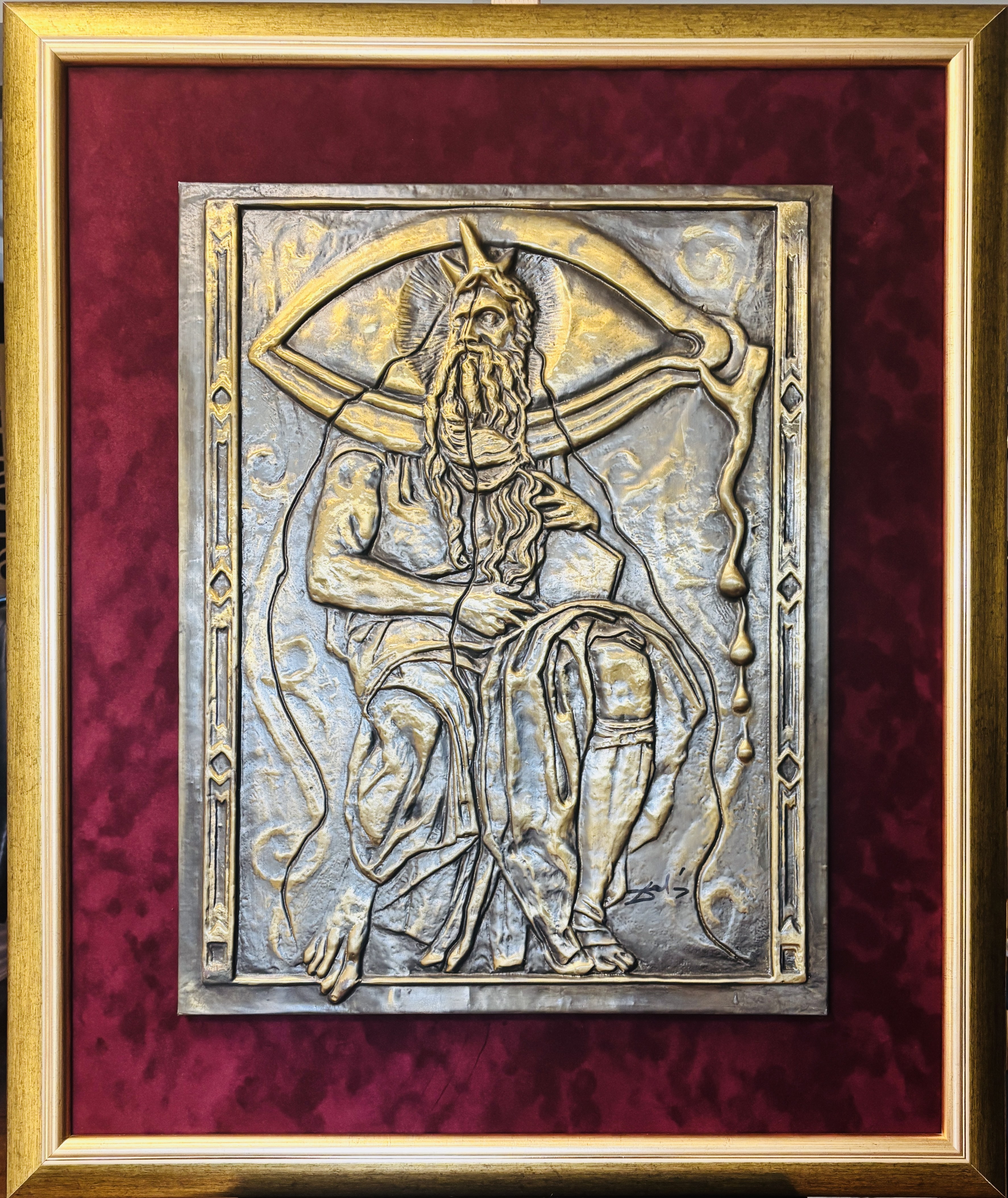
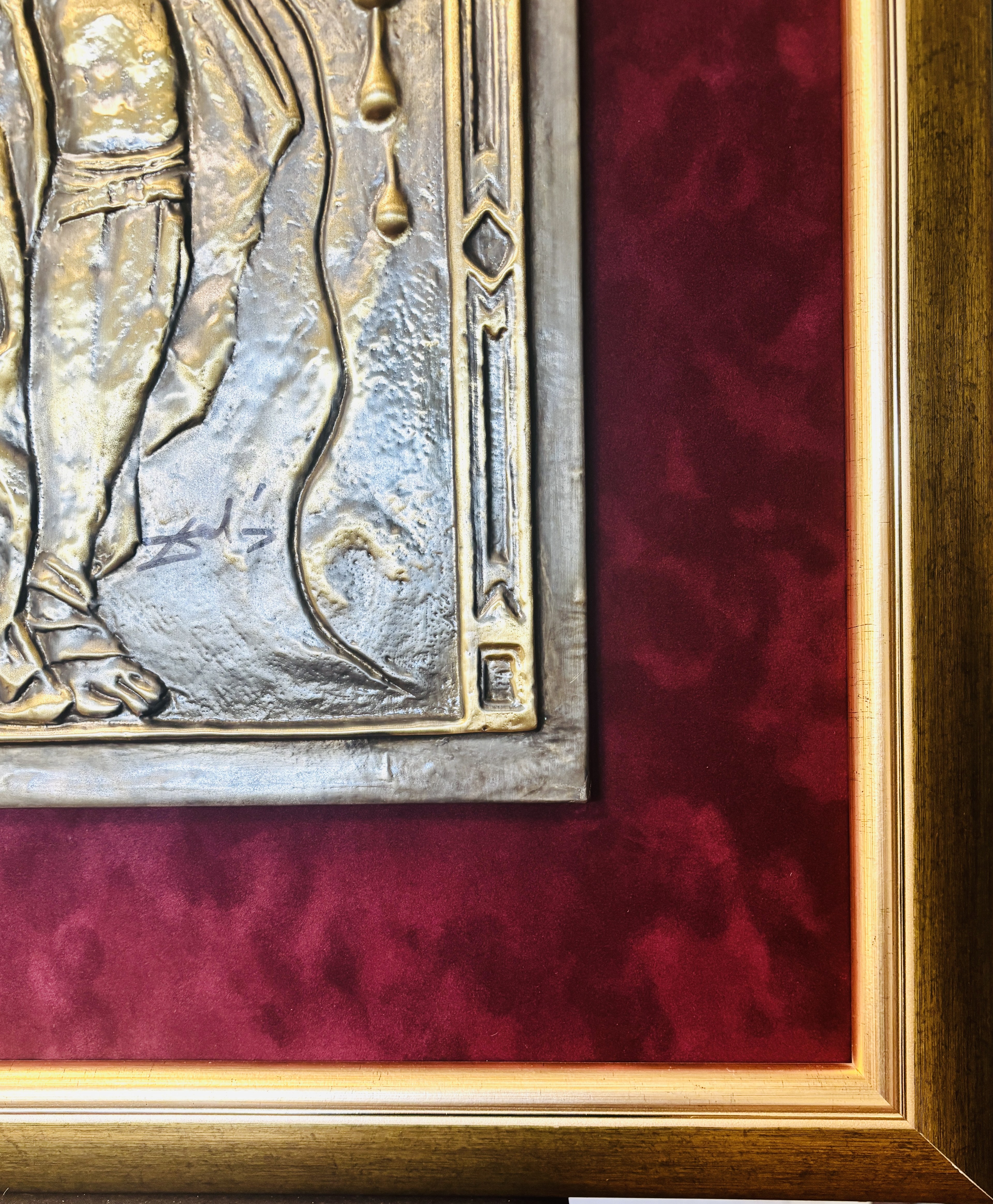
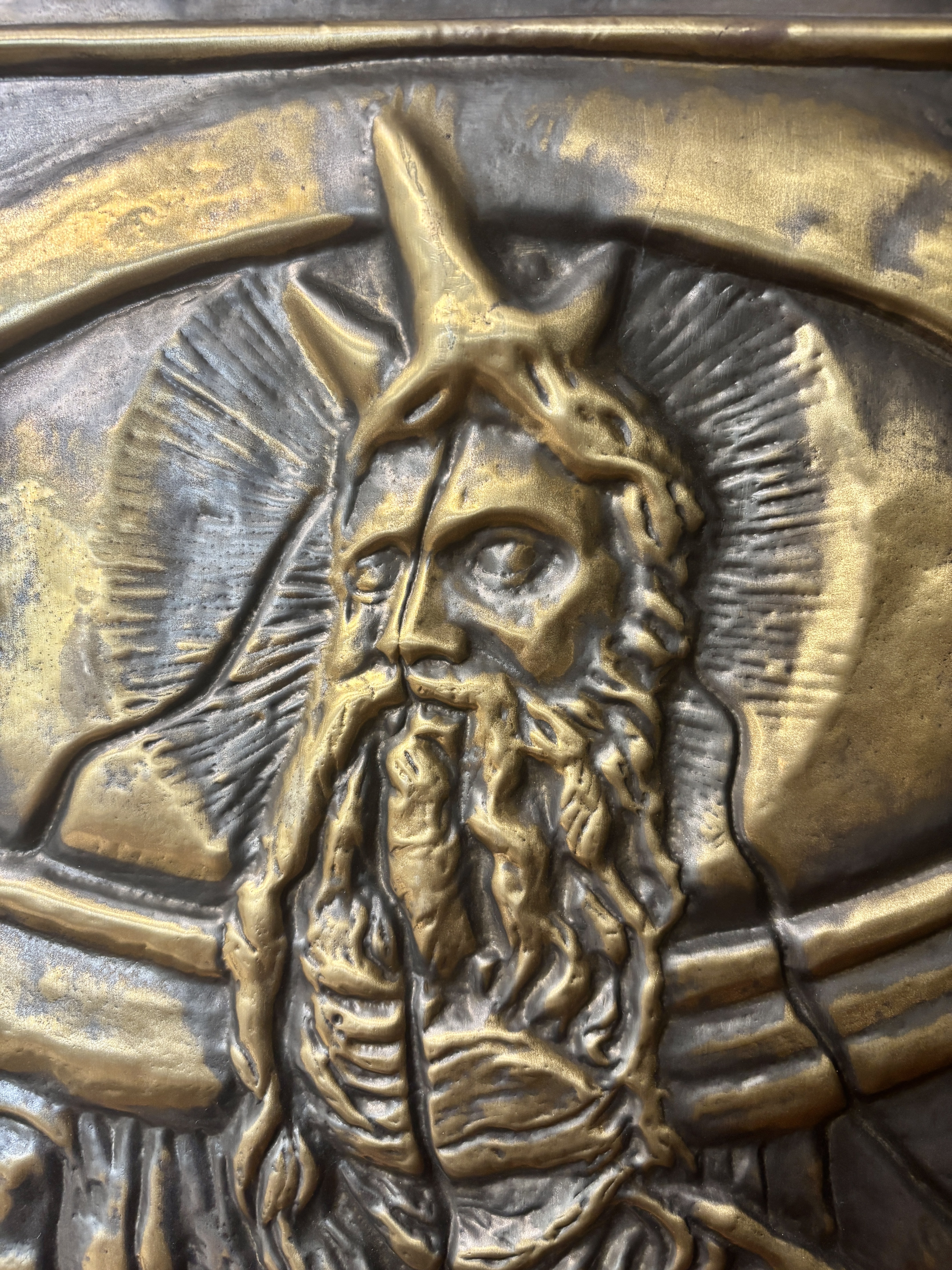
Relief (bas-relief); bronze (sheet metal); 70 x 54 cm (relief) framed in a 100 x 83 cm frame with a burgundy velvet mat, which gives the work an exceptionally elegant appearance.
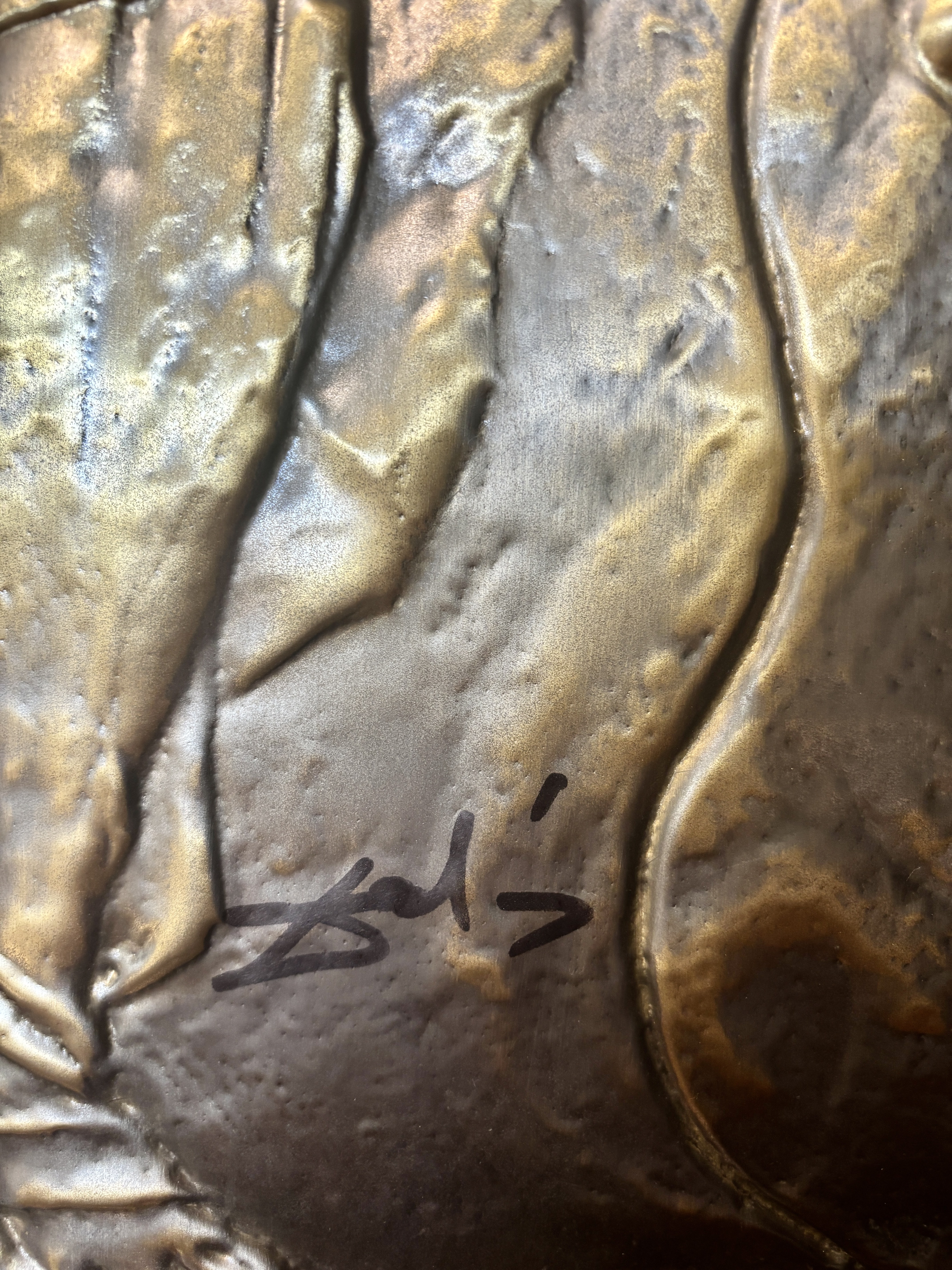
The relief “Moses and Monotheism” served as the artistic complement to an exclusive edition accompanying a text by Sigmund Freud; signed in black ink by Salvador Dalí in the lower right corner; limited edition of 300 copies.
Publisher: Ariane Lancell, Art et Valeur Editions, 1974
Dalí was directly inspired by Michelangelo’s marble statue of Moses, created for the second mausoleum of Julius II, located in Rome at the Church of San Pietro in Vincoli. This plate depicts three things that were very important to Dalí: Freud, Moses, and Michelangelo.
Bibliography:
-Catalog raisonné of sculptures “Le dur et le mou” (eds. Eccart, R. Descharnes, 2004, p. 219, no. 562)
-Catalog raisonné, Field: 75-2.
Salvador Dalí, known for his surrealist works full of symbolism and ambiguity, created a painting between 1968 and 1970 titled “Moses and Monotheism,” also known as “Moses—Ray of Energy.” This painting is a tribute to one of the greatest Renaissance artists, Michelangelo, of whom Dalí was a great admirer.
Moses has horns on his head, which stems from a mistranslation of the Hebrew Bible into Latin. In Hebrew, the word “karan” means both “horn” and “ray.” Jerome, when translating the Bible into Latin, used the word “cornuta,” which means “horned.”
For Dalí, monotheism was one of the most important achievements in human history. He believed that monotheism is the foundation of Western civilization. Monotheism unites three figures important to Salvador Dalí: Moses, Michelangelo, and Freud.
For Dalí, Sigmund Freud was not simply a doctor or a scientist—he was a prophet who provided him with the “keys to the kingdom” of his own fears, dreams, and desires. This is one of the most obsessive and fascinating relationships in the history of modernist art.
Dalí began reading Freud in his early twenties in Madrid. *The Interpretation of Dreams* became the most important book of his life. He later confessed that reading Freud was like discovering a new map of the world—this time, a map of the interior of the human mind.
For years, Dalí tried to meet his idol. He traveled to Vienna three times, but Freud rebuffed him. It was not until 1938 in London, thanks to Stefan Zweig’s mediation, that the legendary meeting took place. Dali was 34 at the time; Freud was 82 and terminally ill.
His fascination with Freud led Dalí to develop his own creative method. Dalí did not simply want to paint dreams (like other Surrealists). He wanted to actively induce a state of paranoia, and then “critically” analyze and recreate it.
If Freud was Dalí’s “spiritual father” in the realm of the intellect, then Michelangelo was his God in the realm of form. Dali considered himself a direct heir to the Renaissance masters, and he placed Michelangelo at the very pinnacle of the artistic hierarchy. In the 1950s and 1960s, Dalí developed an almost mystical obsession with Michelangelo’s sculptures. He repeatedly reinterpreted his most famous works. "Moses" was one of his favorite sculptures. Dali saw in it strength and anger, which he identified with creative power.