


94 x 142.5cm - oil, canvas
Signed p.d.: W.T. MCM
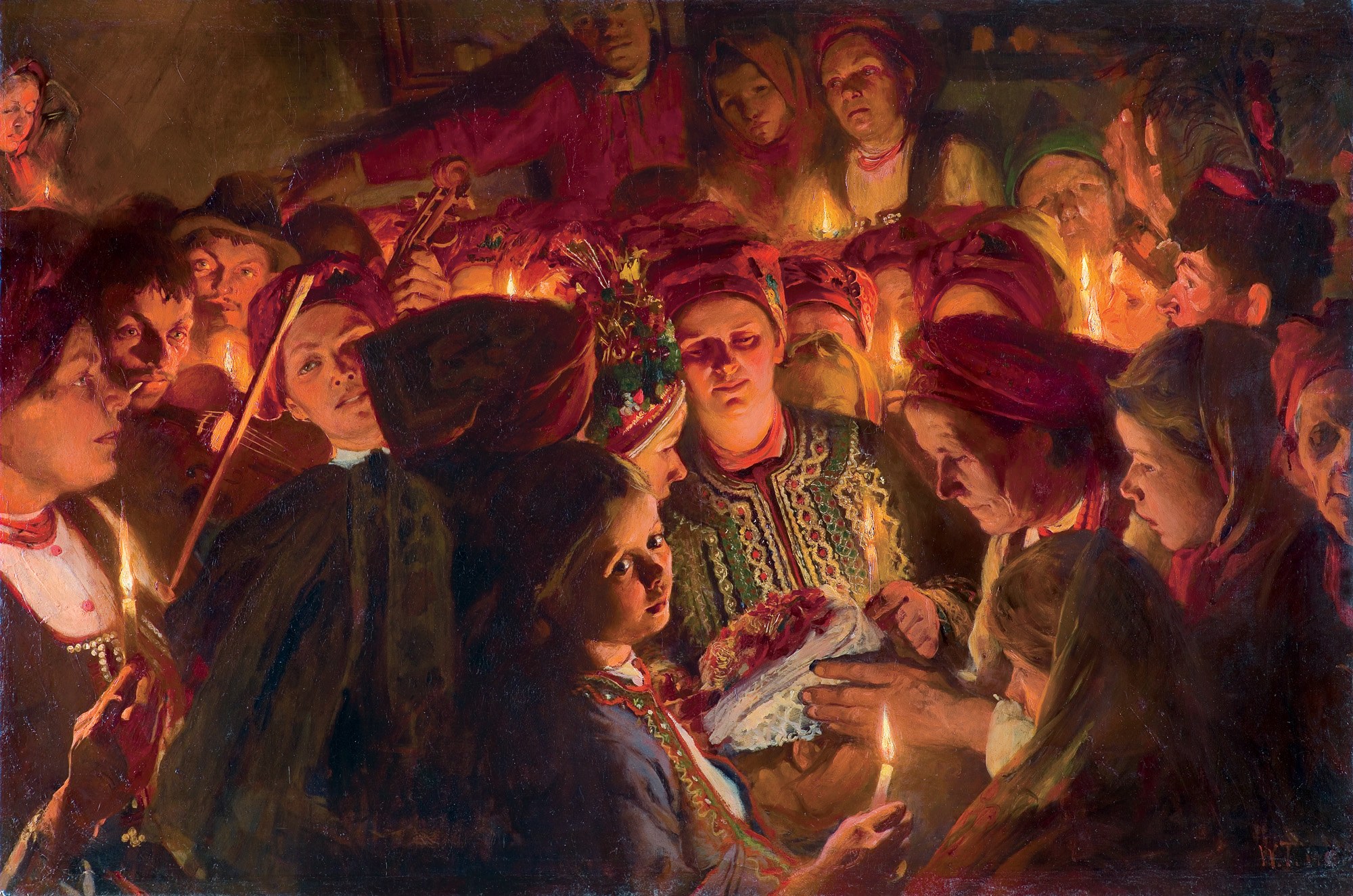
The featured canvas shows a scene from a traditional Bronowice wedding, bathed in candlelight. Beata Pranke in The current of peasantomania.... cites the words of Lucjan Rydel: At about nine o'clock, the cheeping began. The men were removed against the walls, the women and girls alone surrounded the bride and bridesmaids. They both danced forward with each other, then in turn with all the girls and with all the women. Each dancing woman and girl stood in front of the music, sang a song in honor of the bride. Then the senior best man began a dance with the bride, a solo dance, during which married women try to bounce the bride by raping the best man, and when that fails, they bargain with him over the purchase price (a motif from pagan times, of buying a bride). The best man strikes a bargain and takes the payment, and the women plant the bride on a stool. All the married women light the candles they hold in their hands, and the starchestess, prompted to perform the ceremony, sings a song in which she calls on the mother to take one last look at her daughter with the garland on her head and cross the sacred garland. [The view is magnificent, as each grandmother holds a lit candle, so that dozens of flames illuminate the scene.
This description is brilliantly illustrated in the presented canvas by Włodzimierz Tetmajer, in whose house in Bronowice near Krakow took place the most famous wedding in Polish literature of the poet Lucjan Rydel with Jadwiga Mikołajczykówna - the painter's sister-in-law. It is on her head that the headpiece is placed by the starostess - the artist's mother-in-law, Jadwiga Mikołajczyk. The woman standing in front, observing the wedding ceremony, is the painter's wife Anna Tetmajer. On the other hand, the foreground, golden-haired girl, looking straight at the viewer with her characteristic large eyes, is Tetmajer's eldest daughter Jadwisia. The wedding between Rydel and Mikolajczykna resonated with the artistic community of Krakow. For it was a symbol of Young Poland's fascination with peasant culture, characteristic of the era. The wedding described by Stanislaw Wyspianski took place on November 20, 1900, and was attended by artists, poets and painters who entertained the villagers with music, dances and folk rituals. The atmosphere of the wedding made a great impression on Wyspianski, who was one of the guests. However, he noticed not only the colorfulness and uniqueness of the clash of two worlds, but also their mutual misunderstanding, dreams and weaknesses. It was these observations that inspired him to write the drama The Wedding, which has become one of the most important works of Polish literature, showing Poles' dreams of freedom, but also their passivity and lack of unity. Thus, the Bronowice wedding went down in history not only as an extraordinary celebration, but also as an event that inspired the creation of an outstanding literary work. Jadwisia Tetmajerna's presence at the wedding was memorable to Wyspianski, who immortalized her as one of the characters in the drama. In the work she appears as little Isia, a girl full of childlike sensitivity, imagination and naturalness. Her character has a special symbolic meaning. It is to her that the Dipper appears, foreshadowing the unusual and mysterious events unfolding during the wedding night. It is easier for the girl than for adults to perceive the world of spirits, because she has retained a childlike innocence and openness. Through her character, Wyspianski emphasized the unusual fairy-tale atmosphere of his drama. Wyspiański made Włodzimierz Tetmajer the prototype of the Host, and his wife Anna the Hostess. Jadwiga Mikołajczykówna, in the drama, was portrayed as the Bride, becoming a symbol of a young, beautiful peasant woman who delighted with her naturalness and devotion to tradition. Her chosen one Lucjan Rydel was immortalized as the Groom.
The featured Oczepiny is an excellent example of the nocturnal canvases of Włodzimierz Tetmajer, one of the most important painters of Young Poland, who was fascinated by the countryside, its folklore and rituals.
Origins: - Purchased for a private collection in the 1930s.
- Heirs of the above collection, United Kingdom.
- Purchased for a private collection at a Sotheby's auction in 2009.
The painting exhibited, mentioned and reproduced, among others, in:: - Catalog of the Jubilee Exhibition of TPSP in Cracow, Cracow 1904, cat. no. 205 (Czepiny, ol.);
- Report of the Directorate of the TPSP in Cracow on its activities for the year 1904, Cracow 1905, p. 27, no. 204 (Oczepiny);
- E. Swieykowski, Memoirs of the TPSP in Cracow 1854-1904, Cracow MCMV, p. 294;
- "Tygodnik Ilustrowany," 13 May (30 April) 1905, no. 19, p. 351;
- T. Dobrowolski, Nowoczesne malarstwo polskie, vol. II, Warsaw 1960, p. 329;
- B. Pranke, Nurt chłopomanii w twórczości Stanisława Radziejowskiego, Ludwik Stasiak, Włodzimierz Tetmajer, Wincentego Wodzinowskiego and Kacper Żelechowskiego, Warsaw 2003, il. 11.
Włodzimierz Przerwa-Tetmajer (Harklowa near Ludźmierz in the Podhale region 1862 - Kraków 1923), half-brother of the poet Kazimierz, began studying painting at an early age; as early as 1875 he attended classes at the School of Fine Arts in Kraków, where he continued (with breaks) to study until 1895 - initially with Franciszek Cynk, Leopold Loeffler and Władysław Łuszczkiewicz, and after 1889 with Jan Matejko. At the same time he studied classical philology at Jagiellonian University. In 1882 he still studied at the Vienna Academy, and in 1886-89 at the Munich Academy under Alexander Wagner. He supplemented his studies at the Académie Colarossi in Paris. An imperial scholarship enabled him to travel to Rome. Upon his return, he lived in Cracow. In 1890 he married Anna Mikołajczykówna, daughter of a farmer from the village of Bronowice near Krakow, where he himself often stayed, and in 1895 settled permanently. In 1901 he founded and then ran a painting school for women for several years. Since 1899 he was a member of the Society of Polish Artists "Art"; in 1901 he was one of the founders of the Society "Polish Applied Art"; in 1908 he co-founded the "Zero" group. He was a prominent representative of the "folklore" trend, a painter of customs, labor and landscapes of the countryside near Krakow. In his earlier period he created in the spirit of academic, Munich realism. Later he developed his own original style - the composition of his paintings was free, he painted with broad brushstrokes and used bright, vivid colors. In 1892-1894 he collaborated with Wojciech Kossak and Jan Styka on Panorama Raclawicka. He designed stained glass windows, did illustration and mural painting, including a polychrome of the Queen Sophia Chapel at Wawel Cathedral in 1902. The artist was the prototype for the character of the Host in S. Wyspiański's drama The Wedding.













Utoljára megtekintett
A tételek listájának megtekintéséhez jelentkezz be
Kedvencek
A tételek listájának megtekintéséhez jelentkezz be