


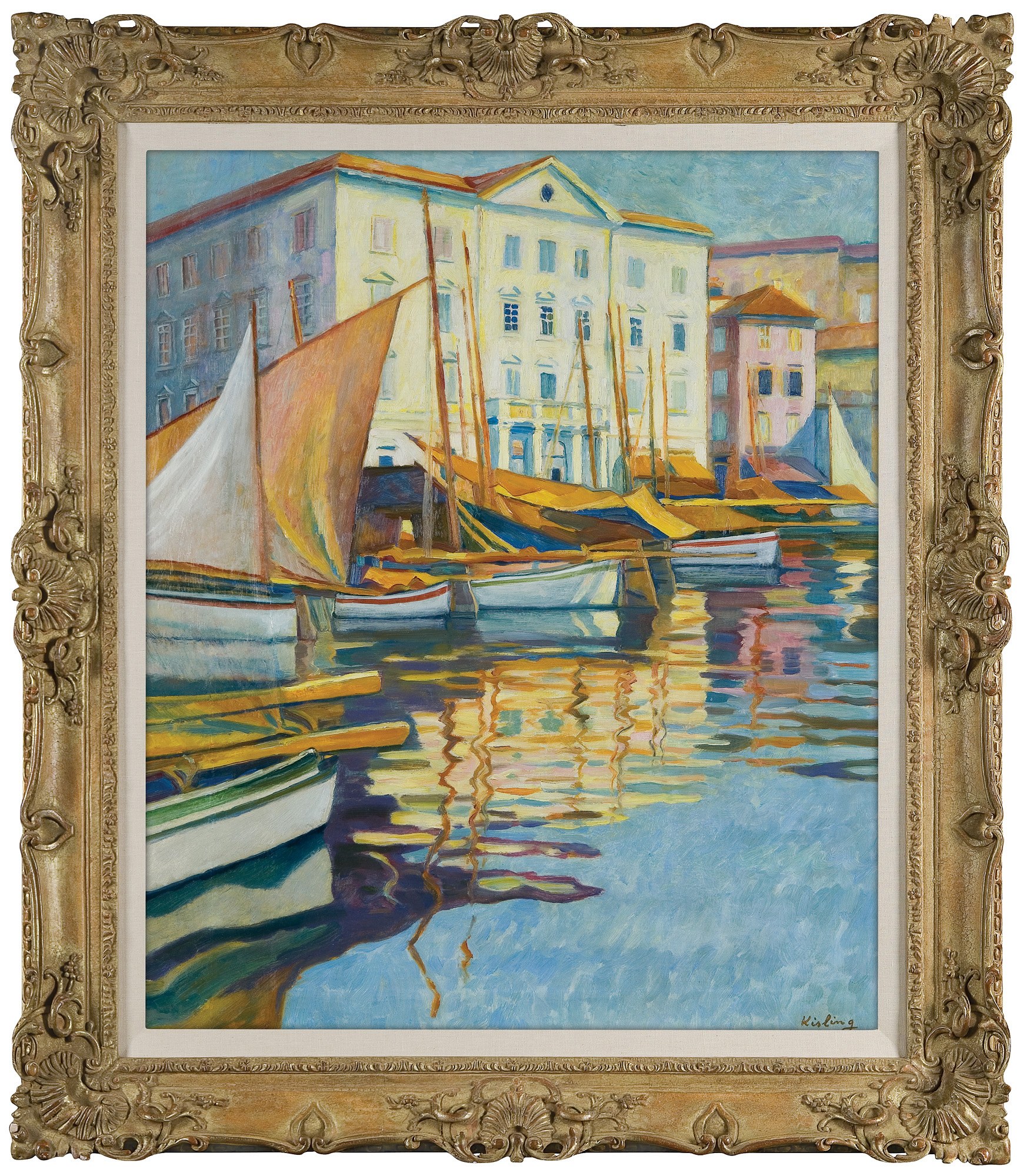
99,8 x 82,0cm - oil, canvas
Signed p.d.: Kisling
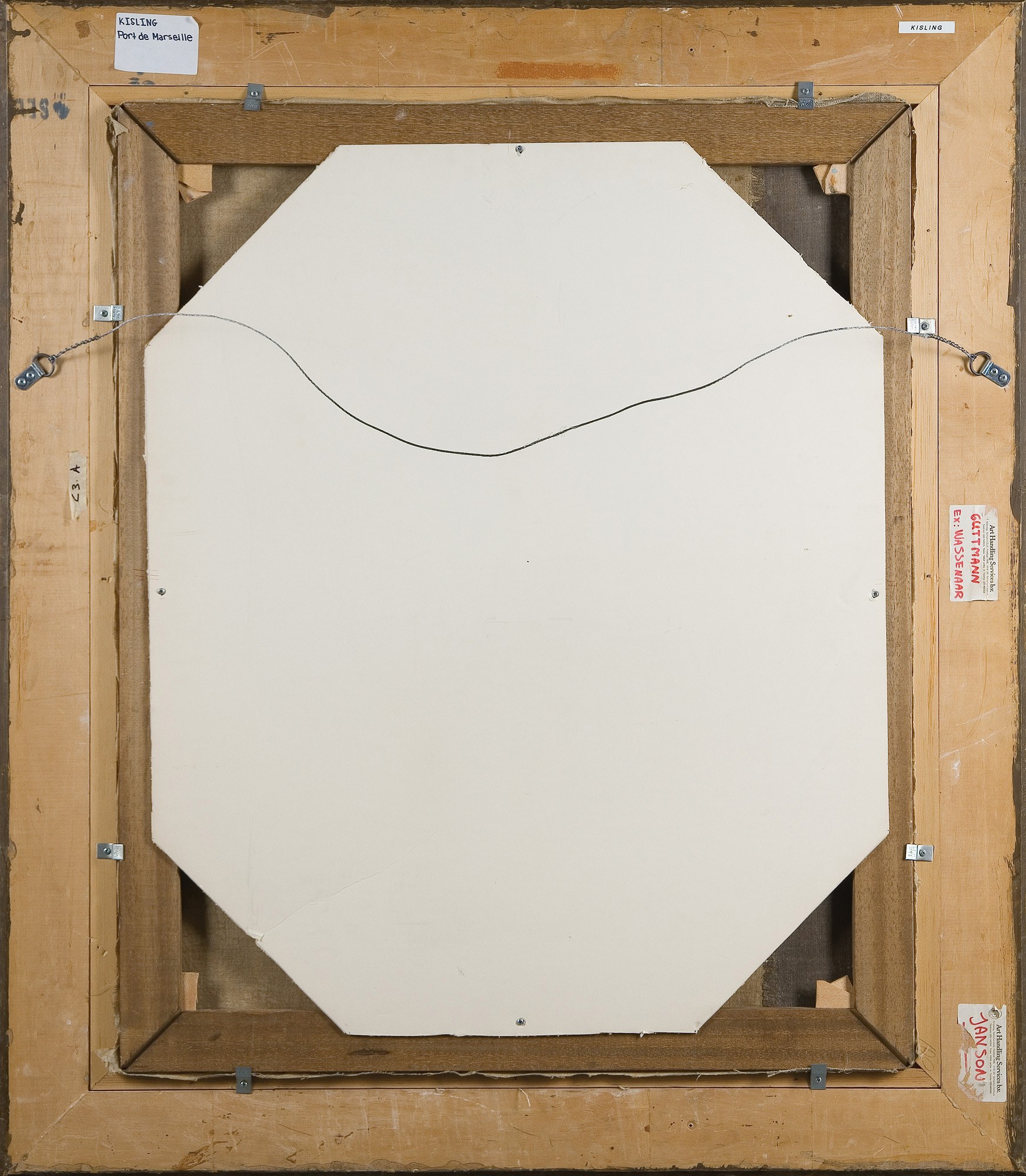
On the reverse, on the slats of the frame, stickers of the art transport company.
Provenance:
- Los Angeles, collection of Charles Boyer, French film actor, four-time Oscar nominee;
- USA, private collection;
- Belgium, private collection;
- Poland, private collection.
Reproduced image:
- J. Dutourd, ed. J. Kisling, Kisling, vol. III, published by Bosch-Druck, Landshut, Germany 1995, cat. no. 124, p. 336.
My ideal is to paint well.
Moses Kisling
In these few words lies the essence of Kisling's art. His sensibility is unique, and he focused only on expressing it through better and better technique. He began his artistic studies in 1907 at the Academy of Fine Arts in Krakow under the guidance of Jozef Pankiewicz. The professor exerted a great influence on the young painter, and it was to him that he largely owed his further artistic fortunes and fame. In "Literary News" in 1926 he recalled: To Professor Pankiewicz I owe virtually everything. He was the first to show me reproductions of works by Cézanne and van Gogh, which caused a real upheaval in me. (A. Prędski, Polish Painters in France. Conversations with Prof. Pankiewicz, Kisling, Menkes, "Literary News," 1926, No. 46). While in 1935 he added: Pankiewicz knew that the country where painting is centered is France, so as soon as I turned twenty, he sent me to Paris, the only place in the world whose atmosphere is conducive to the development of a young painter (M. Kisling, My artistic credo, "Literary News," 1935, No. 51).
In France, the young artist joined the circle of École de Paris. He became acquainted with both the aged Wladyslaw Slewinski and the young Pablo Picasso, Georges Brac. Like all artists of his generation, Kisling began by devoting himself to Impressionism, but soon realized the inadequacy of art, which was only a technique. So he turned to tradition in search of the foundations of a more fully developed art. He experimented with color and light, which was to help him achieve his lofty goal of "painting well." He found the brilliance of color, like Pankiewicz, in Spain, to which he fled before being expelled from France to the Austro-Hungarian army during World War I. His palette took on intense, vivid colors that acquired a distinctive glow.
After returning to France, the artist and his wife traveled to Saint-Tropez, where he was captivated by the harbor landscape. Maritime motifs became one of his favorite painting subjects. In 1929, the artist purchased land in Sanary, where he built a house overlooking Bandol Bay. It was his paradise on earth, where he enjoyed life and where he created. The artist also rented a studio at the Old Port of Marseille, which became one of the important motifs of his works from this period. Unfortunately, the outbreak of World War II made it necessary for the artist to leave his wife and sons in Sanary and go into exile in the United States for several years. Upon his return, he rebuilt his destroyed house and set up a studio in it, where he continued to paint seaside landscapes, with swaying sailboats, for the rest of his life.
Mojżesz Kisling studied with Jozef Pankiewicz at the Academy of Fine Arts in Cracow in the years 1907-1911. On his advice, together with Szymon Mondszajn, he left for further studies in Paris. There the critics André Salmon and Adolf Basler became interested in his work, and he also received a scholarship from an anonymous patron from Russia. During World War I, he fought in the Foreign Legion. He was wounded while fighting at the front, and was discharged from the army in 1915. Probably then he received French citizenship. From about 1920 he began to spend summers steadily in Sanary-sur-Mer, where he bought a house. He also maintained contacts with the country. During World War II, he joined the French army. In 1940, via Spain and Portugal, he went to New York. After the war, around 1946, he returned to Sanary-sur-Mer. He was one of the most prominent representatives of the Ecole de Paris of the interwar years. He had many solo exhibitions, and often participated in group exhibitions abroad as a Polish artist. He also participated in domestic artistic life, including the First Exhibition of Polish Expressionists (later Formists), Krakow 1917. He was friends with Tadeusz Makowski. In his early period he painted cubic landscapes and still lifes. Portraits were a constant theme in his painting, including numerous likenesses of artists, critics and people from artistic circles, making him a chronicler of the Ecole de Paris socialite. His portraits of women and nudes are characterized by a special stylization, with idealized faces with big eyes, assuming studied poses.













Utoljára megtekintett
A tételek listájának megtekintéséhez jelentkezz be
Kedvencek
A tételek listájának megtekintéséhez jelentkezz be