


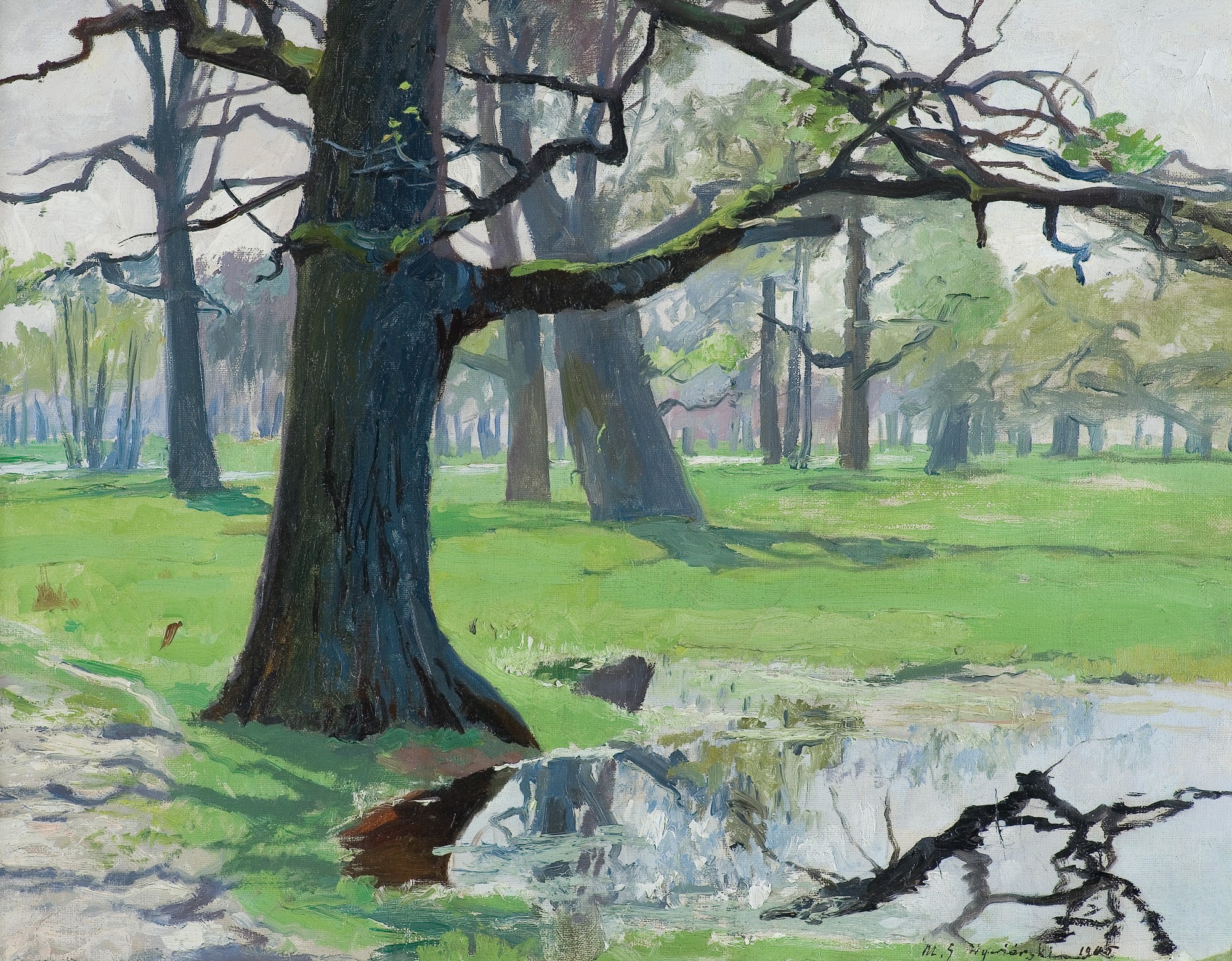
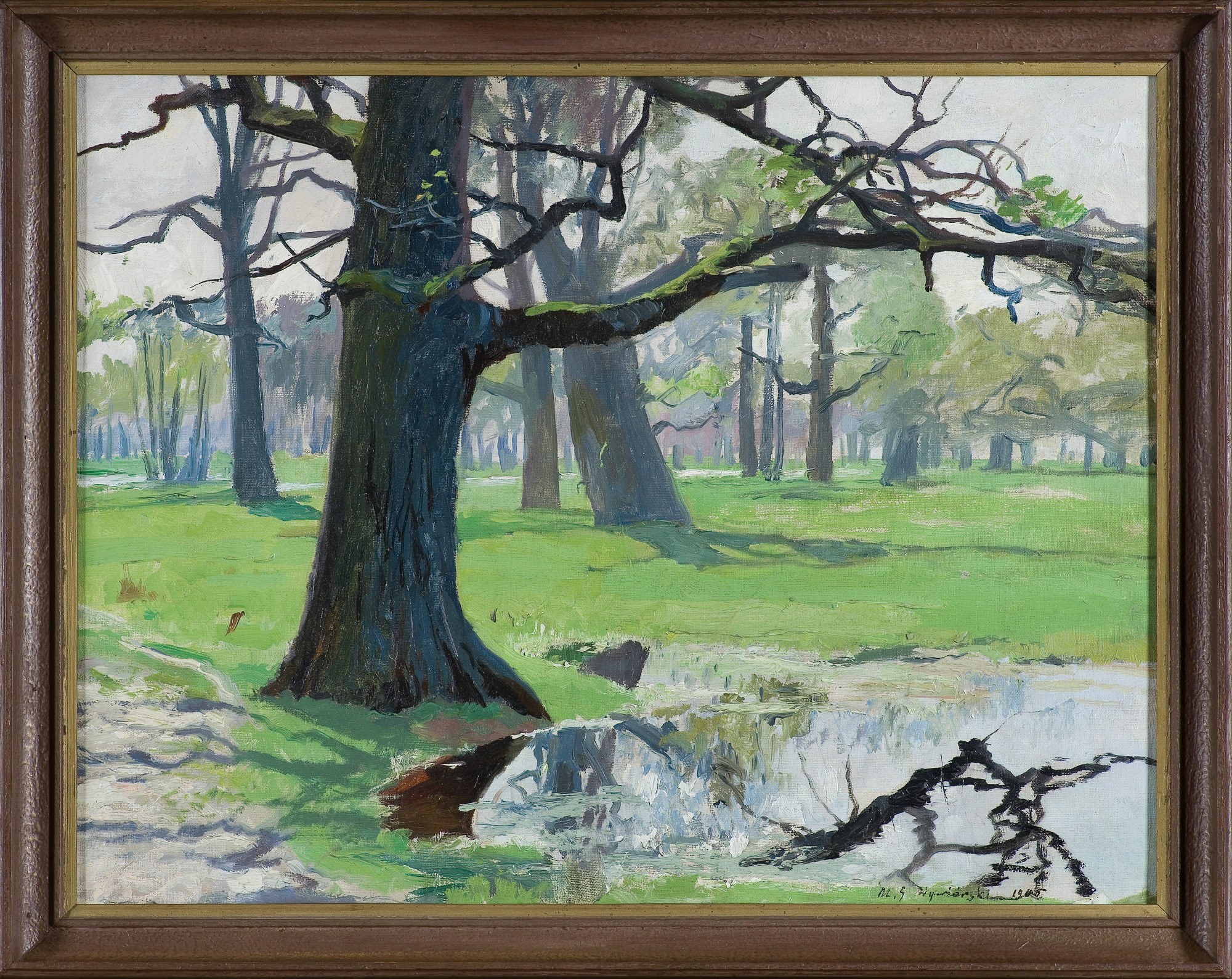
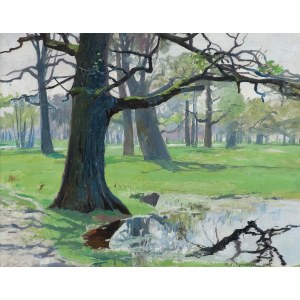
50 x 64.3 cm - oil on canvas
signed lower right: M. G. Wywiórski 1905
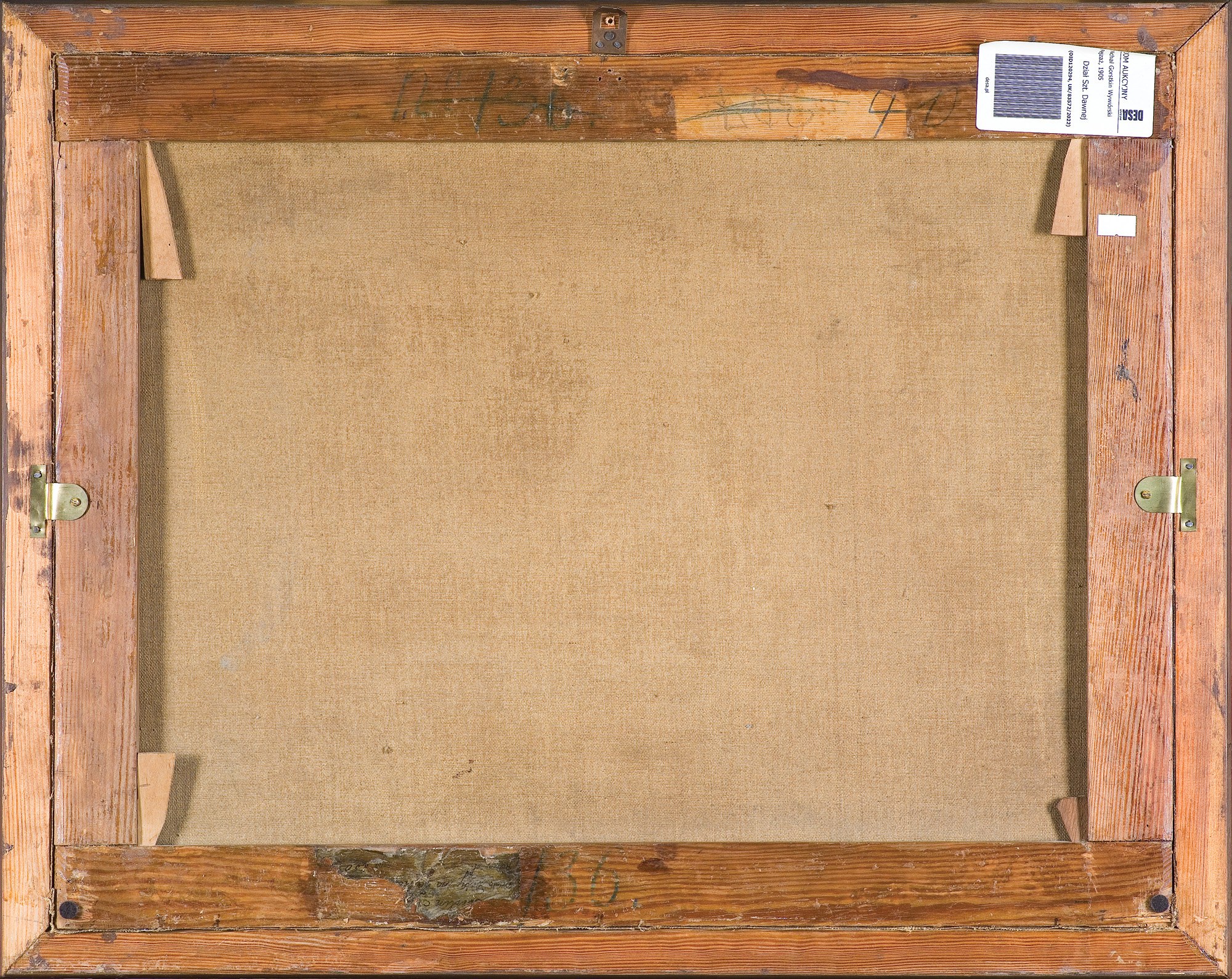
On the reverse, on the lower stretcher bar, a fragment of a label from the Kraków Society of Friends of the Fine Arts (print, ink): [B]erlin | Work: Oaks in the Meadows | Type: oil;
on the upper stretcher bar, on the inner side, a fragment of a label from the Society for the Encouragement of Fine Arts in the Kingdom of Poland in Warsaw; additionally, inscriptions in blue crayon.
The painting was exhibited, mentioned, and reproduced, among others, in:: – Report of the Committee of the Society for the Encouragement of Fine Arts in the Kingdom of Poland for the Year 1906, Warsaw
1907, p. 16 (as one of eighteen landscapes of various subjects);
– Report of the Board of the Society of Friends of Fine Arts in Kraków on Activities for the Year 1906, p. 24, no. 1108 (“Oaks in the Meadows”);
– Janina Wiercińska, Catalog of Works Exhibited at the Society for the Encouragement of Fine Arts in Warsaw, 1860–1914, Wrocław–Warsaw–Kraków 1969, p. 423.
Michał Gorstkin Wywiórski (Warsaw 1861 – Berlin 1926) studied in Munich from 1883 to 1887; at the Academy under Professors Karl Raup and Nikolaus Gysis, and concurrently in the private studios of Józef Brandt and Alfred Wierusz-Kowalski. In 1884, he made his debut at an exhibition at the TPSP in Kraków; he also exhibited his works in Munich, where, in 1894, he was awarded a medal for his painting *From the Lithuanian Forest* at the international exhibition at the Glaspalast. In 1895, he moved to Berlin, invited by Wojciech Kossak and Julian Fałat to work on the Berezina panorama (1895–1896). He settled in Berlin for an extended period, and subsequently spent time in Greater Poland and Warsaw. He also collaborated with Jan Styka on the panorama *The Battle of Sibin* (1897), and in 1900, together with Kossak, he traveled to Spain and Egypt to make plein air sketches for the planned panoramas *Somosierra* (never completed) and *The Battle of the Pyramids* (1901). He also traveled to Lithuania, the island of Sylt, Norway, Sweden, the North Sea, and the Baltic Sea, and painted in Amsterdam, the Crimea, and the Caucasus. In the early phase of his career, strongly influenced by Brandt and Wierusz-Kowalski, he painted hunting and genre scenes, as well as paintings featuring Tatars, Cossacks, and Circassians, which brought him success on the Munich art market. Over time, the primary subject of his painting became the pure landscape, perceived and painted with sensitivity and delight.













Utoljára megtekintett
A tételek listájának megtekintéséhez jelentkezz be
Kedvencek
A tételek listájának megtekintéséhez jelentkezz be