


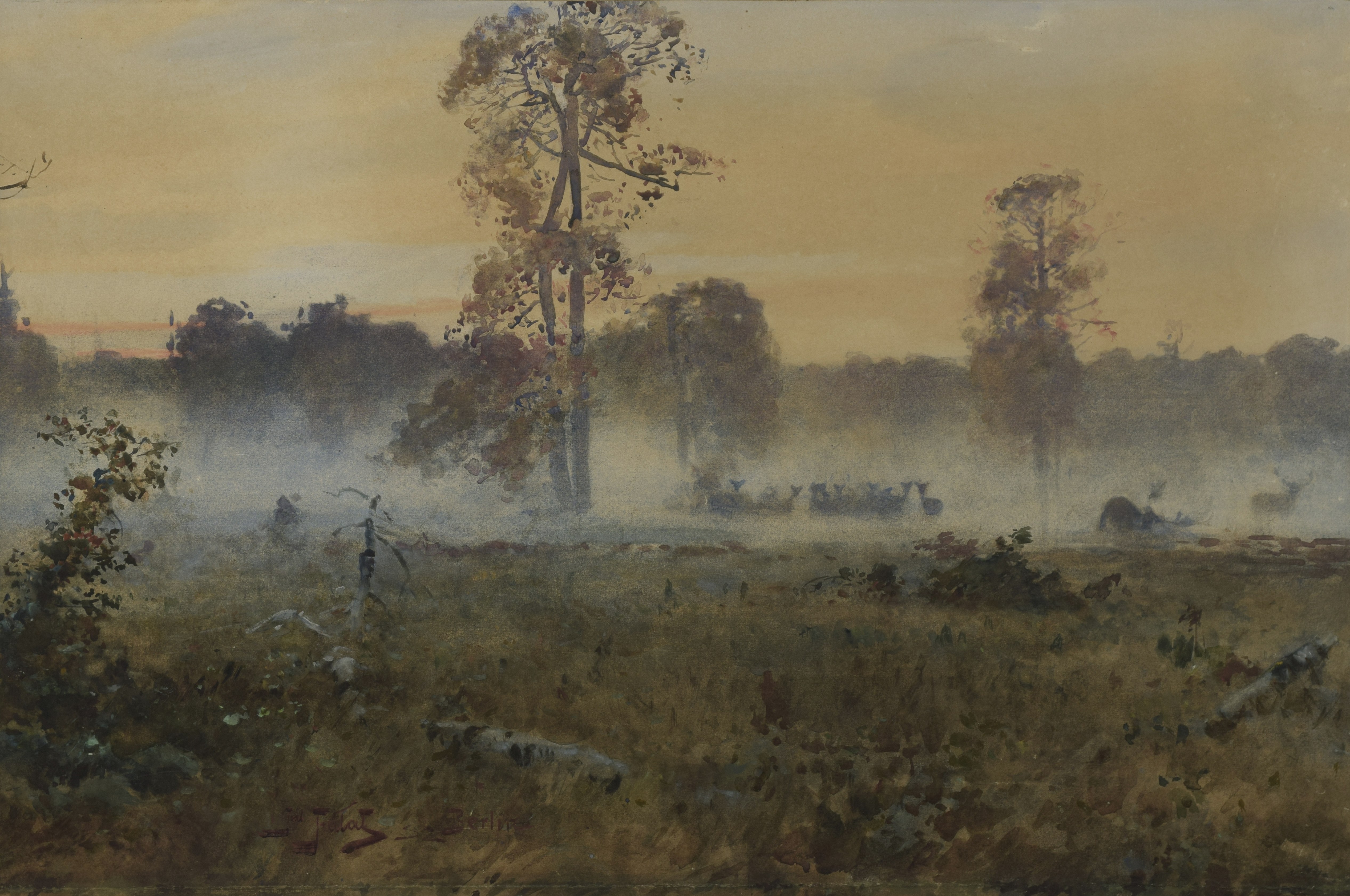
Watercolor, gouache, paper; 43 x 65 cm;
Signed, dated and inscribed l. d.: Jul Fałat 92 Berlin.
The presented work by Julian Fałat is an excellent illustration summarizing his artistic path, related to hunting depictions, which at the time indeed also occupied other prominent painters, such as Wojciech Kossak and Józef Chełmoński. It is noteworthy that for Julian Falat these themes were a pretext for depicting nature and light, often using high contrasts of colors, especially in works depicting a snowy landscape. Therefore, in the artist's paintings that we know, groups of hunters are often removed from the foreground of the composition. The inspiration for the hunting theme was also influenced by literature, specifically the creation of The Hunting Year by Wincenty Pol in 1866, the illustrations for which were just designed by Wojciech Kossak. Julian Fałat in 1890 created his own Hunting Calendar, published in Tygodnik Ilustrowanym. At the same time, Julian Fałat's creative distinctiveness, compared to other painters of the time, was greatly influenced by the artist's participation in a hunt in Nesvizh, organized in 1886 by the Radziwill family for the future Emperor William II. It was there that Julian Fałat presented his watercolors and created 27-28 compositions, gaining the opportunity to work for Emperor Wilhelm II and recognition in Berlin artistic circles, where he consistently organized exhibitions of Polish art. The artist created sketches from nature. Documenting numerous hunts, he chose deer hunting as his main subject, which he created until 1889. Then, from 1891, he turned to depicting the king of the forest - the moose. With time, it was during the Berlin period that he expanded his landscape repertoire to include autumn landscapes painted almost impressionistically, in the spirit of Romanticism, with only symbolically marked game, as in the offered work, The Roar, dating from his most prized period, 1890-1895. The next stage in the painter's work was to turn to Polesie wetlands landscapes.
(compiled. based on: Jerzy Malinowski, Julian Fałat, Warsaw, 1985, pp. 28-34; Julian Fałat, Memoirs, Warsaw, 1935, pp. 161-163, 197-200)










Utoljára megtekintett
A tételek listájának megtekintéséhez jelentkezz be
Kedvencek
A tételek listájának megtekintéséhez jelentkezz be