


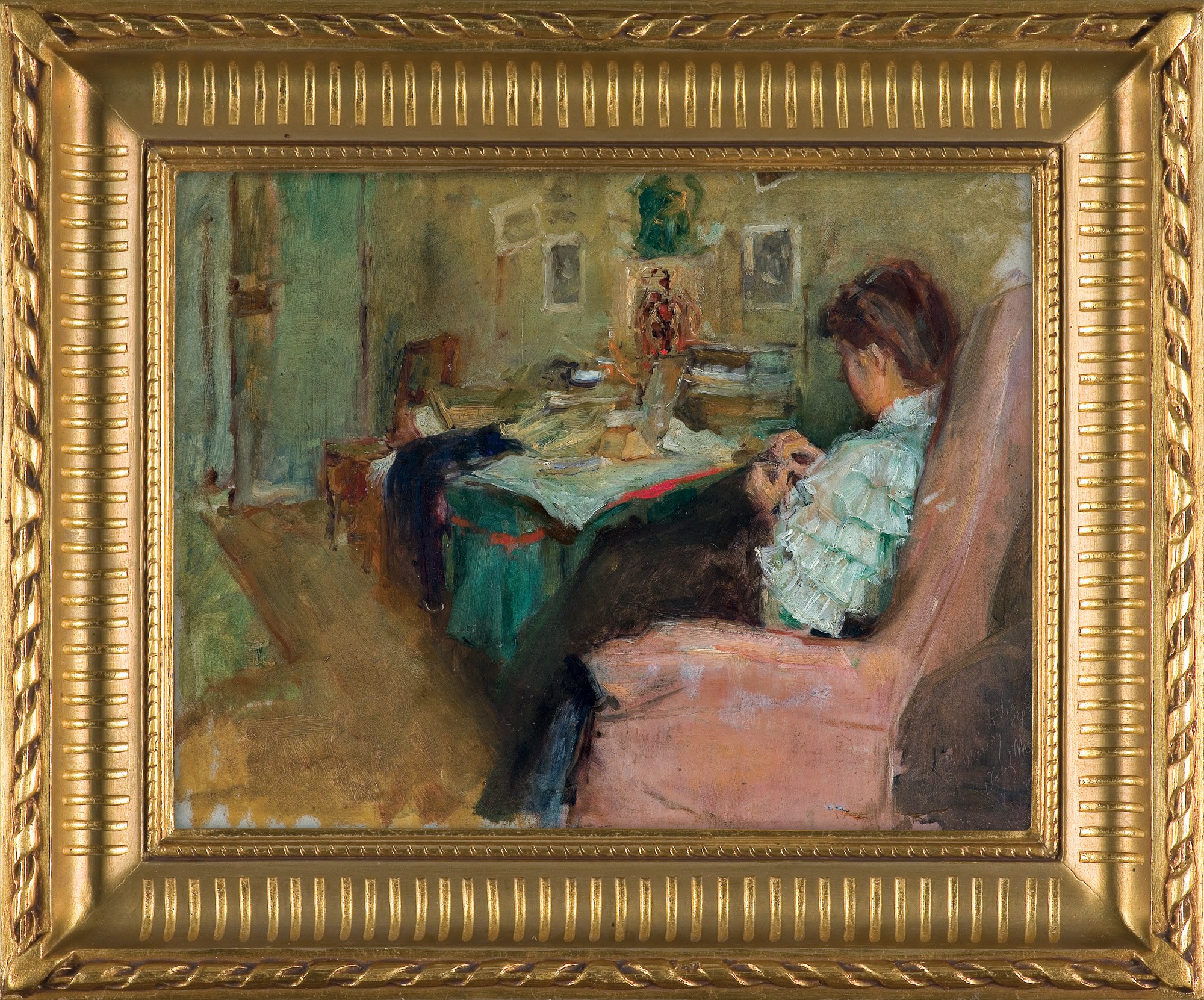
26,9 x 35,0 cm - oil, cardboard
signed p.d. (in wet paint): began in wilia | saint Wanda 1893 | Joseph M
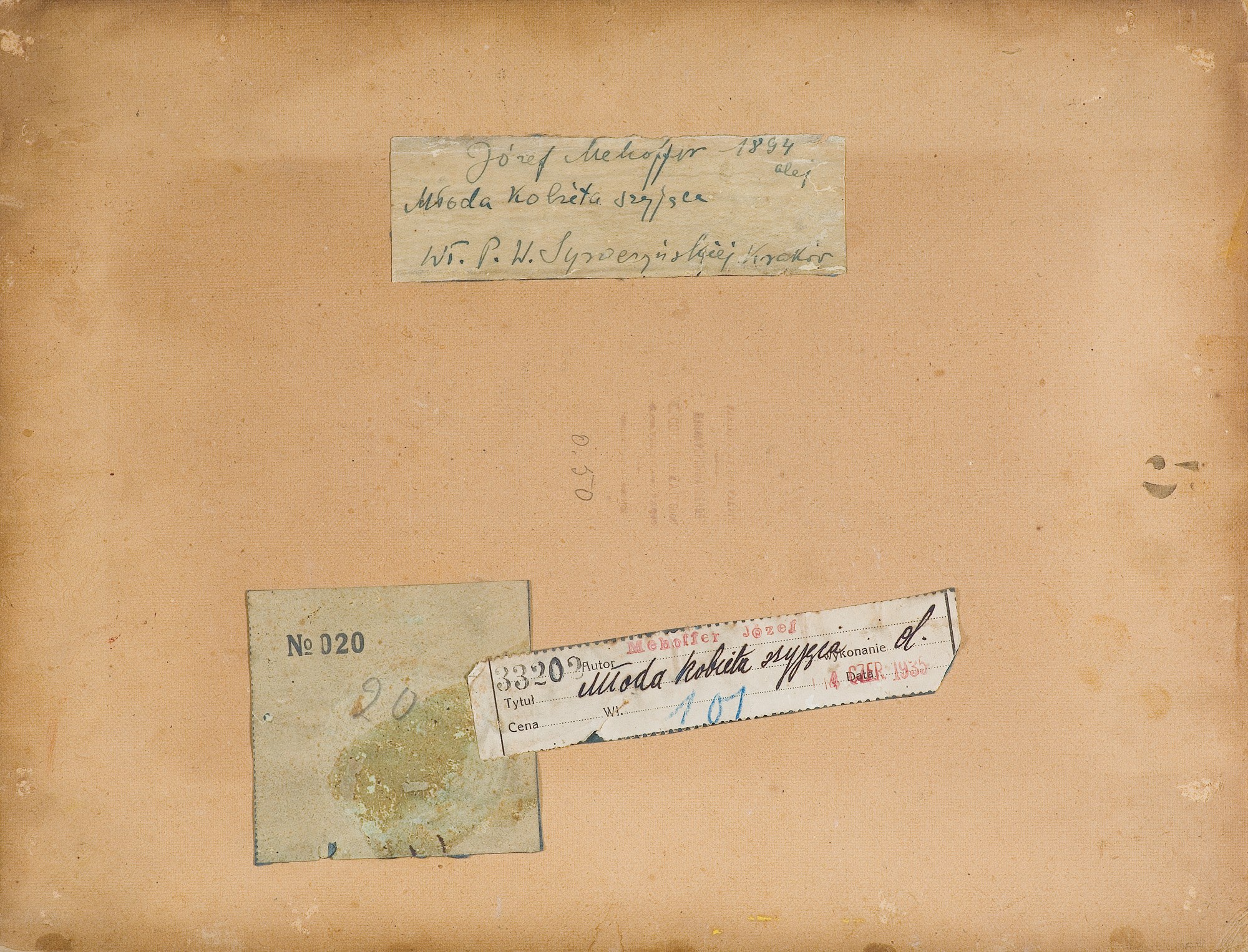
On the reverse:
- sticker (in ink): Józef Mehoffer 1894 | oil | Young Woman Sewing | Wł. P. W. Syroczyńska Kraków;
- centrally the stamp of the storehouse of painting utensils;
- next to the number (in pencil): 0,50;
- below sticker with number (print, in pencil): No. 020 | 20;
- next to sticker of the Society for the Encouragement of Fine Arts in Warsaw (black seal, red seal, print, ink, blue crayon): 33202 Author Mehoffer Józef | Title Young woman sewing Execution ol. | Price Wł. 101 Date 4 JUNE 1935;
- On the right, stamp with number: 5 (referring to the size of the sub-image).
Image exhibited and mentioned:
- Józef Mehoffer, Society for the Encouragement of the Fine Arts in Warsaw, June-July-August 1935, cat. no. 101, p. 26 (title: Young Woman Sewing 1894; owned by Wanda Syroczynska, Kraków);
- Report of the Committee of the Society for the Encouragement of Fine Arts in Warsaw for 1935, p. 25 (Young woman sewing).
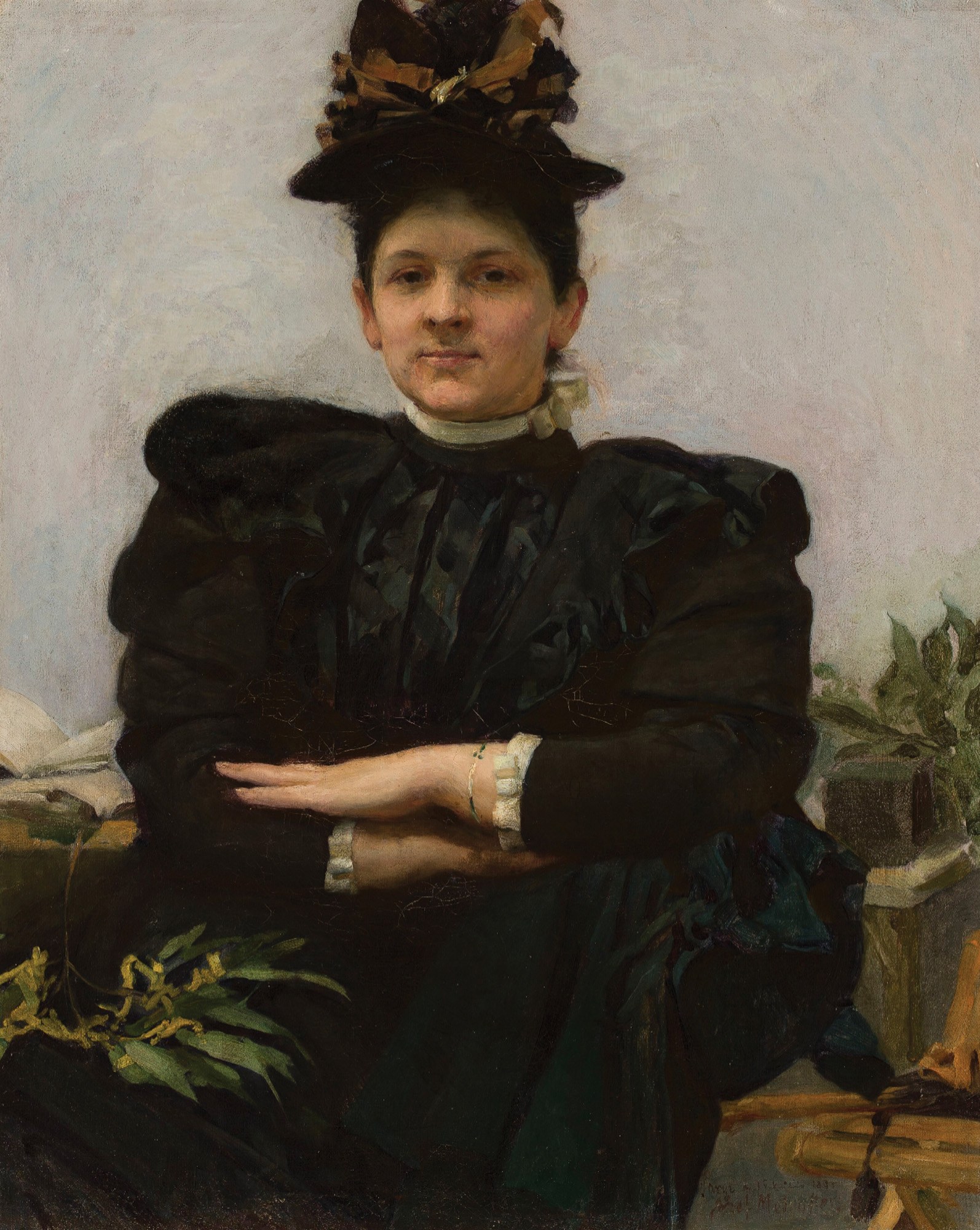
Wanda Syroczynska, née Strazynska (see opposite - Józef Mehoffer Portrait of Wanda Strazynska, 1894) often appears in the pages of the artist's Diary. However, the nature of their acquaintance is difficult to interpret. According to the painter's diary entries, during the period of his studies in Paris, he spent a lot of time with Miss Wanda. They took walks together, went on excursions, went to cafes and theaters, or stayed up late visiting each other. Despite the intimate relationship evident from Mehoffer's notes, the artist never sought the hand of Wanda, who in early February 1893 informed the artist that she had accepted the proposal of a wealthy landowner, Antoni Syroczynski. The artist still maintained cordial relations with them for some time.
Józef Mehoffer (Ropczyce 1869-Wadowice 1946) - painter, graphic artist, stage designer and educator; next to Stanisław Wyspiański, he was the most outstanding Polish creator of stained glass and polychromy. A student of Jan Matejko and the Paris academies - Ecolé des Beaux Arts and Accadémie Colarossi - his creative path began in 1889-1891 with work on the polychrome of St. Mary's Church in Cracow (under Matejko's direction). In 1895, he was awarded first prize in an international competition for stained glass windows for the collegiate church in Fribourg, Switzerland (their realization lasted until 1934). In the following years, he received various other commissions for stained glass and polychromes, including for Wawel Cathedral and Plock, the Armenian Cathedral in Lviv, churches in Opava, Onnes in Switzerland, Jutrosin, Włocławek or Przemyśl (not all completed). He was an outstanding representative of Art Nouveau. He created decoratively treated portraits, including self-portraits and portraits of his wife, as well as paintings with genre overtones, which in 1895-1917 gained the meaning of symbolic compositions. He also painted landscapes combining Art Nouveau decorativeness with the achievements of Impressionism. With masterful mastery of various techniques - oil, tempera, watercolor and gouache - he also worked in printmaking. The last major exhibition of the artist's works, entitled Opus magnum, was held in 2000 at the National Museum in Cracow.













Utoljára megtekintett
A tételek listájának megtekintéséhez jelentkezz be
Kedvencek
A tételek listájának megtekintéséhez jelentkezz be