


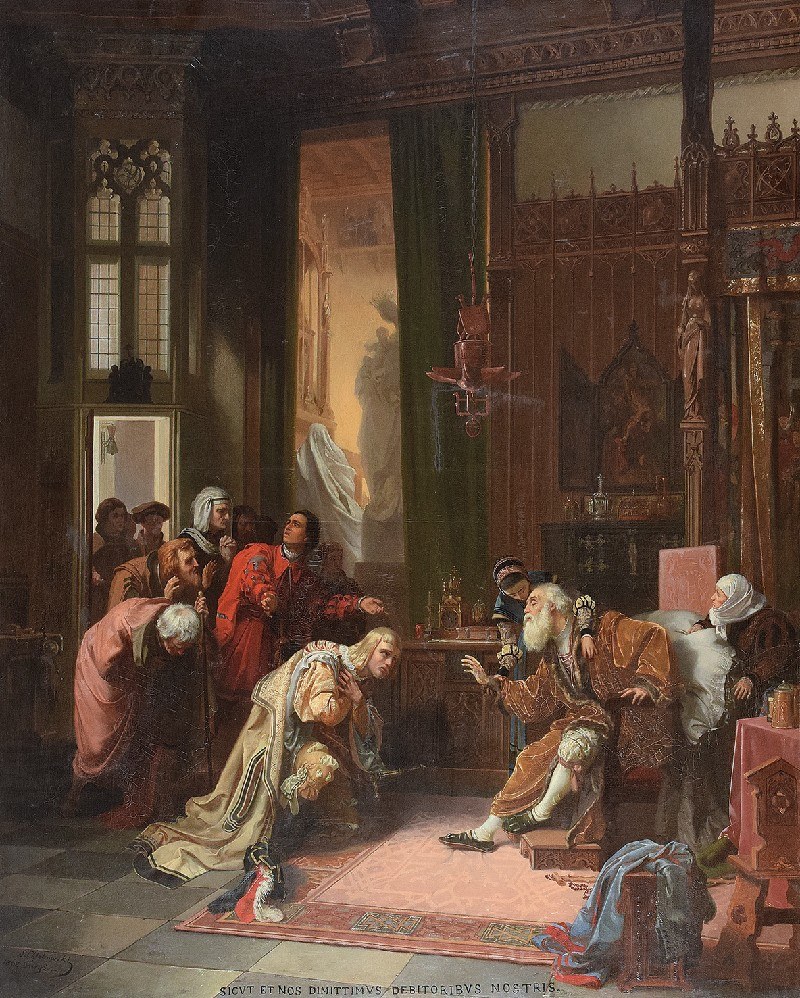
Oil, canvas doubled on wax; 130 x 103 cm;
Signed, dated and inscribed l. d.: S. Chlebowski / 1862 Paris r;
On the reverse, inscription: Stanislaw Chlebowski / 1802 (sic! - conservation transfer error) in Paris;
below inscription: SICUT ET NOS DIMITTIMUS DEBITORIBUS NOSTRIS ["[And forgive us our trespasses,] as we also forgive our trespassers" - fragment of the Lord's Prayer];
Image after conservation.
The scene depicts a legend concerning Wit Stwosz, who, according to writer Wladyslaw Wędrychowski, was said to have fled Nuremberg because envious residents of that city gouged out his eyes. This thesis was also supported by Jan Matejko when he painted in 1865
painting titled "Dim Wit Stwosz with his granddaughter" (National Museum in Warsaw) in 1865.
The offered canvas depicts a blind Wit Stwosz forgiving his tormentor for the harm he caused, which is alluded to by the quotation from the "Lord's Prayer" included in the painting.










Utoljára megtekintett
A tételek listájának megtekintéséhez jelentkezz be
Kedvencek
A tételek listájának megtekintéséhez jelentkezz be