


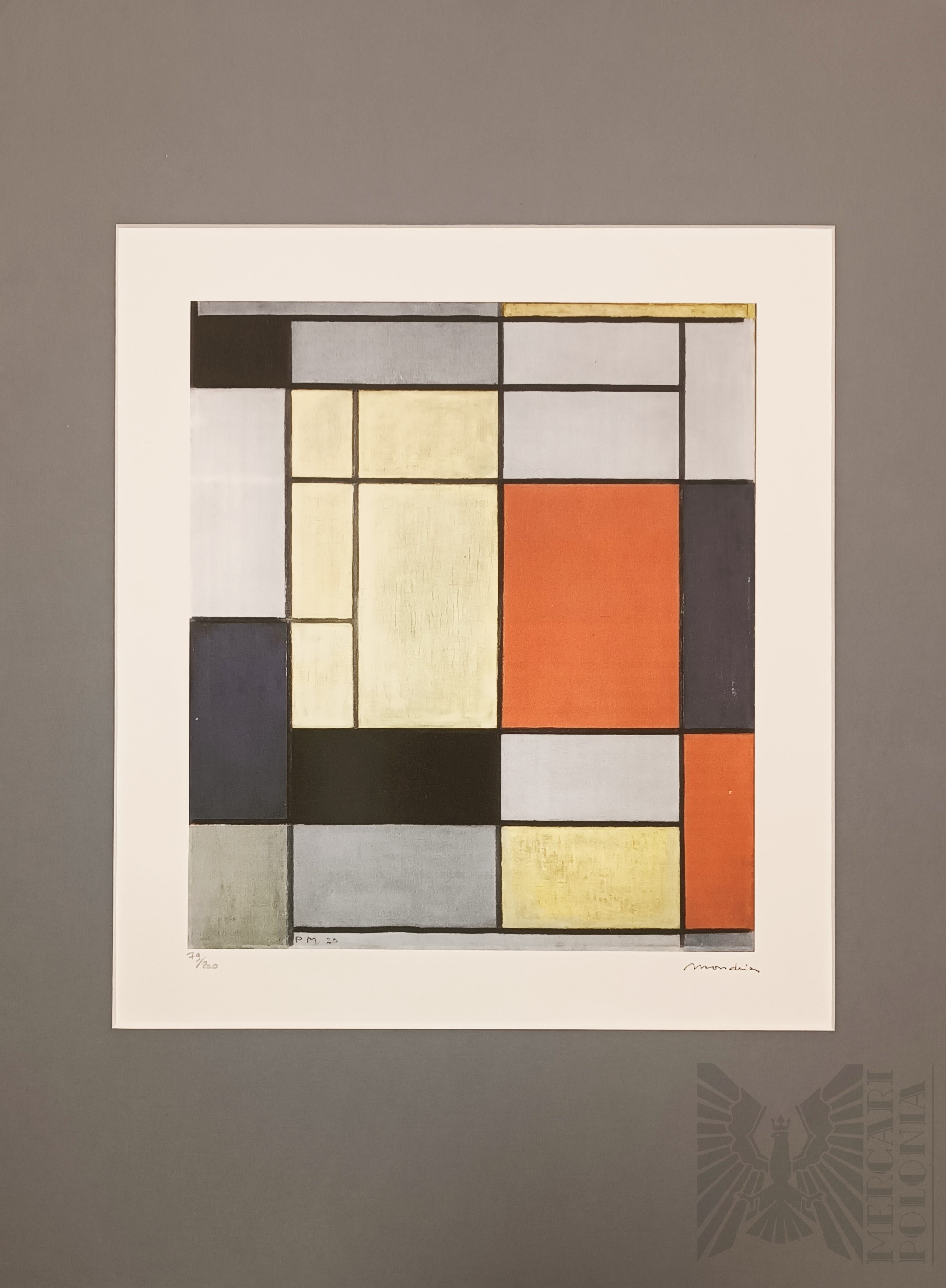
Color lithograph, high-grain veline paper 44 x 40 cm in light passe - partout, 70 x 50 cm, limited edition, numbered in pencil 79/200, signed under the composition facsimile signature "Mondrian" p.d.; oval dry publisher's stamp: ARTIS P.L., on the back hologram "verification of authenticity".
Piet Mondrian - Dutch painter, co-founder of the De Stijl art group (1917), considered, along with Kandinsky and Malevich, to be one of the precursors of abstractionism, creator of neoplasticism - one of the earliest trends postulating geometric abstraction in painting, characterized by the use of vertical and horizontal lines that overlapped, dividing planes into squares and rectangles, and the use of three primary colors (yellow, blue and red) and three so-called. non-colors (black, white and gray). He influenced the development of abstraction in painting and 20th century architecture.
The painting titled "Composition No. 1 "by Piet Mondrian is one of his early works of the same name, which are part of his characteristic abstract style. Mondrian, a Dutch painter, is known for creating compositions
based on simple geometric forms and basic colors, which aimed to reflect universal harmony. "Composition No. 1" was painted between 1919 and 1921.
The work is an example of Mondrian's early use of the modular grid system, which later became characteristic of his style. X-ray photography confirmed that Mondrian sketched the basic grid pattern on the canvas before applying paint.
"Composition No. 1" is currently in the collection of the Museum of Fine Arts in Houston. It is an important work in art history because it shows the evolution of Mondrian's style and his desire to create art that conveyed universal values through abstraction.











Utoljára megtekintett
A tételek listájának megtekintéséhez jelentkezz be
Kedvencek
A tételek listájának megtekintéséhez jelentkezz be