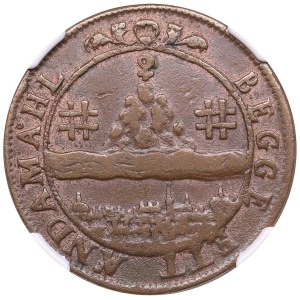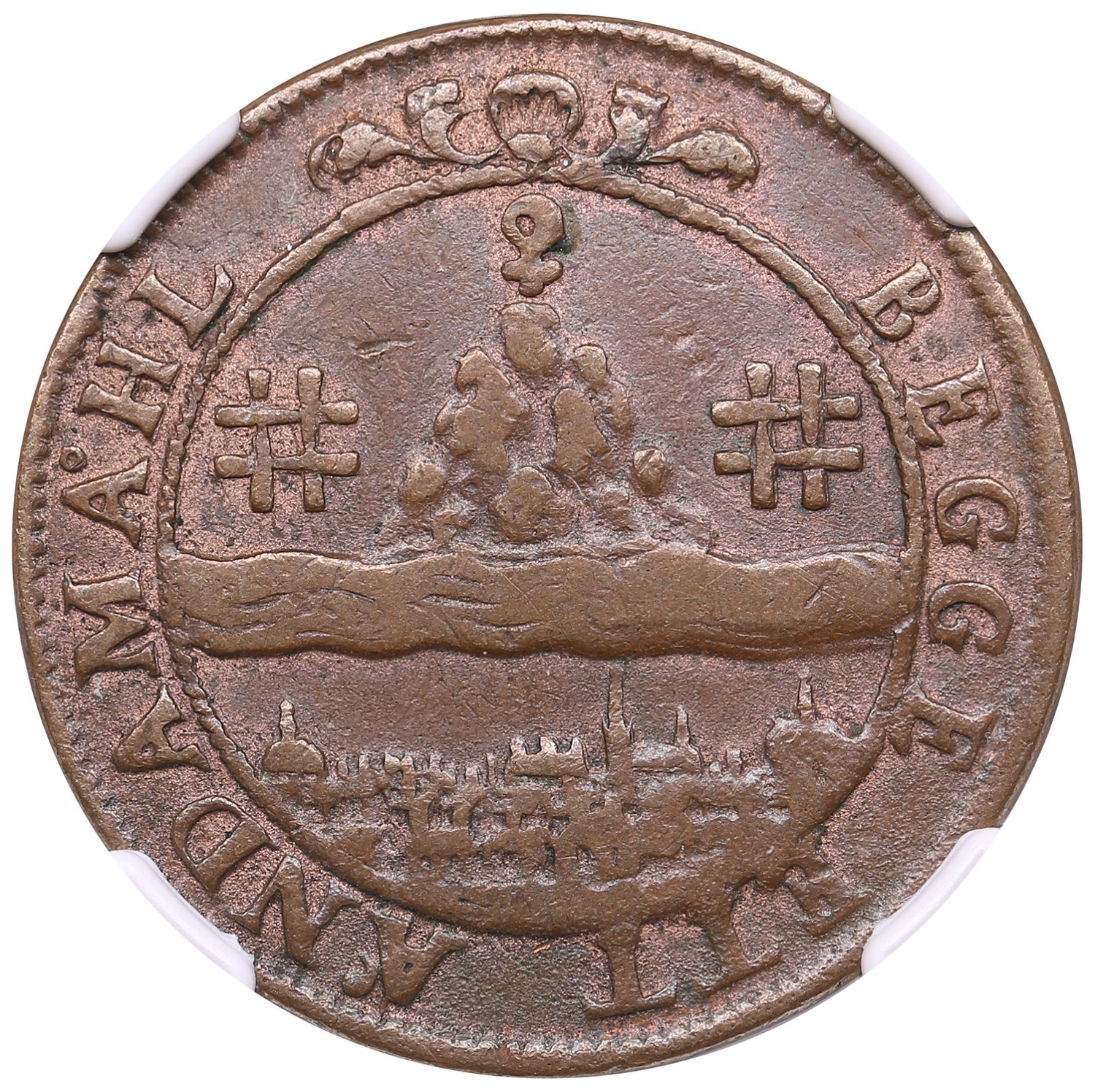
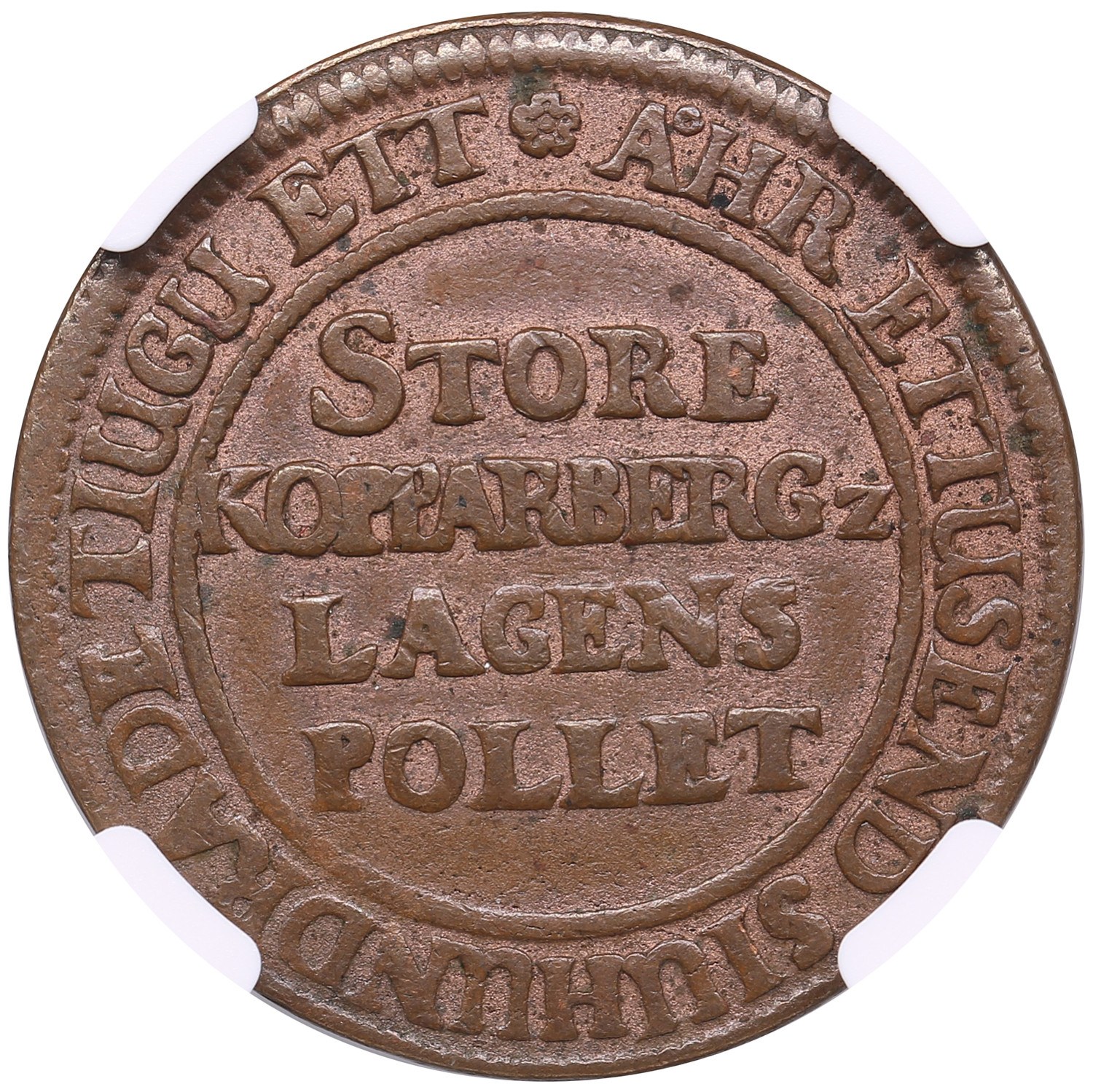
Attractive exemplar with yellow-brown toning.
SMB 419; SM 355; Stiernstedt 176:39; C&T 70.32a.
Rare.
Obv.: The Great Copper Mountain (Stora Kopparberget), surmounted by the copper symbol and flanked by two mining symbols. Below, the River Dalälven dividing the composition horizontally, with a panoramic view of the town of Falun in the lower section.
Legend around: BEGGE ETT ÄNDAMÅHL (Both United in One Purpose), referring to the mutual dependence of the copper mine and the town of Falun.
Rev.: Inscription in four lines within a circular border: STORE / KOPPARBERGZ / LAGENS / POLLET (Token of the Great Copper Mountain Mining Company).
Legend around: ÅHR ETTSUND SIUHUNDRADE TIUGU ETT (Year One Thousand Seven Hundred and Twenty-One).
Stora Kopparbergs Bergslag, the historic copper-mining enterprise at Falun in Sweden, issued several series of copper tokens between 1719 and 1723, with further issues in 1762-1765 and 1790-1791. In 1721, the mining company introduced a token valued at 10 Mark in copper currency, equivalent to 26⅔ öre in silver currency, to facilitate commercial transactions associated with the mining industry. The denomination corresponded to the established price of a stig of charcoal, an essential fuel for copper production. Initially intended for use within the mining district, these tokens subsequently circulated more widely and were accepted as money throughout Sweden, despite their substantially lower weight compared with official copper coinage. The reverse design emphasized the close economic relationship between the Great Copper Mountain and the town of Falun, whose prosperity depended on copper mining and processing. The recorded mintage of the 1721 issue was 25,680 pieces.