


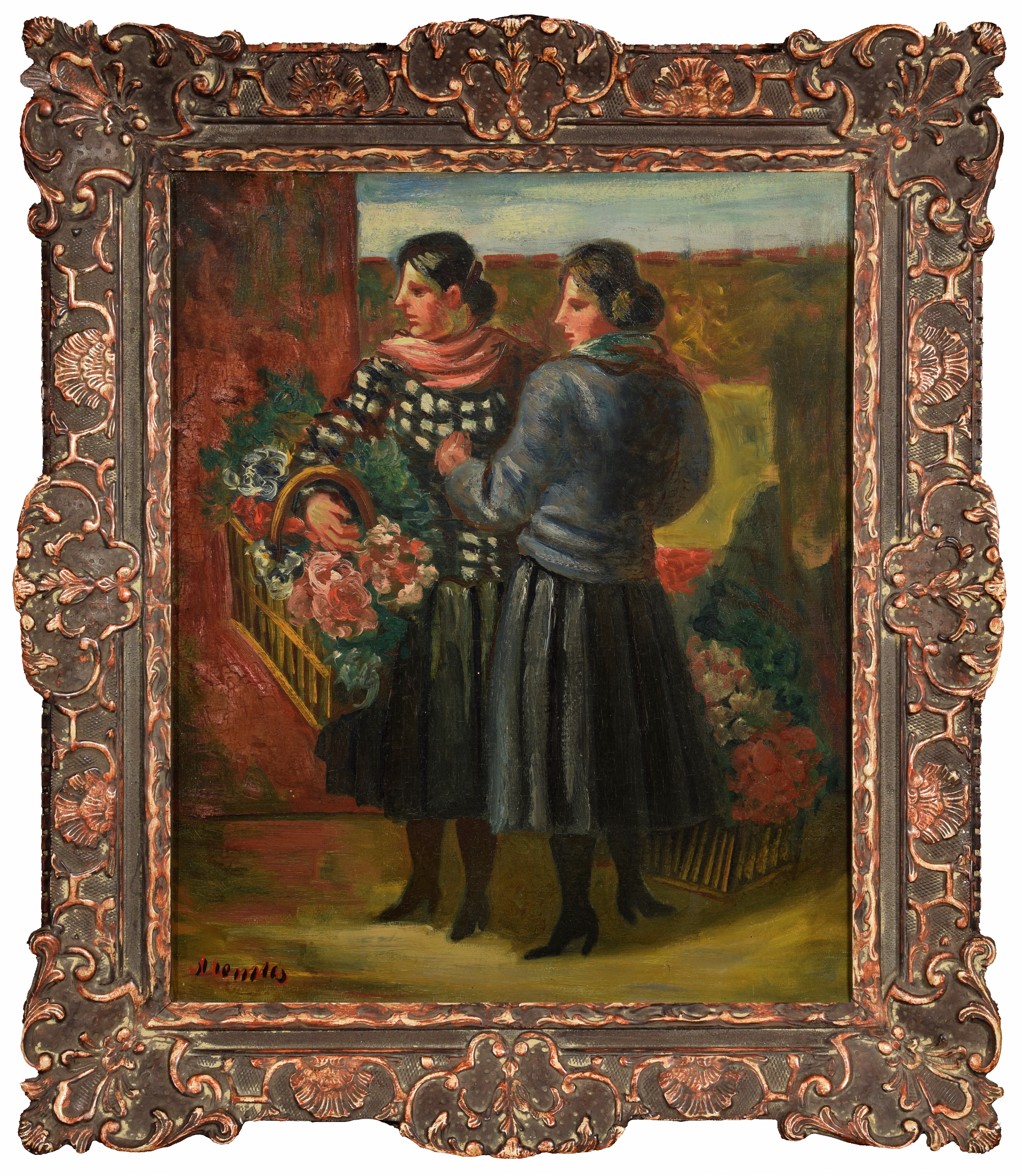
oil, canvas; 65 x 54 cm;
Signed l. d.: Menkes.
Zygmunt Menkes was a painter associated with the École de Paris, whose work combined elements of Expressionism and Colorism. Figurative scenes occupy an important place in his oeuvre, including depictions of women shown not only as individual figures, but also as part of everyday situations and collective compositions.
In paintings depicting women - such as the scene of two women at a market - the artist departs from classical portraiture in favor of capturing the entire figure in a specific space and context. The figures are usually synthesized, with simplified shapes and soft modeling, which directs the viewer's attention more to the arrangement of the composition than to the detail.
Women in Menkes' works are often inscribed in the rhythm of the scene: they stand side by side, busy with their daily activities, forming a compact, almost decorative whole. Their gestures are sparing, and the contact between them is subtle, suggested by the arrangement of their bodies rather than a clear narrative. The artist does not focus on individual psychology, but on the relationship between the characters and the harmony of the whole scene.
Color plays a key role - intense, saturated, building both the form and the atmosphere of the fair scene. Color patches organize the space of the painting, while color contrasts emphasize the presence of the figures and their interrelationships.
As a result, Menkes' depictions of women have a generalized and timeless character - they are more a study of form, color and rhythm than a realistic record of a specific situation.








Utoljára megtekintett
A tételek listájának megtekintéséhez jelentkezz be
Kedvencek
A tételek listájának megtekintéséhez jelentkezz be