


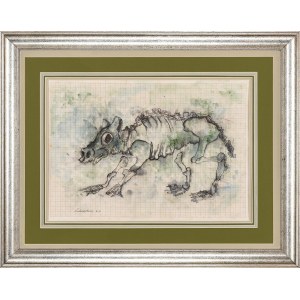
watercolor, ink, millimeter paper / 28 x 40.5 cm [świetle passe-partout]
47.7 x 60.2 cm, dimensions with frame
signature and date l.d.: 'Lebenstein 65'
inventory number: UK/mp/3/6/2020/a
ORIGIN:
private collection
Jan Lebenstein was born in 1930 in Brzesc Litewski, died in 1999 in Kraków. Painter and graphic artist. Studied painting at the Warsaw Academy of Fine Arts (1948-54) under Artur Nacht-Samborski. The originality of the formula of figurative painting was appreciated by French critics, who in 1959 awarded Lebenstein the Grand Prix at the 1st International Biennale of the Young in Paris. From then on, the painter lived in France. His art aroused the interest of such opinionated authors as Jean Cassou, Raymond Cogniat, Mary McCarthy, Michel Ragon.
Among others, he made a set of outstanding illustrations related to George Orwell's Animal Farm (1974), The Book of Job (1979), The Apocalypse (1983), The Book of Genesis (1995); he illustrated many short stories by Gustav Herling-Grudzinski, with whom he was a friend. He also designed a stained glass window with scenes from the Apocalypse for the Palotin chapel in Paris (1970). He was occasionally involved in stage design.
Before 1981, there was only one exhibition of the artist's work in Poland (1977), after which he donated a large selection of works to the National Museum in Wroclaw. In 1976 Lebenstein was honored with an award from New York's Alfred Jurzykowski Foundation, and in 1987 he received the independent Jan Cybis Award. The largest official national (retrospective) exhibition of the artist's oeuvre did not take place in Warsaw's Zachęta Gallery until 1992. The symbolic summation of Lebenstein's creative path, however, ultimately became the exhibition Etapy, shown in Paris and many Polish cities in the year before the painter's death.










Utoljára megtekintett
A tételek listájának megtekintéséhez jelentkezz be
Kedvencek
A tételek listájának megtekintéséhez jelentkezz be