


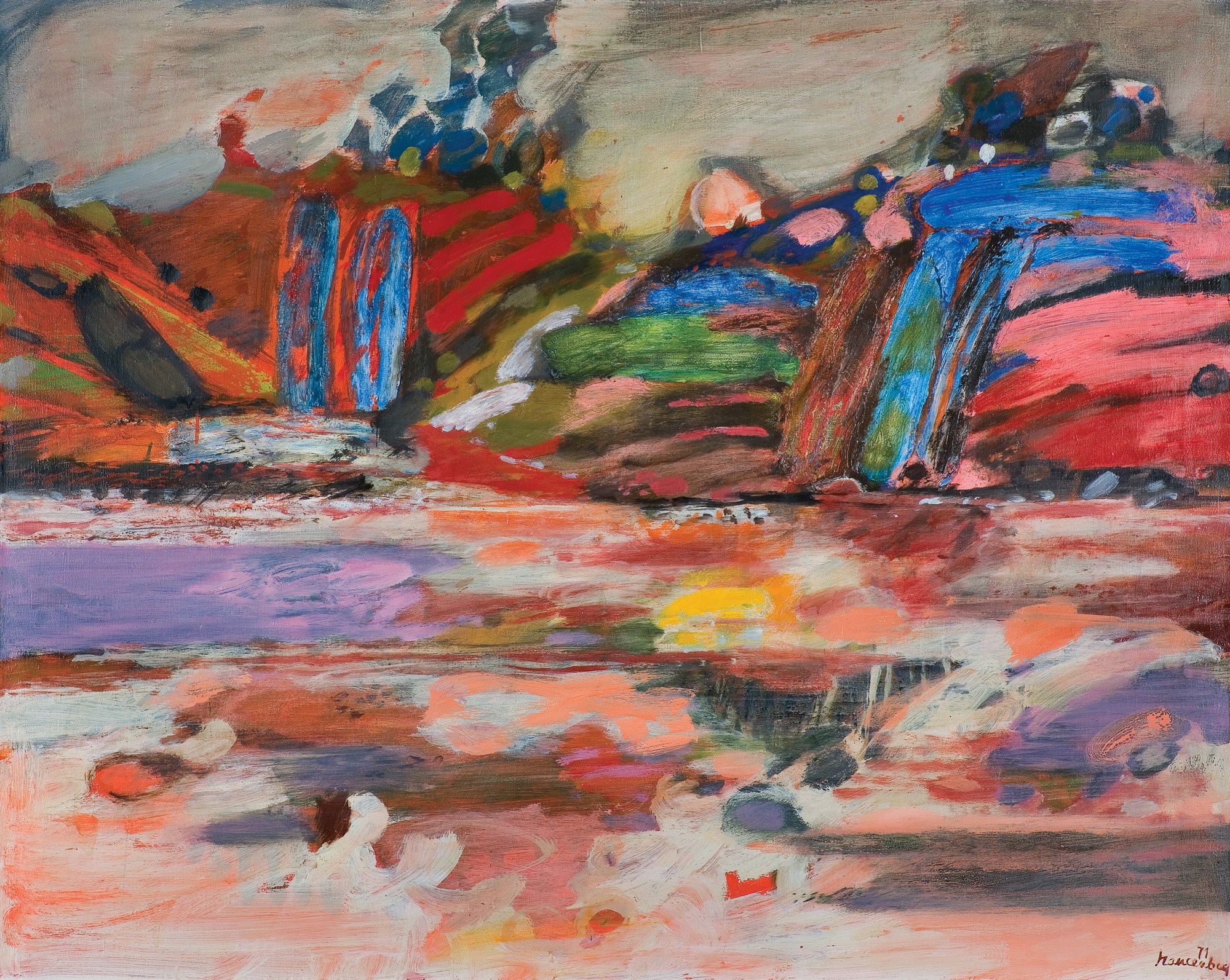
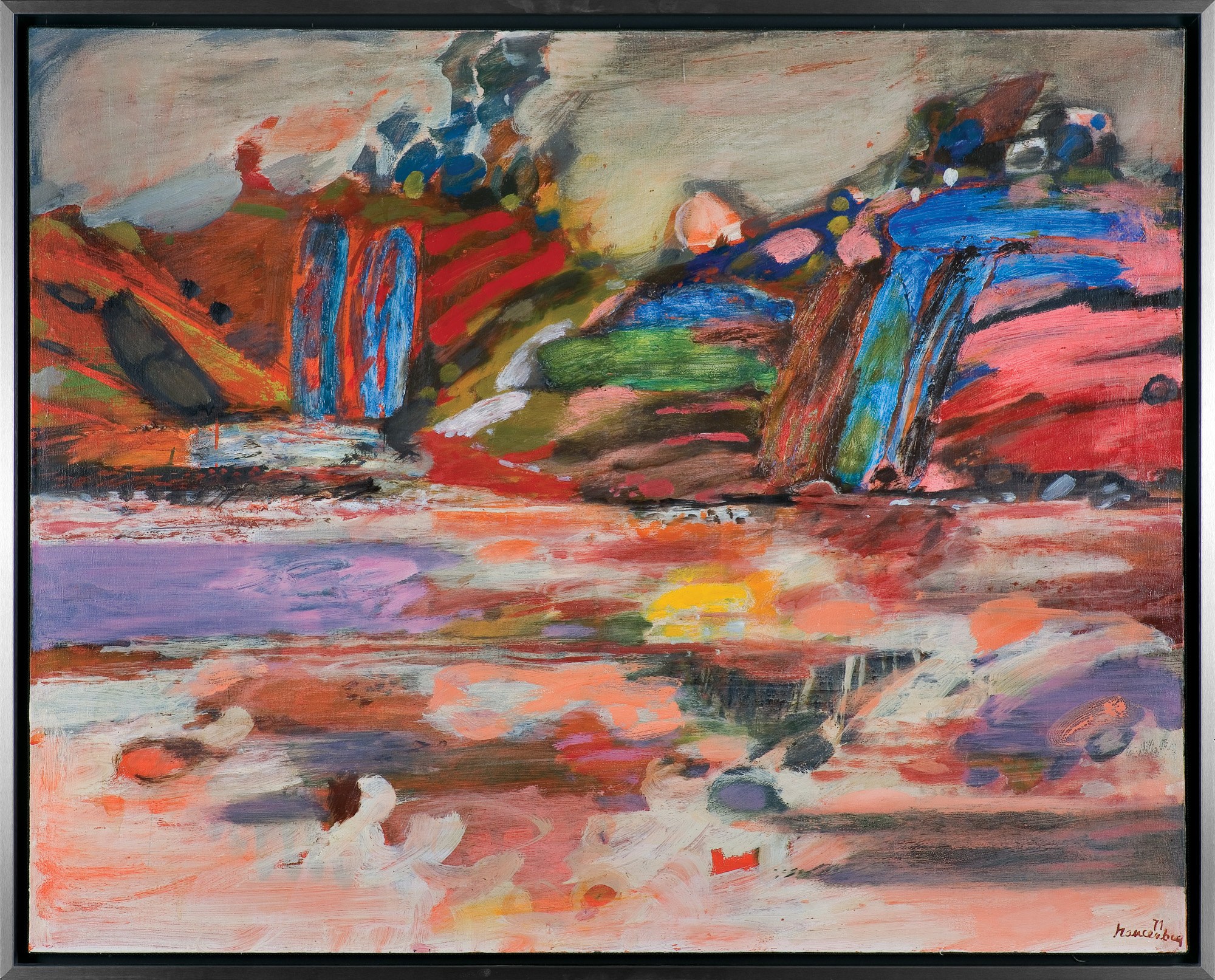
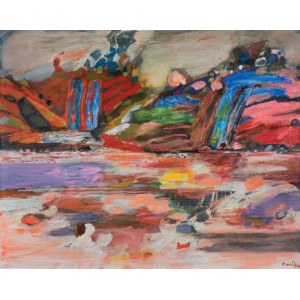
101 x 126 cm - oil on canvas
signed lower right: 71 | Szancenbach
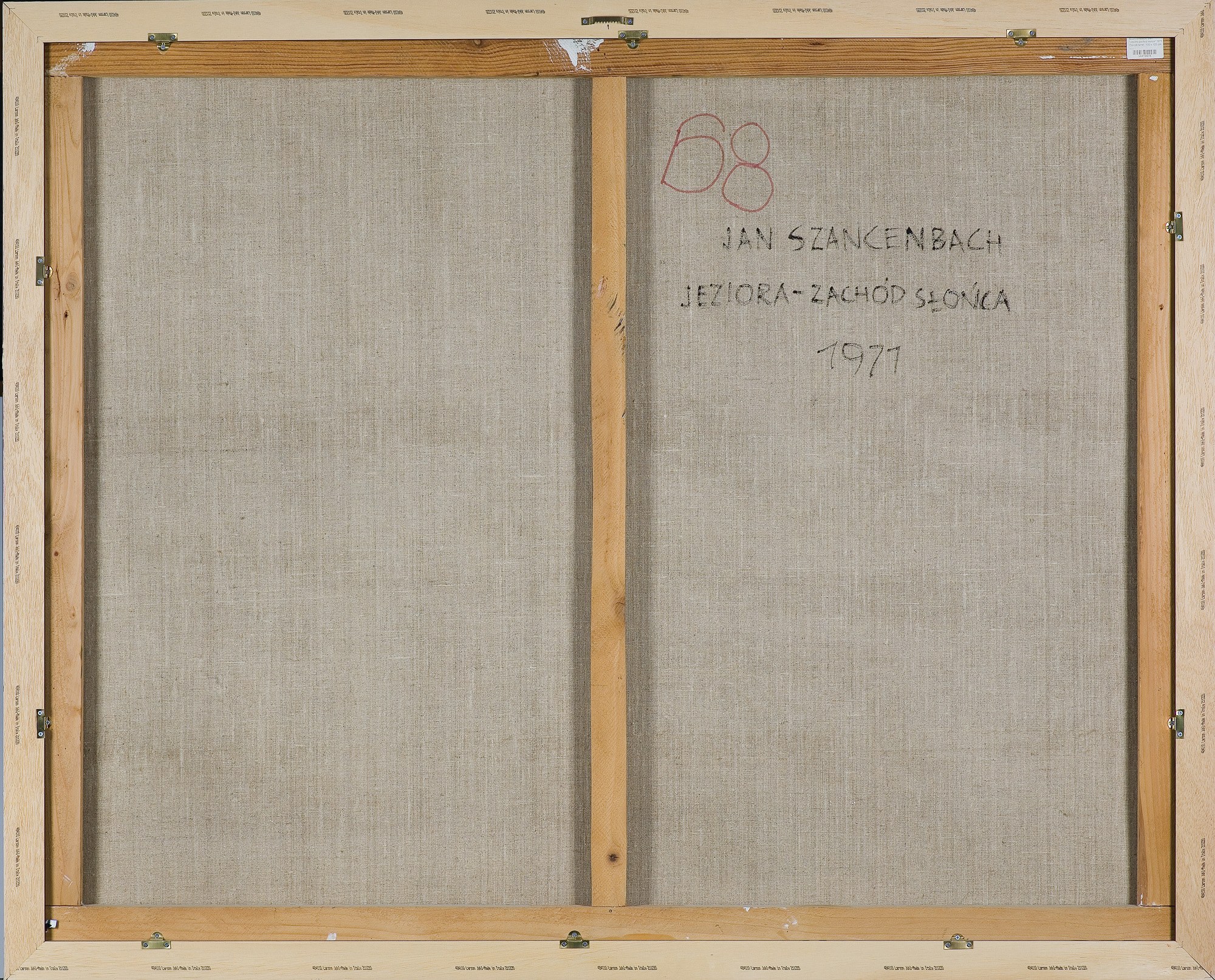
signed on the reverse, lower left: JAN SZANCENBACH | LAKES—SUNSET | 1971, above 68
on the top rail of the stretcher, a sticker with the painting’s details
Jan Szancenbach is considered the heir to a generation of Polish colorists who drew inspiration from French Post-Impressionism. Maria Rzepińska, a distinguished scholar of color in the history of world painting, wrote about the Kraków painter’s work: Szancenbach employs all the colors of the prism with equal freedom and boldness, yet he has his own preferences. When we recall his paintings, what comes to mind above all are fiery vermillions and saturated turquoise blues. These two contrasting colors often dominate the painting; they possess a specific resonance that serves as a particularly emphatic signal—almost like the artist’s calling card. They appear both in canvases with a light color palette and in those with a dark tone (though the latter are rarer in this artist’s work), where they become less joyful but take on a mysterious glow (Maria Rzepińska, Jan Szancenbach, Painting, exhibition catalog at the Piano Nobile Gallery, Kraków, November 1992, p. nlb.).
Jan Szancenbach’s painting consistently drew on forms derived from nature; however, in some works the artist allowed himself a greater degree of painterly synthesis, adopting approaches that approached an abstract composition of forms. One such canvas is the painting we are presenting at our auction.
♣ Droit de suite: ♣ A fee resulting from the right of the artist and his heirs to receive remuneration in accordance with the Act of February 4, 1994, on Copyright and Related Rights (droit de suite) will be added to the Purchase Price.
Jan Szancenbach (Kraków 1928–Kraków 1998) studied from 1940 to 1942 at the Kunstgewerbeschule (the Academy of Fine Arts, which had been downgraded by the occupying forces to the status of a vocational school) under the guidance of, among others, Stanisław Kamocki, Józef Mehoffer, and Andrzej Jurkiewicz. After the academy was closed, from 1942 to 1945 he worked to earn a living and studied on his own. In 1945, he was readmitted to the second year of his studies, which he completed under the supervision of Eugeniusz Eibisch in 1948 (he received his diploma in 1952). From 1948, he worked as an assistant in his department’s studio and in Ludwik Gardowski’s studio of typography and graphic design. He rose through all the ranks of the academic career, from assistant to full professor (since 1986). Beginning in 1972, he headed his own department at the Faculty of Painting. From 1987 to 1993, he served two terms as rector of the Academy of Fine Arts in Kraków. As a painter, he remained faithful to the Polish Colorism school, whose principles he mastered while studying under Eibisch. His paintings are full of light and saturated colors; they are joyful, even magical. In addition to his outstanding use of color (especially in reds, where he achieved an extraordinary range of variations and shades), he does not shy away from decorativism, which together contributes to a hedonistic, carefree style. Known primarily as a creator of still lifes, landscapes, and garden scenes, Szancenbach also engaged in monumental painting. He worked, among other projects, on the renovation of the Słowacki Theater in Kraków and the auditorium and ceiling of the Opera House in Wrocław. Another aspect of his art was graphic design (logos, posters, covers, packaging, labels, postage stamps, etc.); he also worked in book illustration and animated films.













Utoljára megtekintett
A tételek listájának megtekintéséhez jelentkezz be
Kedvencek
A tételek listájának megtekintéséhez jelentkezz be