


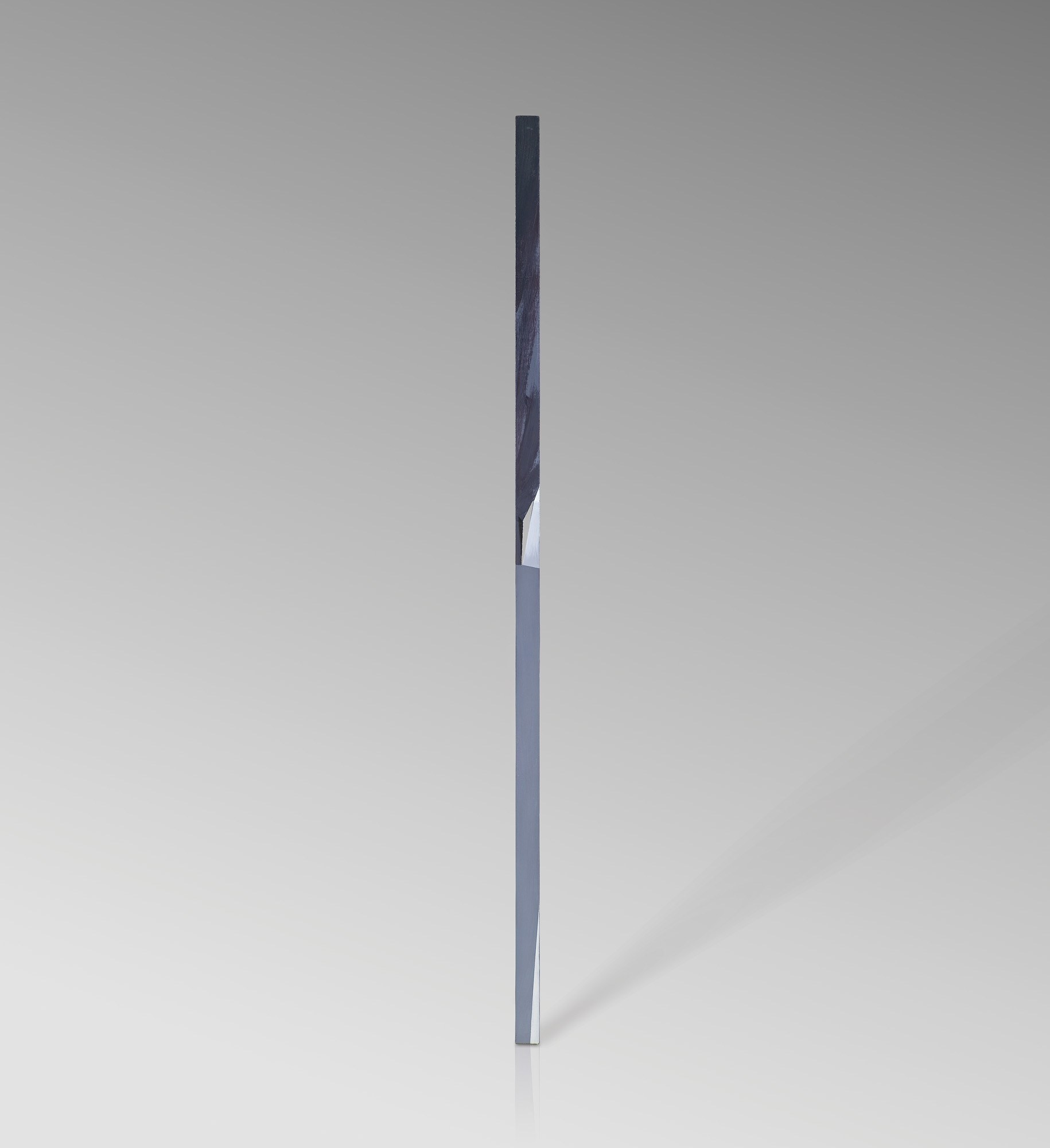

180 x 4.8 cm - acrylic on canvas mounted on a board
180 x 4.8 x 2 cm
signed on the reverse: JAN | BER | DYSZ | AK 1978-79 ACRYLIC CONCENTRATING AREA XXVIII.
Jan Berdyszak worked on the “Concentrating Areas” series from 1973 to 1980.
This series (...) was created solely with the intention of evoking, facilitating, and strengthening concentration in the broadest sense. This intended purpose of the works in this series means that they are devoid of any suggestions that might direct our consciousness toward reflections related to the tradition of the image. These objects are stripped of their functions as images in favor of concentration and questions about it, as well as forms capable of supporting it.
A cut-out, empty space in a painting or drawing opens it up to infinity, (...) and may also refer to the infinite creative possibilities of art. Although mathematical models describe the reality in which we live, they do not seek answers to questions concerning the dimensions of an individual’s life. Only art can answer these questions. (Tamara Książek, “In between Values,” in Jan Berdyszak, Works from 1960–2002, Center for Polish Sculpture in Orońsko, Orońsko 2002, p. 13)
♣ Droit de suite: ♣ An additional fee will be added to the Purchase Price, arising from the right of the artist and his heirs to receive remuneration in accordance with the Act of February 4, 1994, on Copyright and Related Rights (droit de suite).
Jan Berdyszak (Zawory 1934 – Poznań 2014) studied sculpture at the State Higher School of Fine Arts in Poznań from 1952 to 1958, while simultaneously experimenting independently with painting and printmaking. From an early stage, his work focused on issues of space. In the series “Double Circles” (1962–64 and 1967–69), he broke with the convention of the rectangular painting. The paintings consisted of two circles, arranged vertically one above the other, covered with dynamic, contrasting forms that created an internal space within the composition. The next stage of his exploration involved introducing real space into the painting in the form of an opening cut into the canvas. From 1967 onward, the space intruding into the fabric of the painting achieved “liberation” through the division of the work into separate parts, which were exhibited in various arrangements (symmetrically, antithetically, perpendicular to one another in a corner of the room, etc.). While Berdyszak’s experiments with painting and space had previously been accompanied by graphic works (plaster etchings, woodcuts, especially the “Compositions of Circles” series), it was at this point that painting encountered sculpture. Also from this period are multi-part, collapsible forms made of colorful, enameled sheet metal, designed to be arranged in any combination. From the late 1960s onward, Berdyszak’s painted surfaces became flat, and his forms sharply defined. The artist attempted to transpose concepts such as openness, infinity, and potentiality—rooted in Eastern philosophical thought—into a visual language. At the same time, in the series “Concentrating Areas” (1973–80), he proposed forms that encouraged the viewer to meditate. The series of objects made of glass and Plexiglas titled “Transparent” (1970–78) was continued in installations from the 1980s and 1990s. Starting in 1990, the artist created the “Passe-partout” series, realized in the form of objects, installations, prints, and other works. These are objects that replicate the form of a print mount but feature an empty opening that reveals the surroundings. Berdyszak’s body of work also includes ephemeral performances, a large number of sketches, and texts written and spoken on the occasion of various meetings, lectures, presentations, etc. Since 1965, he has taught at his alma mater (the Academy of Fine Arts since 1996). From the very beginning, alongside his main artistic practice, he was active in theater set design (he collaborated, among others, with the “Marcinek” Theater in Poznań).
He died on September 18, 2014













Utoljára megtekintett
A tételek listájának megtekintéséhez jelentkezz be
Kedvencek
A tételek listájának megtekintéséhez jelentkezz be