


300,0 x 600,0cm - pastel, charcoal, sepia, primed canvas
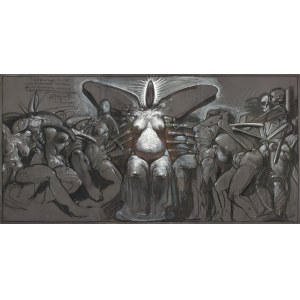
CHAOS, THE EXPECTATION OF THE DESCENDANT OF REGINA TENEBRIS AND THE ARRIVAL OF THE WORLD OF MECHANICAL DECAY, 1995
Middle part of the triptych "In anticipation of the Survivor", 1995
pastel, charcoal, sepia, primed canvas, 300 x 600 cm (3 parts measuring 300 x 200 cm)
Signed on l. part g.: Day two. 9. VI. 1695 | CHAOS, LOOKING FOR A POTENTIAL | REGINA TENEBRIS | MISSING | THE WORLD OF MECHANICAL DISTRIBUTION | FStarowieyski [tied monogram] | v B. 1695 | FCIT [sic!] MANUI SATANIS | L [in circle].
Image exhibited:
Art Gallery of the Center for Culture and European Encounters in Bialogard, 28 VI - 30 VIII 2013;
Copper Museum in Legnica, May 1 - June 30, 2015;
Podlasie Opera and Philharmonic - European Art Center in Bialystok named after Czeslaw Moniuszko, 3 XI 2015 - 17 I 2016;
Regional Museum in Człuchów, 8 July - 28 August 2016;
Kutno House of Culture "Window on Art," 3 X - 4 XI 2018;
Center for Culture and Art - Oskard House of Culture in Konin, 4 - 21 II 2021;
Center for Art Propaganda in Lodz, City Art Gallery in Lodz, 4 - 28 III 2021.
Office of Art Exhibitions and Visual Arts Services in Pila, September 3 - October 1, 2021.
The presented work, which is the middle part of a triptych, was created as part of the Drawing Theater in Lublin, during four days from June 7 to 10, 1995, and the artist was directly inspired by Juliusz Słowacki's poem The King Spirit. During the performance, excerpts from the work were recited by one of the two models (an actress of the Moment Group Theater), while Beethoven's music was heard in the background. The center of the composition is an advanced pregnant woman about to give birth to the Survivor.
In the work as a whole, the inspiration of the Renaissance (ancient love of geometry, symmetry) and the Baroque (richness and intricacy of form and content, vehemence and strong chiaroscuro contrasts) is strongly felt. After the triptych was completed, it was auctioned off, and since the individual parts were in the possession of two collectors, Starowieyski made the necessary changes to the drawing so that each part could be an independent composition. Starowieyski gave the individual parts titles and applied signatures to them.
The artist created the Theaters of Drawing from 1980: for the first time at the castle in Świdwin, and then until 1995 he made nearly thirty of them, including in Warsaw (1984), Venice (1986), Paris (1986), and Munich (1989).
Each time, Starowieyski worked on three large stretchers (3 x 6 meters in total), covered with primed canvas. The unique idea was to create a multimedia show in which the public process of creation was as important as the work itself. Before the eyes of the audience, with the participation of nude models, accompanied by music, the artist - acting as director, priest, magician - realized his idea.
This is what Franciszek Starowieyski said about the behind-the-scenes creation of this monumental work, which is 3 x 18 meters in its entirety: ...Before I start the performance - I gymnastize and exercise my hands. The sweep of such a plane is quite a physical effort, and one must not lose tact. It starts tentatively, only somewhere further it accelerates, momentum, horror, amazement and delight are created in the soul. The audience senses these states, and I, mobilized by collective consciousness, work biologically. (...) The huge space (54 sqm) allows to preserve and even surpass the natural human scale. A physical and mental identification with the created world is thus carried out. The place of cool analysis is filled by a narcotic need to continue.
♣ to the auctioned price, in addition to other costs, will be added a fee resulting from the right of the creator and his heirs to receive remuneration in accordance with the Law of February 4, 1994 - on copyright and related rights (droit de suite)
Franciszek Starowieyski (Bratkówka near Krosno, July 8, 1930 - Warsaw, February 23, 2009), using the pseudonym Jan Byk, studied from 1949 to 1952 at the Academy of Fine Arts in Cracow under Prof. Wojciech Weiss , after which he continued his studies at the Academy of Fine Arts in Warsaw, receiving his diploma in the studio of Prof. Michał Bylina in 1955. In the 1960s and 1970s, he gained the greatest recognition as a poster designer, in which he quickly rivaled the coryphaeuses of this art in Poland. He cultivated a poster of the author's type, with a recognizable style based on sweeping and at the same time calligraphic drawing, and above all surprising, surreal associations. From 1964 he was the art director of the fashionable monthly magazine "You and Me." With time, the predominance in his achievements gained "pure" drawing, since 1980 often presented in the form of dynamic sessions of the so-called "Theater of Drawing", with the participation of models, audience and the artist himself, fulfilling in it the role of demiurge. He created many painting and drawing compositions emanating a surreal atmosphere of life on the verge of physical decay, being a contemporary version of the vanitas theme. Fascinated by Baroque culture, the artist has been anti-dating all his works by 300 years since 1970. The artist was the recipient of numerous awards, which he won at such exhibitions as the Sao Paulo Art Biennale 1973, the International Film Poster Exhibition, Cannes 1974, the "Annual Key Award", Los Angeles 1978, among others. He was in New York on several occasions at the invitation of the Kosciuszko Foundation. In 1980 he was a professor at the Berliner Hochschule der Künste, in the 1990s he taught at the European Academy of Arts in Warsaw.













Utoljára megtekintett
A tételek listájának megtekintéséhez jelentkezz be
Kedvencek
A tételek listájának megtekintéséhez jelentkezz be