


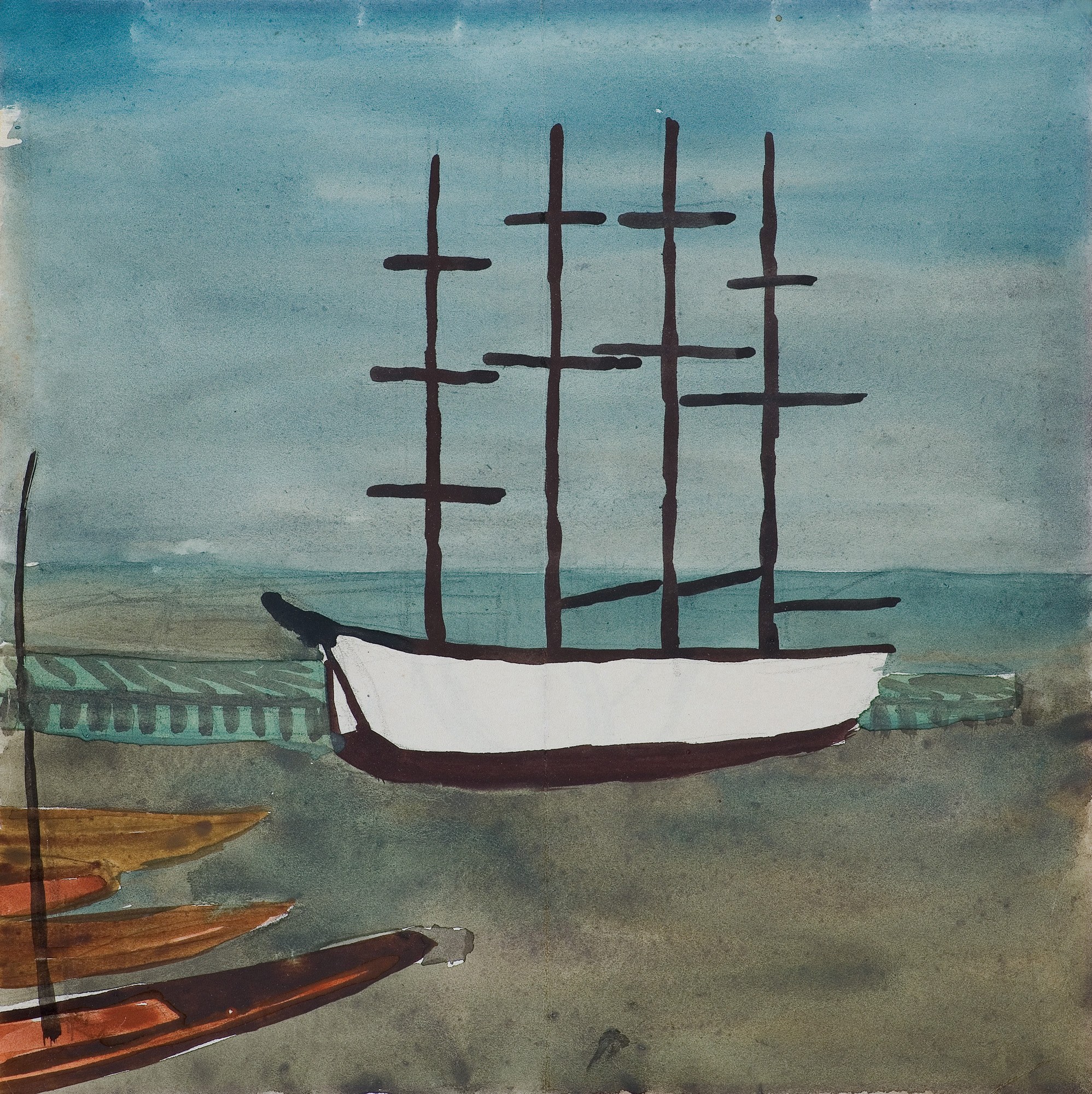
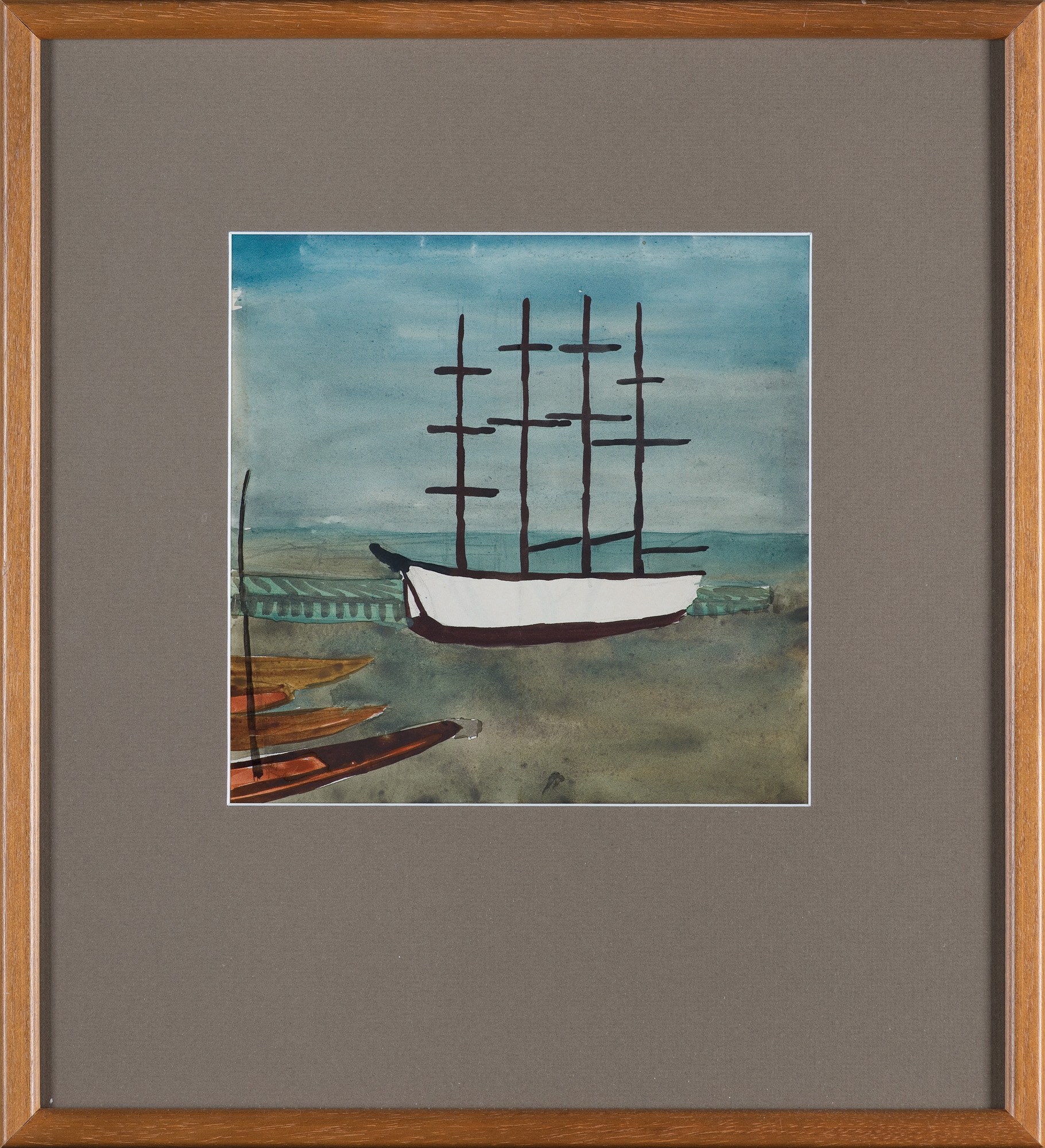
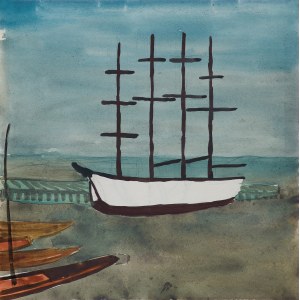
22,6 x 22,6cm - watercolor, paper
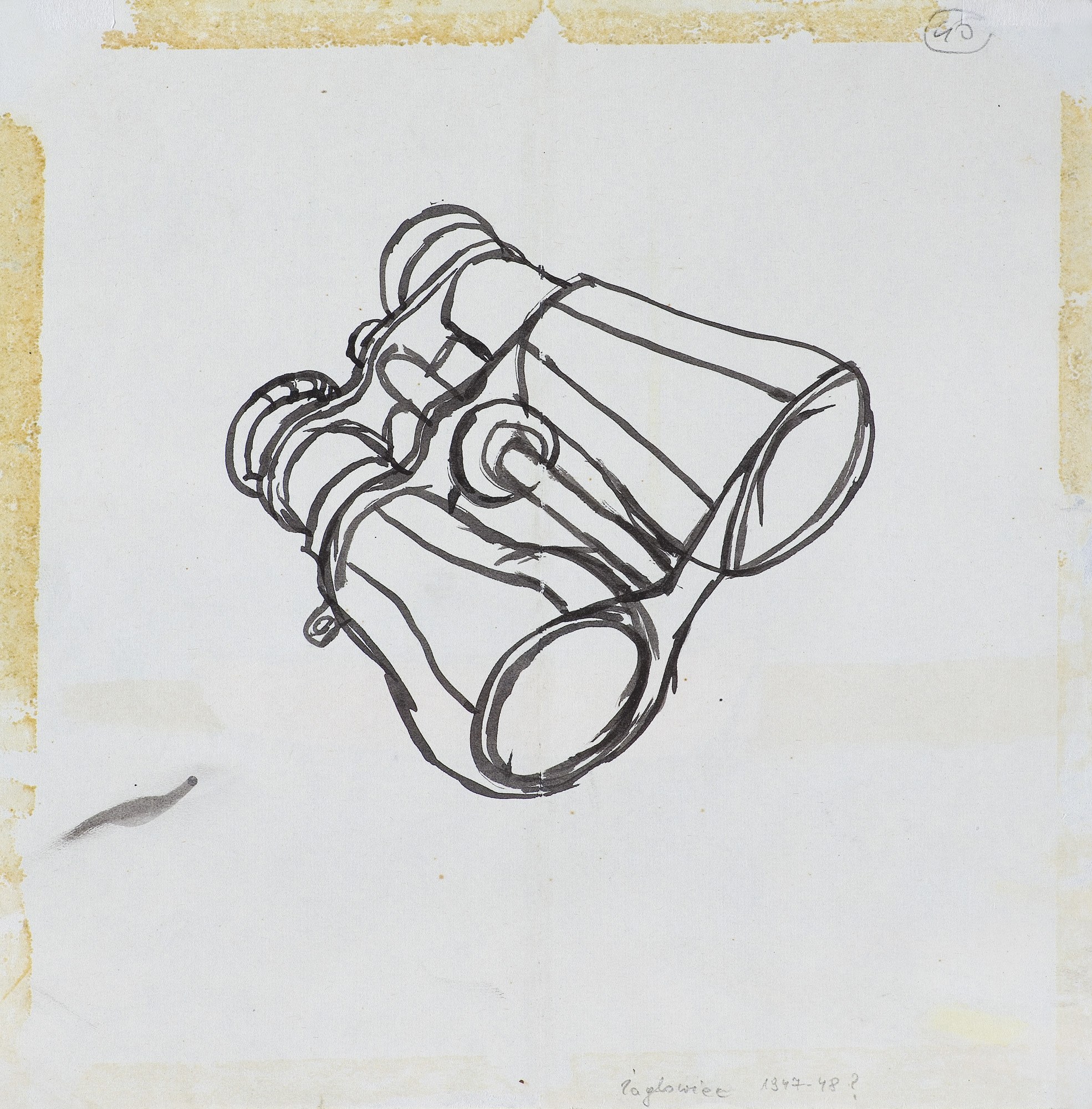
On the reverse: Binoculars, ink, paper
On the reverse, inscription p.d.: Sailing ship 1947-48 ?, p.g.: 45 [ in circle].
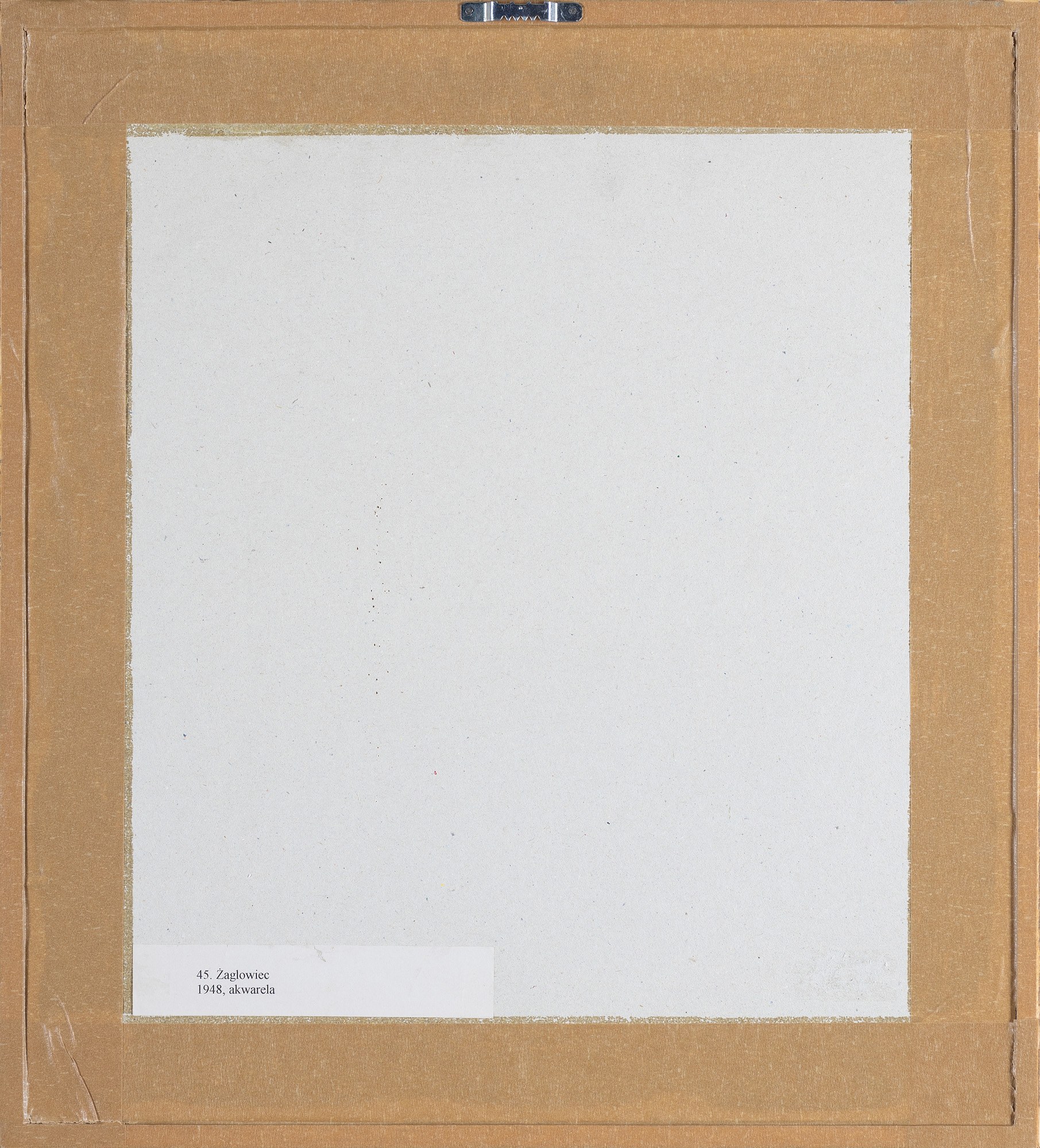
On the back of the binding l.d. sticker from an exhibition at the In Spe Gallery, print: 45. Sailing ship | 1948, watercolor.
Image exhibited:
- Theater Museum, Grand Theater - National Opera, Warsaw II 2002;
- Art Exhibition Office, Gorzow Wielkopolski III 2002;
- Bureau of Art Exhibitions, Olsztyn IV 2002;
- El Gallery Art Center, Elblag V 2002;
- Arsenal City Gallery, Poznań VI 2002.
Image described and reproduced:
- Gouaches, watercolors, drawings by Andrzej Wróblewski. Inedita, In Spe Gallery, cat. compiled by. Katarzyna Kasprzak, Warsaw 2002, cat. item 45, color ill;
- MKJ, Wróblewski the unknown (exhibition review), "Życie Warszawy" (Warsaw Life Guide), 1 II 2002;
- Agnieszka Kowalska, You don't know everything! Andrzej Wróblewski exhibition, "Gazeta Wyborcza," 5 II 2002.
The motif of ships has appeared in the work of Andrzej Wróblewski many times - including in the gouaches White Ship (1957), Pink Ship (1956), Green Ship (1957), Black Barge (1957). In his text on Wróblewski's work, Andrzej Kostolowski attributes motifs with ships to a theme he terms "Navigation." Navigation is a theme that has always interested Wróblewski as a constant "strategist" (and, in fact, utopian) of disaster. (...) In 1956 and 1957, navigational objects include carts, ambulances, buses, locomotives, streetcars, chauffeurs or riders on horseback. But particularly interesting is a large series of gouaches with ships, barges, boats. There, spectral and ominous ships or vessels sail among the waters in complete isolation and silence. There is no one of the crew or any passengers on them. The vehicle moves quietly amidst the all-encompassing red or in the icy cold, dark blue landscape of water and air. Against the backdrop of these elements, the white, black, red or pink of the ship sounds emphatically, with only the most distinctive components accentuated. These masts, chimneys or bridges live together with the ship, a mysterious, silent entity. It is interesting to note that the return to these navigational motifs of ships lost in the watery wilderness, with chords of color sounding unusually clear, accompanied perhaps the most depressive period in Wroblewski's life. At that time, various people from the so-called milieu would reproach the artist for his mistakes from the Socialist Realist era, which seemed to heighten the sense of crumbling values. (A. Kostolowski, Andrzej Wróblewski - confrontations and settlements, in Andrzej Wróblewski, Warsaw 1998, pp. 28-29)
The watercolor featured in our auction was included in the famous exhibition of works from the collection of the artist's family, organized by Joanna Stasiak of the In Spe Gallery at the Gallery at the Opera at the Grand Theater in Warsaw in February 2002, and then also shown in Elblag at the EL Gallery Art Center in May and June 2002. At this exhibition, almost 300 works on paper, dating from 1946 to 1954, were shown for the first time, which became a great event for both the public and researchers of Wróblewski's work. In the exhibition catalog, Katarzyna Kasprzak-Stamm wrote: Among Wróblewski's papers, a large part is occupied by landscapes painted in watercolor. (...) It is difficult to determine the time of creation of individual works. Views from the window of a house in Salwator at different times of the year with a recurring motif of a fence in an empty field, barges on the Vistula, landscapes of Podhale and summer landscapes from the Foothills painted most likely at plein-air events in 1952 and 1953 in Czachow and Waganowice. (K. Kasprzak- Stamm, Andrzej Wróblewski's works on paper, in: cat. published by the In Spe Gallery, accompanying the exhibition of Andrzej Wróblewski's works at the Galeria Przy Operze, at the Grand Theater in Warsaw in February 2002, p. 14)
In the same catalog, Joanna Stasiak wrote about Wróblewski's landscapes: His landscapes are a classic order, a lesson in well-balanced space. He is able to tighten the net of the picture - its horizontal and vertical lines (horizon, tree...). He also tightens the contrast of white and black, between them he finds the differences from the subtle silvery qualities of a light cloud to the heavy grays of the earth. This is not aestheticism, but the effort to learn about the world. (J. Stasiak, op. cit., p. 7).
♣ a fee will be added to the auctioned price in addition to other costs, based on the right of the creator and his heirs to receive remuneration in accordance with the Law of February 4, 1994 - on Copyright and Related Rights (droit de suite).
Andrzej Wróblewski was the son of the well-known graphic designer Krystyna Wróblewska, who guided his first steps in the field of art. He studied at the Faculty of Painting of the Academy of Fine Arts in Cracow (1945-1952) under Zygmunt Radnicki, Zbigniew Pronaszko, Hanna Rudzka-Cybis and Jerzy Fedko-wicz. At the same time, he studied art history at the Jagiellonian University (1945-1948), graduating from this course with a master's degree. In 1948-1949 he was a member of the "Self-education Group" he founded at the Academy of Fine Arts in
Krakow's "Self-education Group," which also included Andrzej Wajda, Witold Damasiewicz and Andrzej Strumillo, among others. As the group's theoretician, and in his own painting practice at the time, Wróblewski advocated a method called "neo-barbarism" by the reluctant young Kapists. This was the first attempt in Poland to introduce a native version of socialist realism, not imported from the USSR, which was stifled by the art education authorities during the All-Polish Art School Po-pises in Poznań in 1949. The series of "Shootings," begun at that time, was not recognized until after 1956 as the most shocking and thus true rendering of the drama of war.
From 1950 Wróblewski worked as an assistant, then an aspirant at his alma mater (until 1955). He tried - unsuccessfully - to submit to the discipline of socialist realism. In 1955 he took part in an exhibition at the Warsaw Arsenal. From the last years of the artist's work come his most important works, apart from "Shattering": The Queue Continues, Ukrzesłowienia, Szofer - all from 1956. An important strand of his work was works on paper: numerous watercolors, drawings, monotypes.







![Andrzej Wróblewski (1927 Wilno - 1957 Tatry), Pieta [szkic do Dziewczyny z misiem], przed 1946](https://img1.one.bid/img/9405/2906905_1w.webp?1770315196)


![Andrzej Wróblewski (1927 Wilno - 1957 Tatry), [Kompozycja ze skrzypcami 52] oraz [Martwa natura nr 52] - praca dwustronna](https://img1.one.bid/img/8677/2606337_1w.webp?1757524167)








Utoljára megtekintett
A tételek listájának megtekintéséhez jelentkezz be
Kedvencek
A tételek listájának megtekintéséhez jelentkezz be