


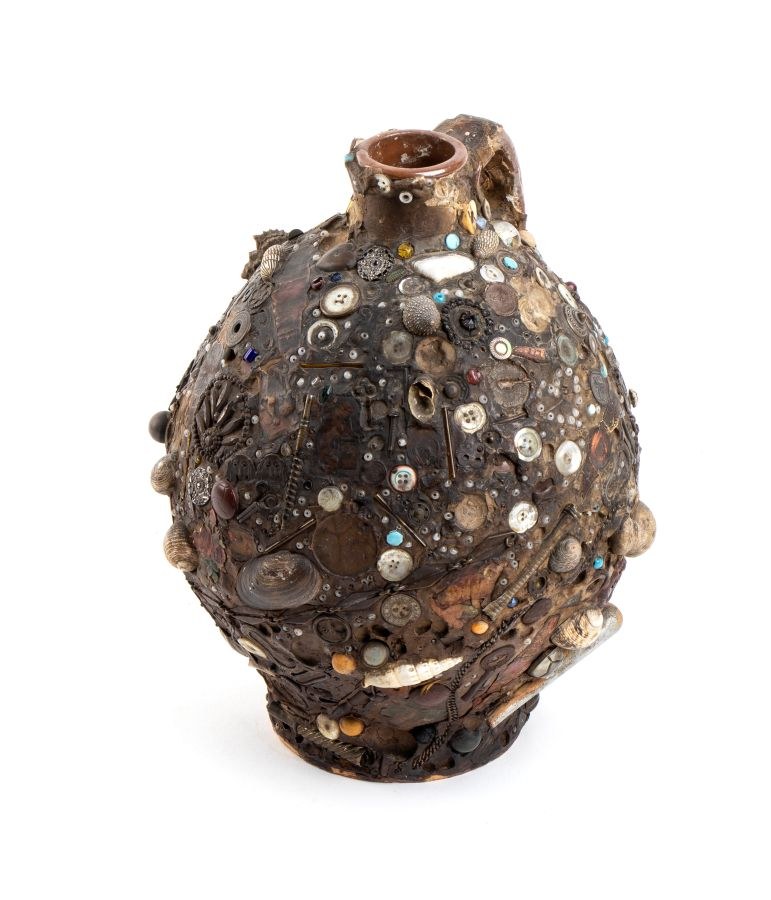

French "picassiette" vase mid 20th century Height x diameter: 28 x 20 cm. Weight: 2980 g.
The picassiette technique is a form of art that consists in creating mosaics using broken pieces of plates, ceramics, glass, or porcelain. The term picassiette comes from the French words "piquer" (to take or steal) and "assiette" (plate). In an artistic sense, it refers to the creative reuse of shards and fragments to make decorative works. The vase in question belongs to the realm of naïve and outsider art, and to the expression of popular art in France.The most emblematic period of its diffusion was between the 1930s and 1960s, mainly thanks to the figure of Raymond Isidore (1900–1964), whose work gave the technique its name. Isidore began decorating his house in Chartres (the famous Maison Picassiette) around 1938 and continued until his death. He used shards found in dumps to cover every surface of his home: walls, furniture, floors, and objects.Later, the technique was adopted by other outsider artists and craftsmen, but it has always remained associated with a spontaneous, non-academic aesthetic, and often with creative recycling. Item condition grading: **** good.The lot is in a good state of preservation with the normal wear and defects commensurate with its age and use over time.










Utoljára megtekintett
A tételek listájának megtekintéséhez jelentkezz be
Kedvencek
A tételek listájának megtekintéséhez jelentkezz be