


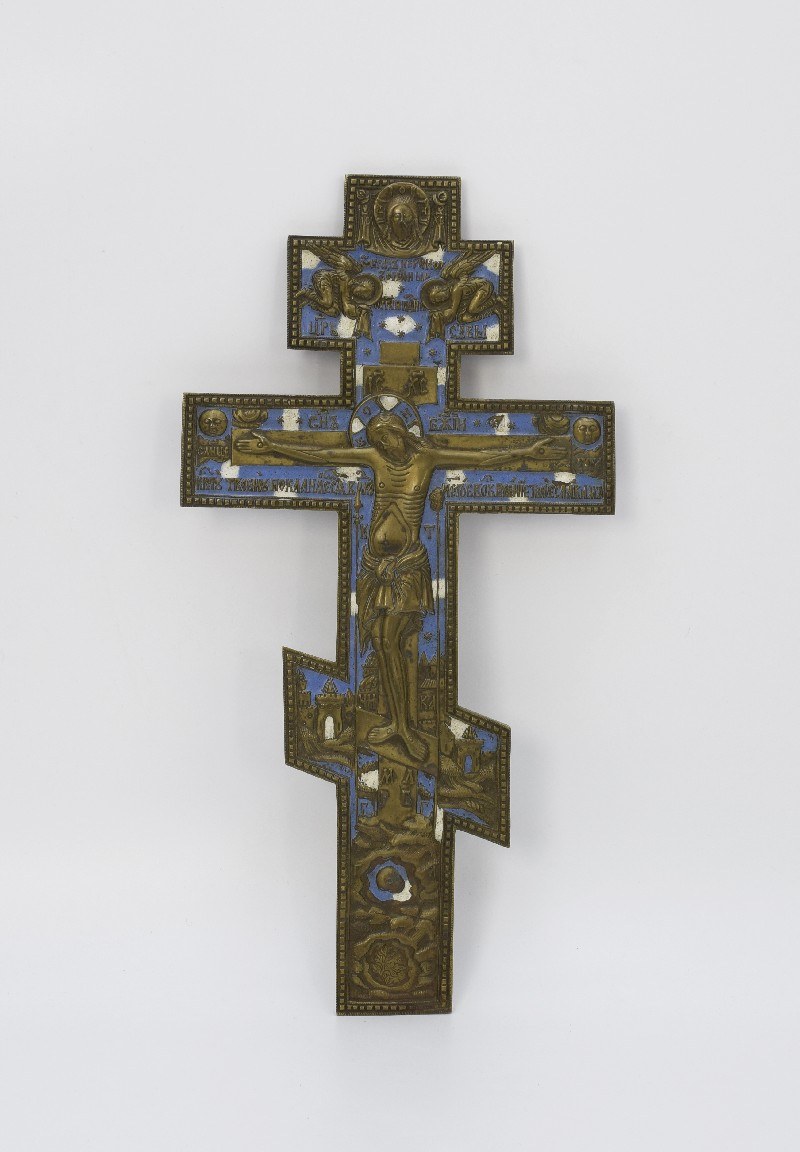
Brass, multicolor enamel; 38 x 19.5 cm.
Russia, 19th century.
Floral and floral decoration all over the back.
It is a cross with three beams, called "raspiatje", forming a background for a smaller crucifix proper superimposed on it.
The large cross, together with the depiction of the sun and moon on the ends of the horizontal second beam and the walls of Jerusalem on the lower beam, is meant to symbolize the universe. Above the upper beam is the Mandylion, below which two angels with their hands shielded, in deep prostration (proskynesis) adore Christ. Beneath the upper beam, known as the "titulus," of the large cross begins a smaller crucifix. On it, the crucified Christ is depicted as the God-Man standing on the beam of the subpedaneum with his arms open in a straight line.
Under the cross of Christ is the skull of Adam, symbolizing victory over death. All elements are further explained by the inscriptions on the cross.
Crosses of this type were used in the Orthodox Church for the blessing of the faithful by the priest. In the upper part, above the "title", there was a representation of a figure blessing God the Father and the Holy Spirit in the form of a dove.
The iconography of this crucifix is identical to the depiction of the Crucifixion in some icons. Perhaps this crucifix was once part of such an icon.








Utoljára megtekintett
A tételek listájának megtekintéséhez jelentkezz be
Kedvencek
A tételek listájának megtekintéséhez jelentkezz be