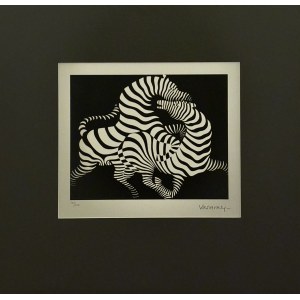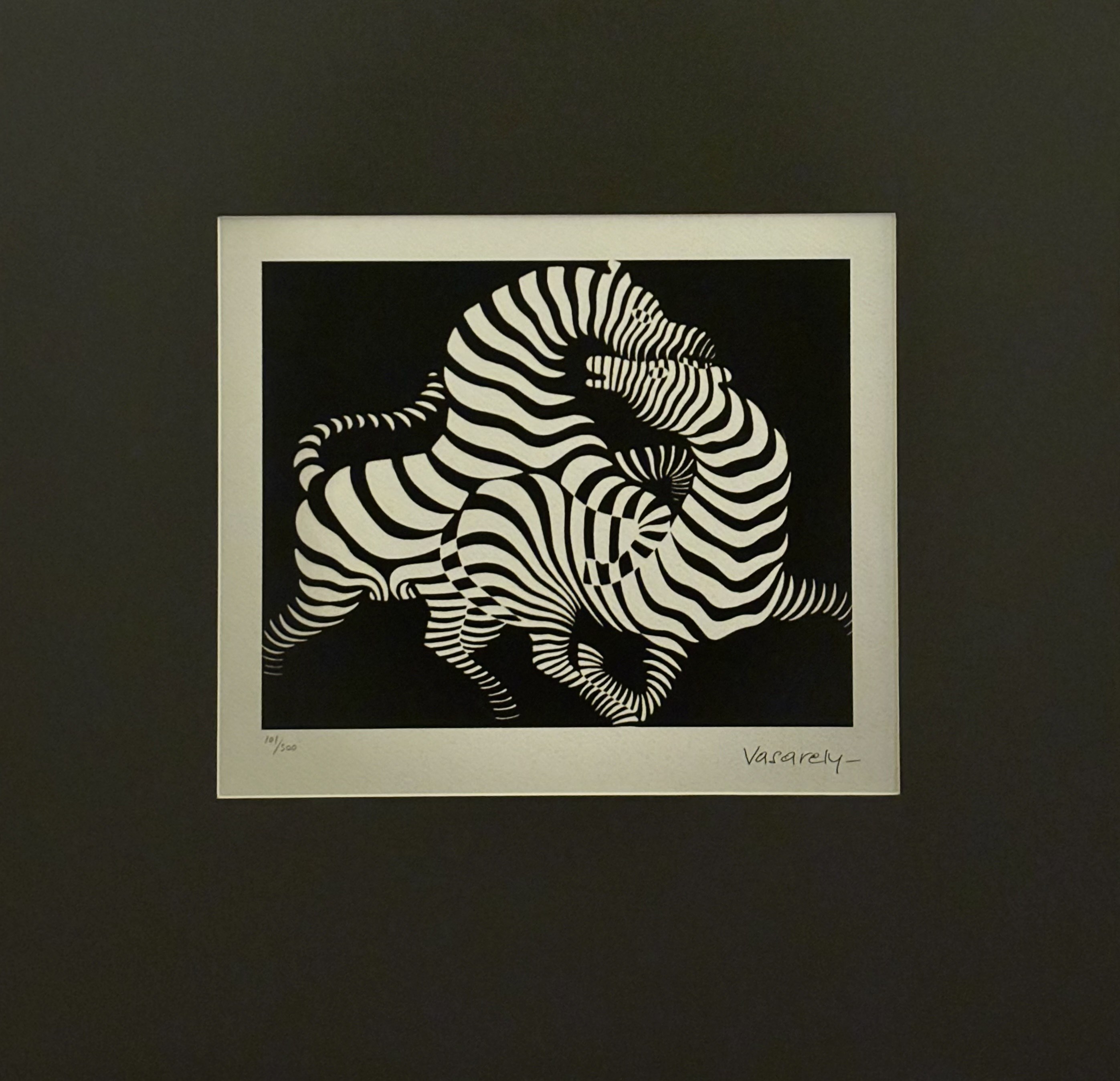
Color lithograph, Arches France Infinity paper, dimensions: 27 x 30 cm clear passe-partout , 48 x 48 cm framed passe-partout, cm, limited edition, numbered in pencil 101/500, signed under the composition facsimile signature "Vasarely" p.d.; publisher 's drystamp: S.P.A.D.E.M. PARIS l.d., hologram "verification of authenticity" on the back . Original certificate.
Victor Vasarely, considered the father of the art of op-art (optical illusion), became famous for his unique, hypnotic works that explore the phenomena of visual perception and movement. His works, rich in geometric shapes, patterns and contrasts, lead the viewer through intricate,almostpulsatingspacesthatseemtovibrate andmove. One of the most outstandingexamples of hisworkis "Zebras,"consideredby some tobe theearliestexample of op-art. Victor Vasarely revolutionizedthe approach to visual art byintroducingelements of science and mathematics into his work. Hisworksare a study of optical illusionsthatcreateimpressions ofmovement,variationanddepth ona flat surface.
"Zebras" is one of Vasarely's most recognizable works, which has become an icon of op-art. The painting depicts two intertwined zebras, executed in black and white stripes. " Zebras" is the quintessence of minimalism and geometric precision. Vasarely uses the simplicity of black and white lines tocreateacomplexformthat seemstocome alive ona flat surface. The zebra stripesarearranged in sucha waythat the viewer's eye constantlyfollowsthem,creatingan effect of movement. Vasarely masterfully manipulates the viewer's perception. Throughthe use ofrepeatedparallellinesthattwist andoverlap, he createsthe illusion ofdepth and dynamism. The viewercanfeelthat the zebrasare in motion, even thoughthey are static forms on paper. Althoughthe painting is monochromatic, the richness of its form and structure makesit extremely dynamic. The contrastbetweenblack andwhite not only defines the forms, butalso createsa sense of rhythm and harmonythatdraws the eye in.
"Zebras" canbe seen as a symbol of harmony andunity ofopposites.Theblack andwhitestripesrepresentduality - light andshadow, positive and negative spacesthatcoexist andcomplementeachother. Theworkcanalsoberead as a reflection on thenatureof perception andreality - how oursensesinterpret andprocess information.
Through his works such as "Zebras," Victor Vasarely has pushed the boundaries of traditional painting, bringing art into a new dimension where science and art come together toexplore the limits of human perception. "Zebras" is not onlya work of art, butalso a manifestation of his philosophy,where mathematical precisionmeetsartisticvision,creating an extremelyfascinating andlastingcompositionin the viewer's mind.