


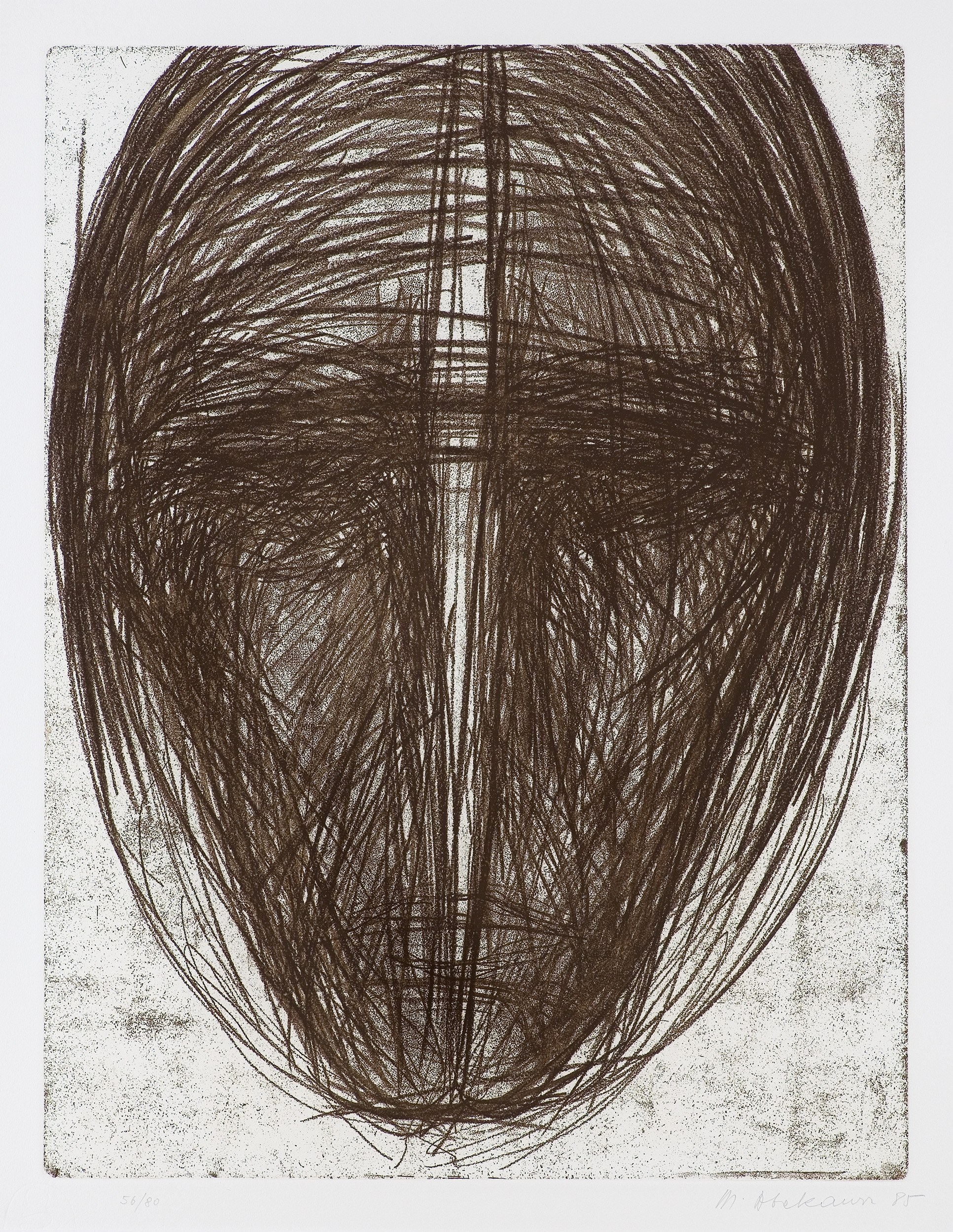
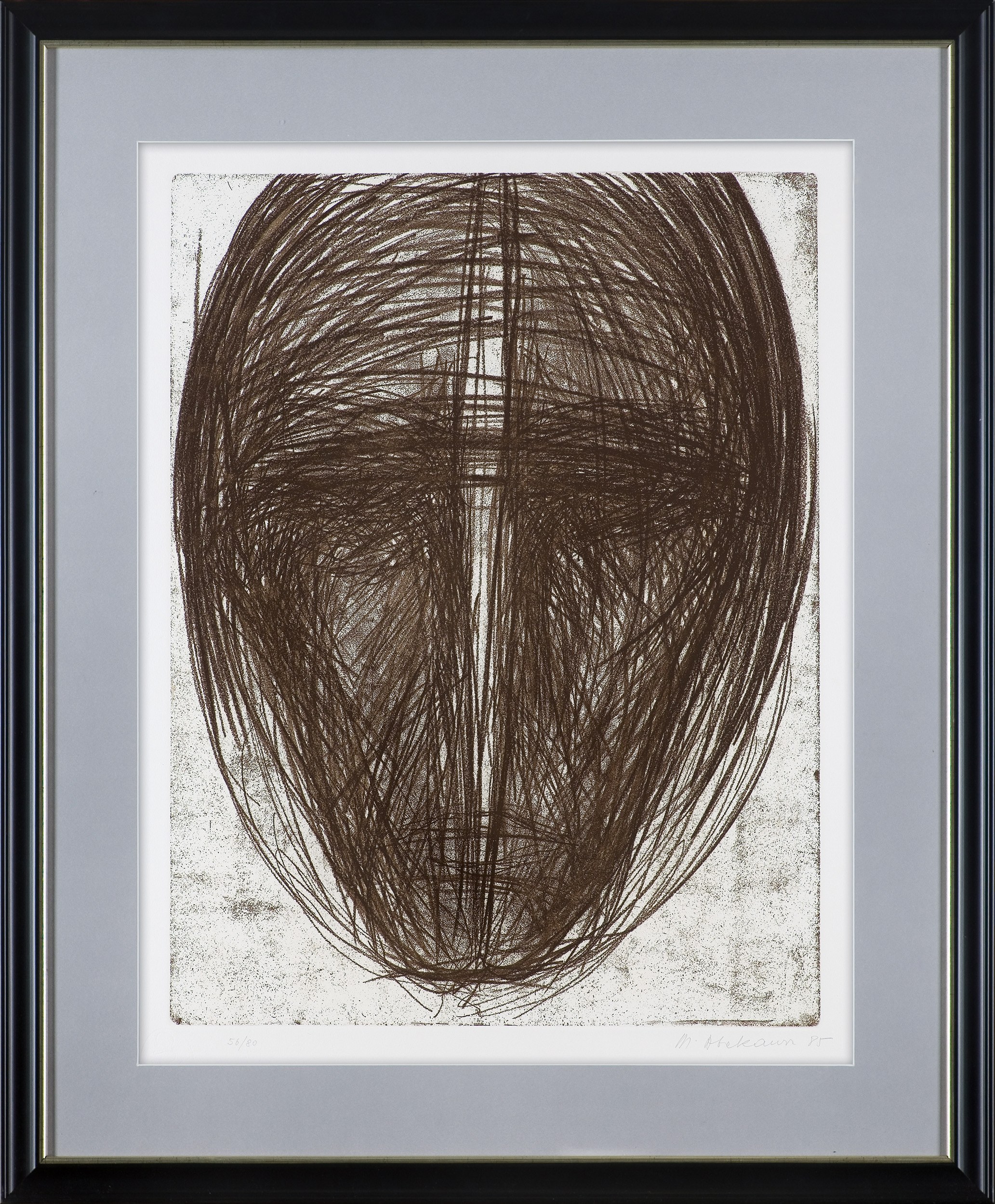
64.0 x 48.5cm - soft sepia varnish, paper with dry seal
Signed in lead under the engraving l.: 56/80, p.: M. Abakanowicz 85
In 1985, at the invitation of the Giuliano Gori Foundation of Florence, Magdalena Abakanowicz made and arranged in space one of her most famous outdoor realizations, which she entitled Katarsis. In the sculpture park surrounding Villa Celle in Santomato near Pistoia in Tuscany stood a "crowd" of 33 anthropomorphic forms resembling grave steles, each about 3 meters high. The artist referred to them as "people-trees" and "people-coffins."
The shapes of the figures can be found in the publications accompanying the sculptural realization. A book with text by Pierre Restany Abakanowicz. Katarsis was published by Edizioni della Bezuga in Florence in 1987. A graphic portfolio, containing 6 works made in soft varnish, a title board and a colophon, went out there in November 1986 in an edition of 120 pieces. Finally, other versions of the graphics from the portfolio were rebound in the same Florence outhouse, differing from them in details, including the offered composition. As loose prints, they were separately signed and numbered.
♣ A fee will be added to the auctioned price in addition to other costs, based on the right of the artist and his heirs to receive remuneration in accordance with the Law of February 4, 1994 - on Copyright and Related Rights (droit de suite).
Magdalena Abakanowicz (Falenty near Warsaw 20. VI 1930 - Warsaw 20. IV 2017) studied in Gdansk (1949-1950) and at the Warsaw Academy of Fine Arts (1950-1954). She taught at the Academy of Fine Arts in Poznań (1965-1990). Since the early 1960s, she was involved in unique textiles, creating original spatial forms, named "abakans" after her. In 1965 she won the Gold Medal at the Second International Biennale of Textiles in Sao Paulo. In the 1970s, she began creating figural series in resin-cured jute: "Alterations" (from 1974), "Backs" (1976-80), "Embryology" (1978-80), "Crowds" (from 1986). Since the 1980s, the artist has been practicing outdoor sculpture, using wood, clay, stone and casts (the "Crowds" groups, "Katharsis" in a private collection in Italy, "Negev" - 7 colossal stone circles in the Israel Museum park in Jerusalem). In 1987 she began work on "War Games," large projectile-like forms constructed from natural wood and iron. Since 1991, she has been developing the concept of "arboreal architecture," originally designed as an extension of the La Defense axis in Paris, which she promotes as a solution to the problems of large agglomerations. She has participated in the most important reviews of contemporary art, such as the Sao Paulo Biennale (1965, 1979), the Venice Biennale (1968, 1980) and others. She has won many Polish and foreign awards.













Utoljára megtekintett
A tételek listájának megtekintéséhez jelentkezz be
Kedvencek
A tételek listájának megtekintéséhez jelentkezz be