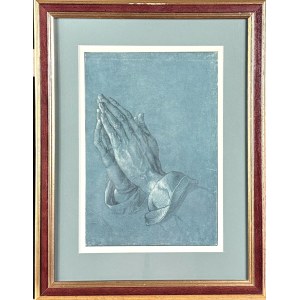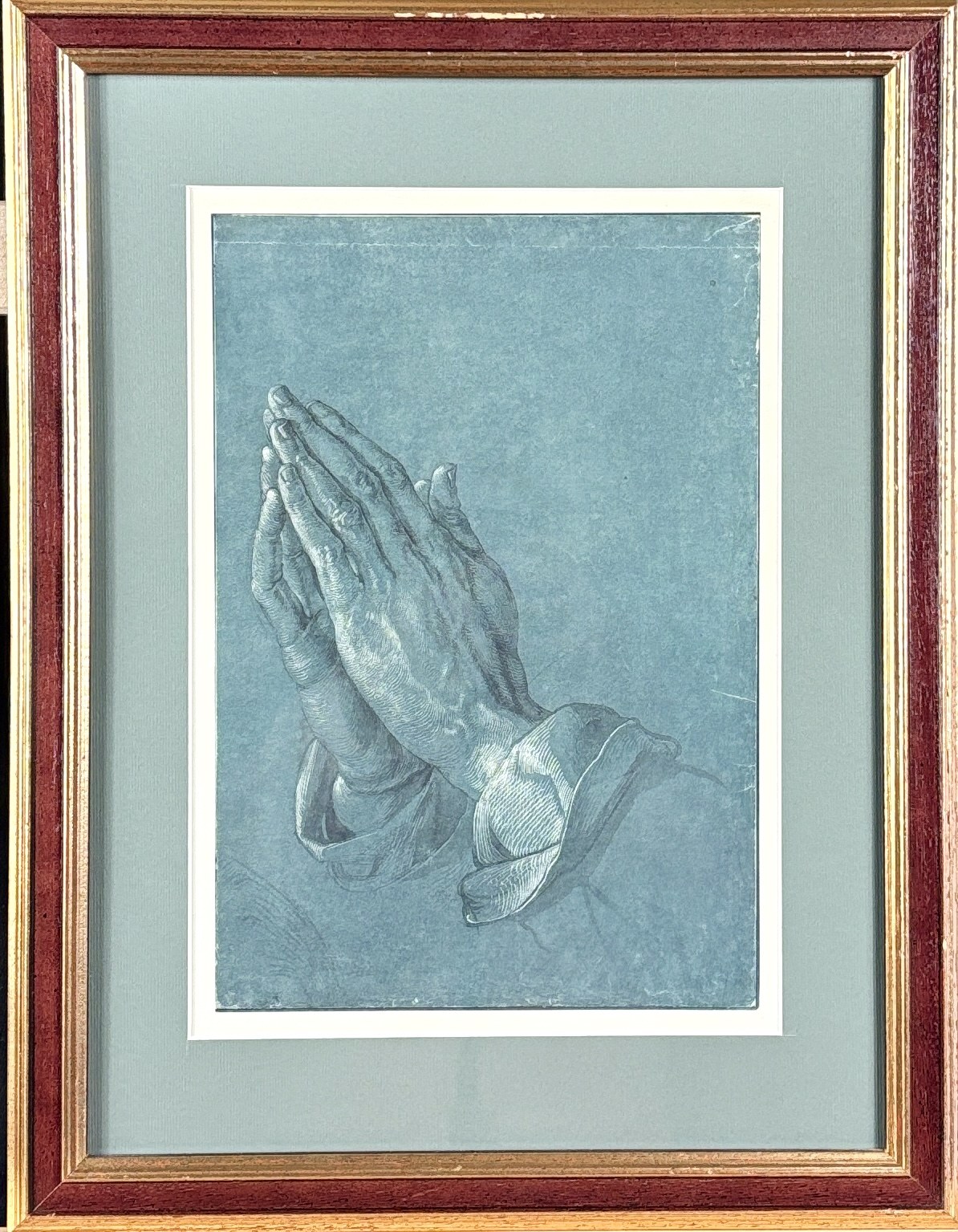
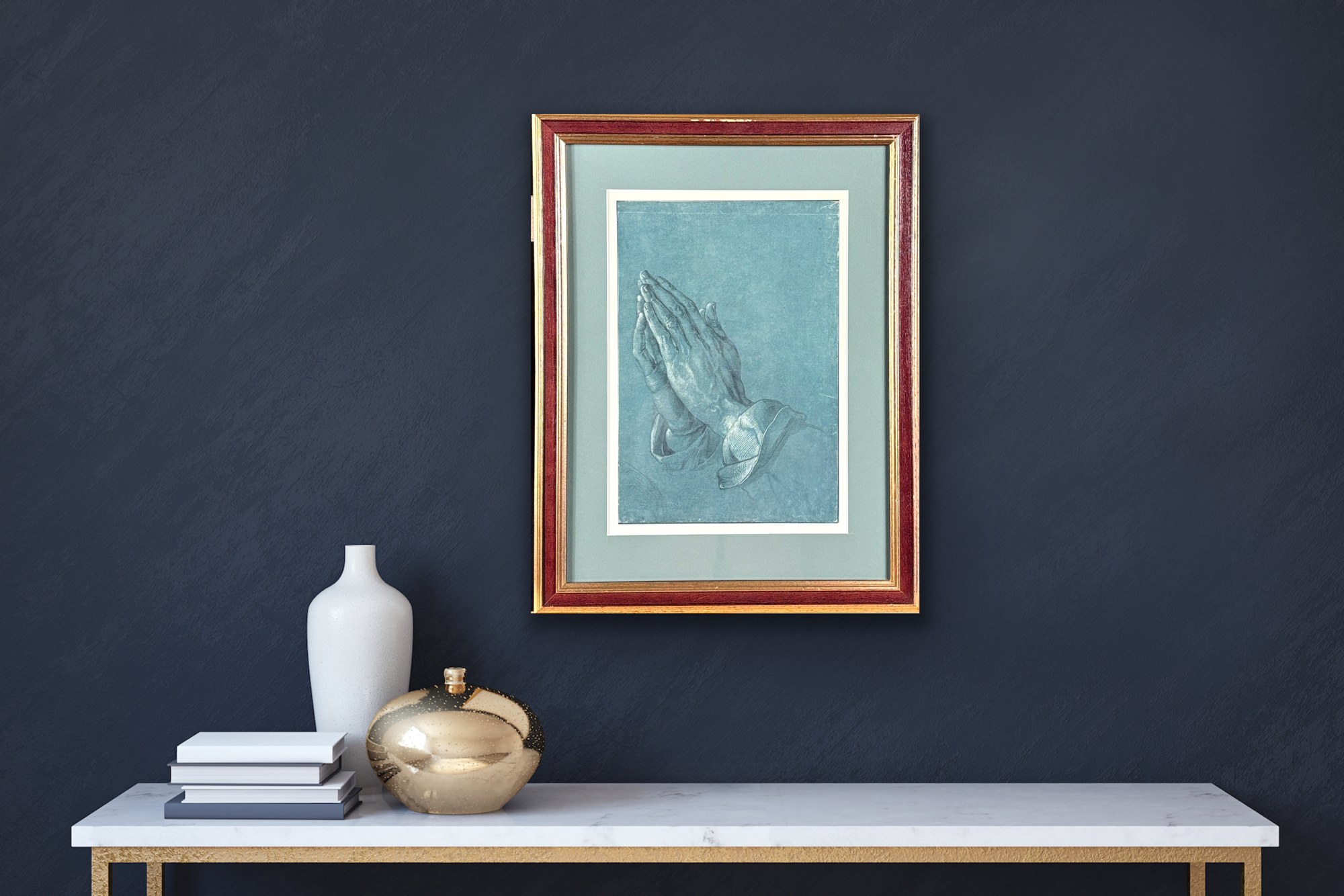
lithograph, paper, 30 x 20 cm in light of original passe - partout framed 45 x 35 cm; produced in the 19th century by the museum outhouse "Albertina Facsymiles" in Vienna, a unique print from the only unique edition of Durer's prints published at the end of the 19th century. (Albertina is one of the most important art museums in Austria, holding the largest and most valuable collection of drawings and prints by Albrecht Dürer).
"Praying Hands" (original: "Betende Hände") is one of the most famous drawings by Albrecht Dürer, a Renaissance artist of German origin.
Albrecht Dürer's drawing "Praying Hands" was made around 1508. The work is part of a larger preparatory work for the Heller altarpiece, which Dürer was creating on commission from merchant Jakob Heller for the Dominican Church in Frankfurt am Main. Although the altarpiece itself was completed in 1509, preparatory drawings, such as the "Praying Hands," were created somewhat earlier, while he was working on the design.
Dürer, a master of technique and precision, used his ink drawing and watercolor skills in this work. The composition is simple but very expressive, and its minimalism and monochromatic color palette focus the viewer's attention on the detail of the hands and the emotions they may express. The work has become an icon of religious Christian art and is often reproduced as a symbol of faith and spiritual commitment.
The drawing is rendered in gray and blue tones, which adds subtlety and depth. The hands are depicted with great attention to detail - you can see every wrinkle of the skin, the arrangement of the fingers and the shading, which emphasizes their three-dimensionality. The folding of hands in prayer symbolizes spirituality, humility and devotion.
Albrecht Dürer's drawing "Praying Hands" is also known by other titles. In German, it is often referred to as **"Betende Hände "**, which literally means "Praying Hands." In English, the drawing is sometimes referred to as **"Praying Hands "**. These alternative titles refer to the same work, and their variety is due to translations into different languages and interpretations of the gesture depicted in the drawing. Besides the obvious association with prayer, the gesture of folded hands can symbolize humility and devotion. In some contexts, the gesture of folded hands can be interpreted as a request for help, protection or blessing. It can be a gesture expressing a need for support during difficult times. The gesture of praying hands is often a symbol of hope and faith in something greater than everyday life. It can express hope for a better future or faith in divine protection.
Regardless of religious connotations, the gesture of folded hands can be seen as a universal sign of human humility and togetherness. It can express feelings of gratitude, sorrow or sincerity in a way that people of different cultures and traditions can understand. Each of these interpretations adds depth to Dürer's drawing and underscores its universal character, which appeals to people regardless of their religion or worldview.
The original of Albrecht Dürer's drawing "Praying Hands" is housed in the Albertina, an art museum in Vienna, Austria. The Albertina has one of the largest and most important collections of prints in the world, and "Praying Hands" is one of its most valuable exhibits. This museum also displays other works by Dürer, such as the famous "Great Passion" and "The Hare"