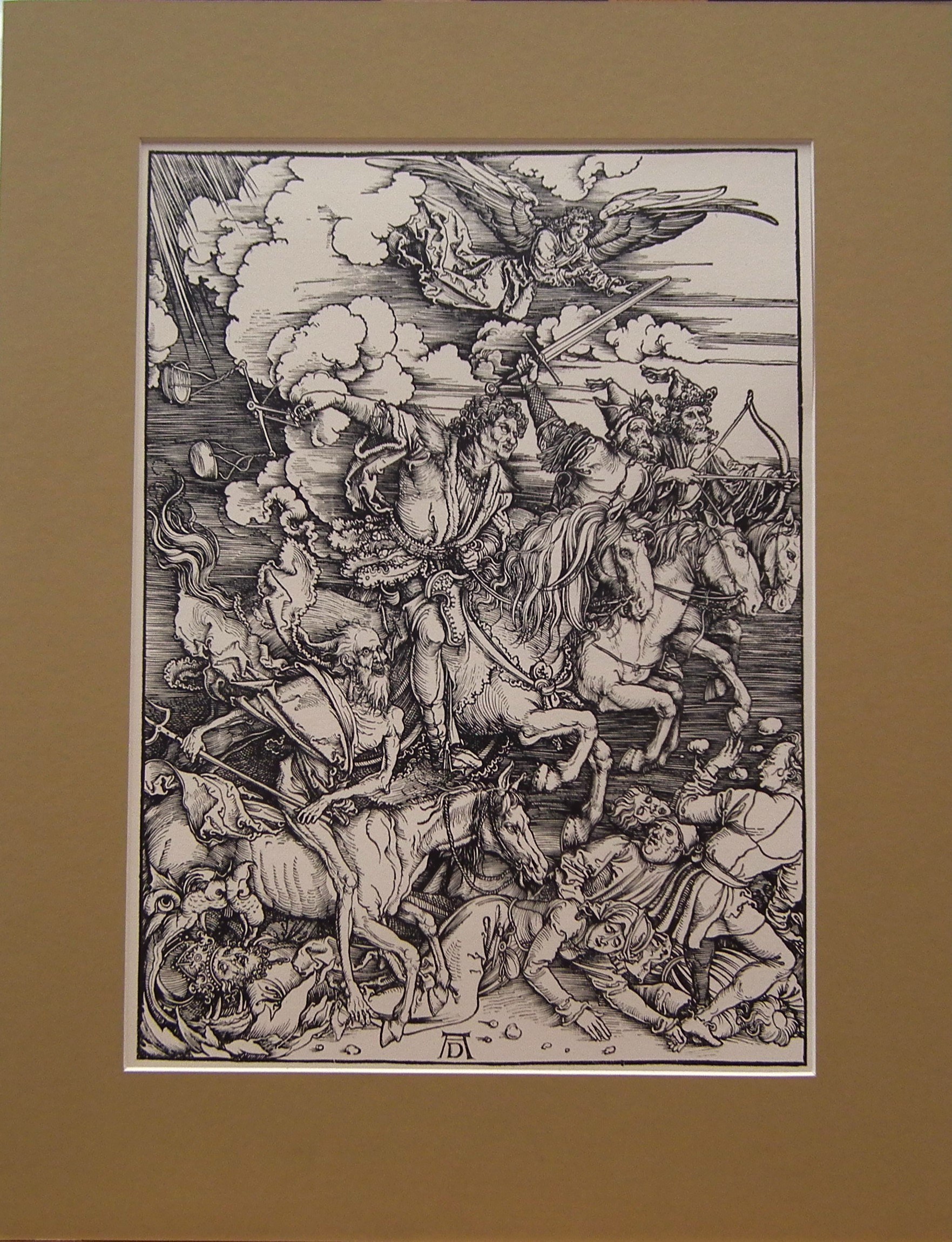
woodcut (20th century print), paper, 40 x 30 cm in light passe - partout,
signed on the board, middle: bound monogram "AD"
Woodcut "Four Horsemen of the Apocalypse" (German: Die vier apokalyptischen Reiter) by Albrecht Dürer is one of the most famous works by this German Renaissance artist. It was created in 1498 and is part of a series of woodcuts published in the book "Apocalypse" (Die Apokalypse), The series is based on visions from the Apocalypse of St. John (the Book of Revelation), one of the most symbolic books of the New Testament, which describes the end of the world, the struggle between good and evil and God's final victory over the forces of darkness.
The woodcut depicts the four horsemen of the Apocalypse, symbolizing the destruction and chaos foretold in St. John's vision: The first horseman - usually identified with the Victor, rides a white horse and holds a bow, suggesting conquest. The second rider - on a red horse, symbolizes War. He holds a great sword, with which he divides the world, bringing conflict and violence. The third rider - riding a black horse, represents Famine. In his hand he holds a scale, symbolizing shortages and difficulties in obtaining food. The fourth rider - on a pale, corpse-like horse, personifies Death. Accompanying him is a raven, followed by the abyss that consumes the souls of the dead.
Dürer used the technique of woodcuts to achieve detailed and dramatic visual effects. His extraordinary precision, detail and dynamic composition give the scene drama and intensity. The figures of the horsemen almost seem to emerge from the surface of the painting, and the background is full of swirling figures, which emphasizes the chaos and horror of the apocalyptic events. The entire scene is filled with biblical and moral symbolism, which is typical of late medieval and early Renaissance art.
The "Apocalypse" series was Dürer's first major project, which brought him international fame. It was created at a time of great social, religious and political tensions in late 15th century Europe. At the time, people were living in an atmosphere of anticipation of the imminent end of the world, which explains the popularity of apocalyptic motifs in the art of the period.
Dürer's woodcuts also show the influence of humanism and modern ideas. Although grounded in the medieval tradition, Dürer brought an innovative approach to composition and expression to his works, making his art unique to the period.
"The Four Horsemen of the Apocalypse" is one of the most outstanding examples of woodcut art and one of Dürer's most important works. Its influence on later artists and on the development of European art is enormous. By combining a biblical narrative with technical mastery, this woodcut became a timeless work that still inspires admiration and interest today.
The work can now be admired in various museums, often as part of temporary exhibitions, and original prints can be found in prestigious art collections around the world, such as the **Rijksmuseum** in Amsterdam and the **British Museum** in London.