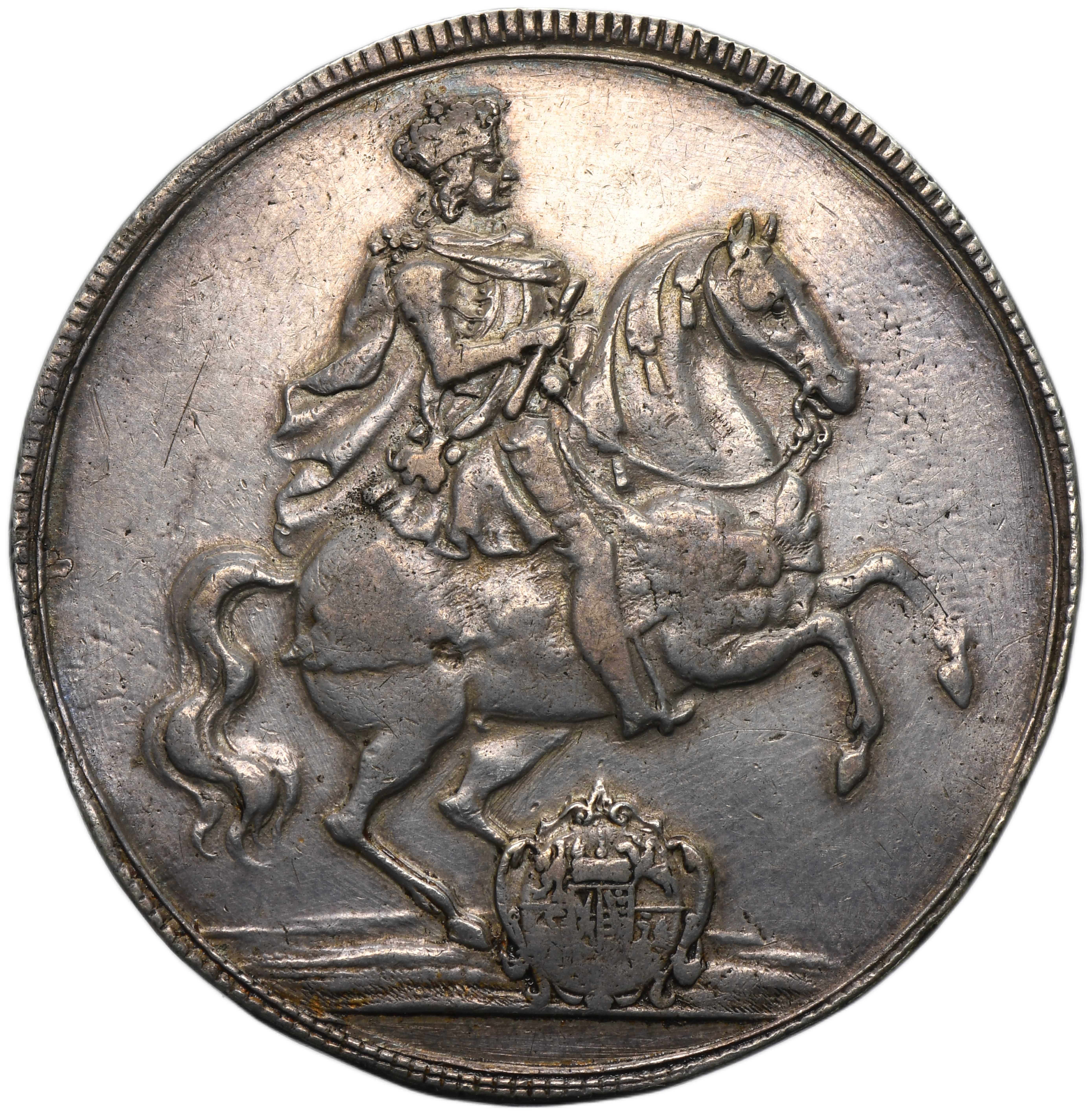
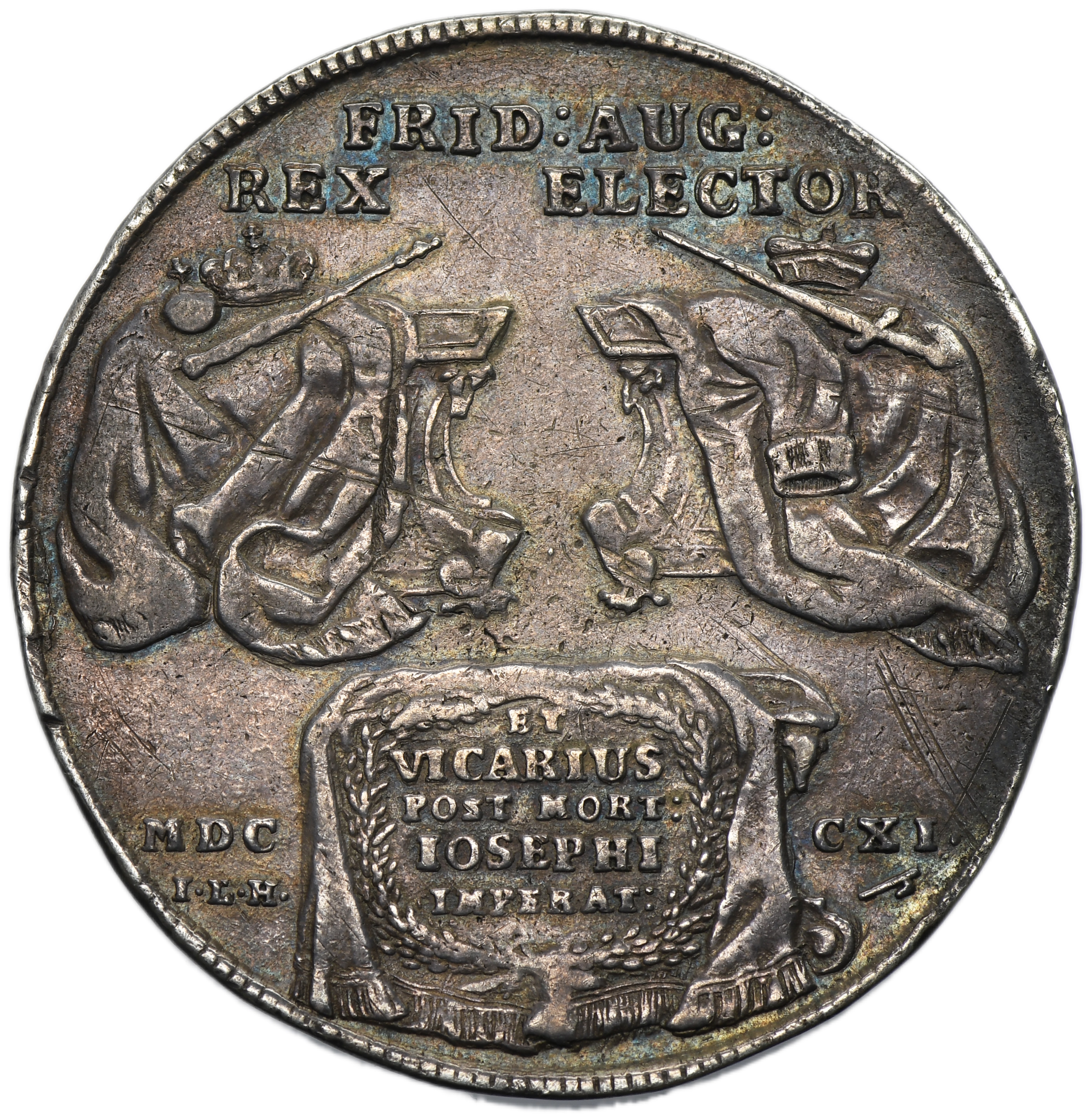
An impressive vicariate thaler of Augustus II the Strong, which was the first vicariate coin of a Polish king.
On the reverse are the initials ILH of Johann Lorenz Holland, mintmaster of the Dresden mint.
A coin with the popular depiction of a king on horseback.
Obverse: King on horseback facing right, under the horse a five-field coat of arms, with the coats of arms of the Crown, the Grand Duchy of Lithuania and the House of Wettin
Reverse: three altars, with the insignia of the king, the elector of Saxony and covered with a cloak with a wreath, at the top FRID AUG / REX ELECTOR, in the wreath ET VICARIUS POST MORT / IOSEPHI / IMPERAT, on the sides the date MDC - CXI, the initials ILH and the mint mark hook
Diameter 45 mm, weight 29.18 g
During the reign of Augustus the Strong, no mints were established in the Polish-Lithuanian Commonwealth. Strictly speaking, no Polish or Lithuanian coins were minted at that time. Under current law, the Leipzig issues belonged to the Saxon coinage. Nevertheless, due to the Polish denominations and the king's Polish name—August II, rather than Frederick Augustus as on Saxon coins—some coins from this group are classified as Polish coinage. These include the six-coin, ort, thaler, half-ducat, and ducat. In addition, the Moscow mint issued Lithuanian six-coin, while the Gdańsk mint issued ducats, double-ducats, and shillings. Commemorative coins, tokens, and private issues also played a significant role in minting during Augustus the Strong's reign.