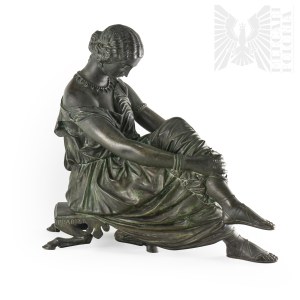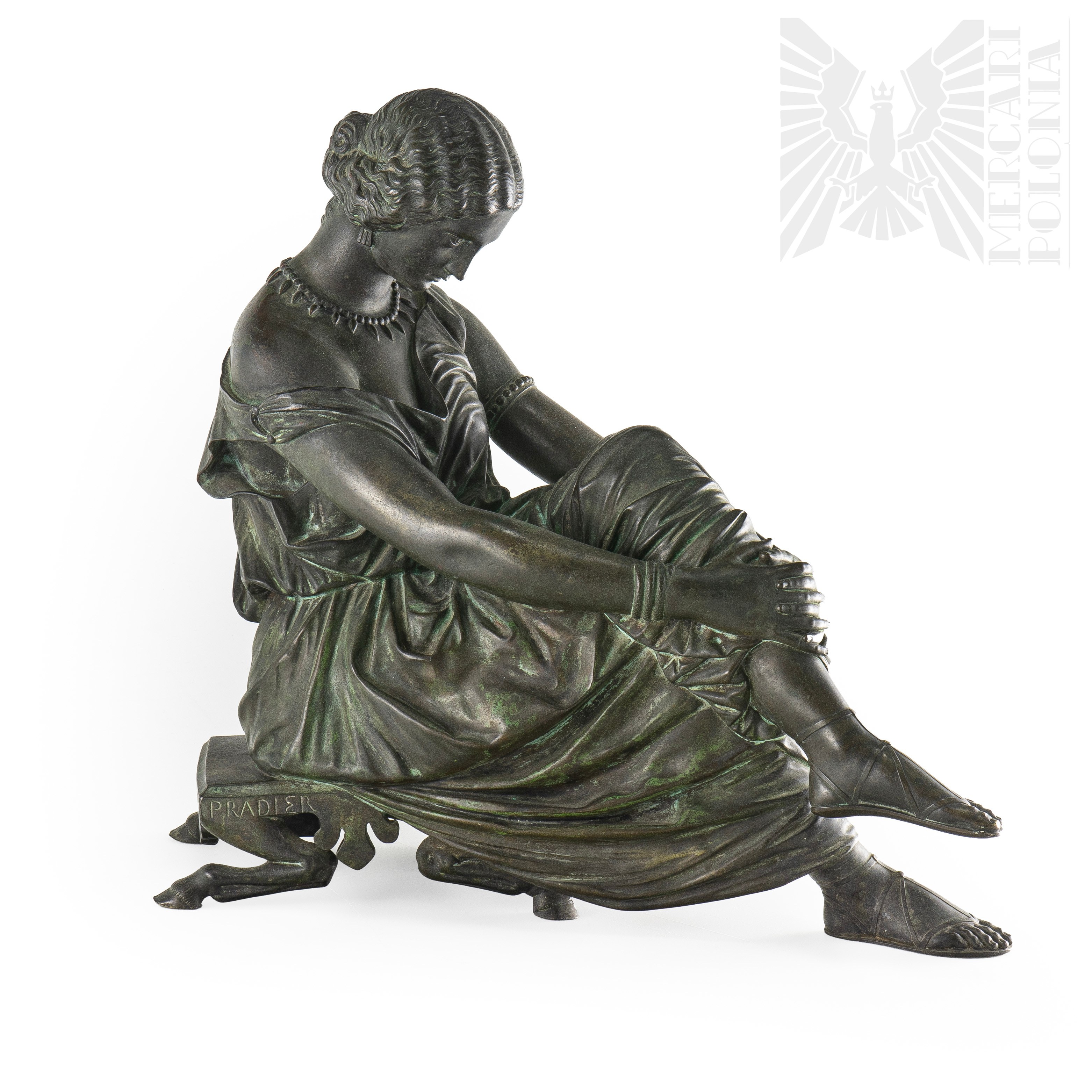
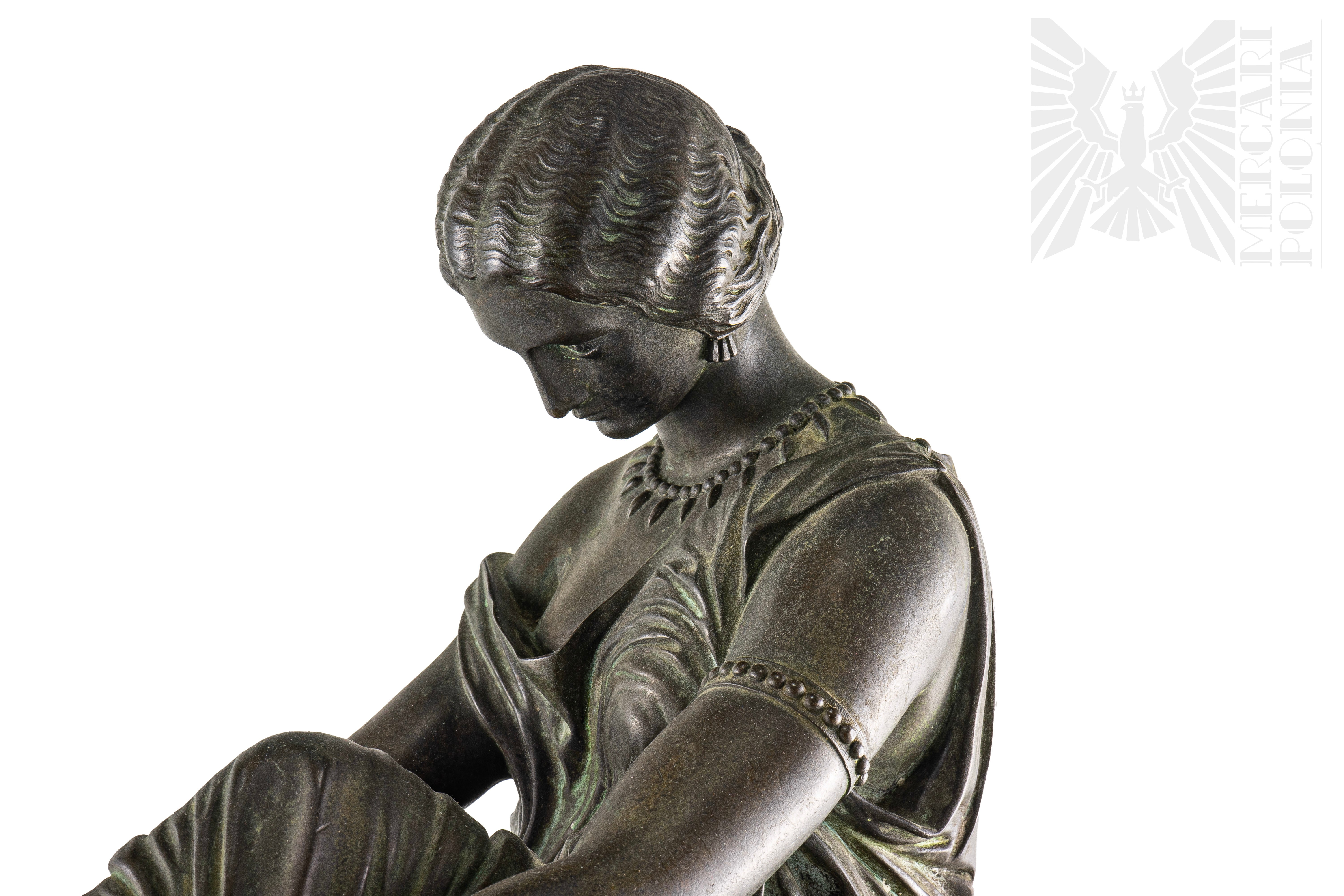
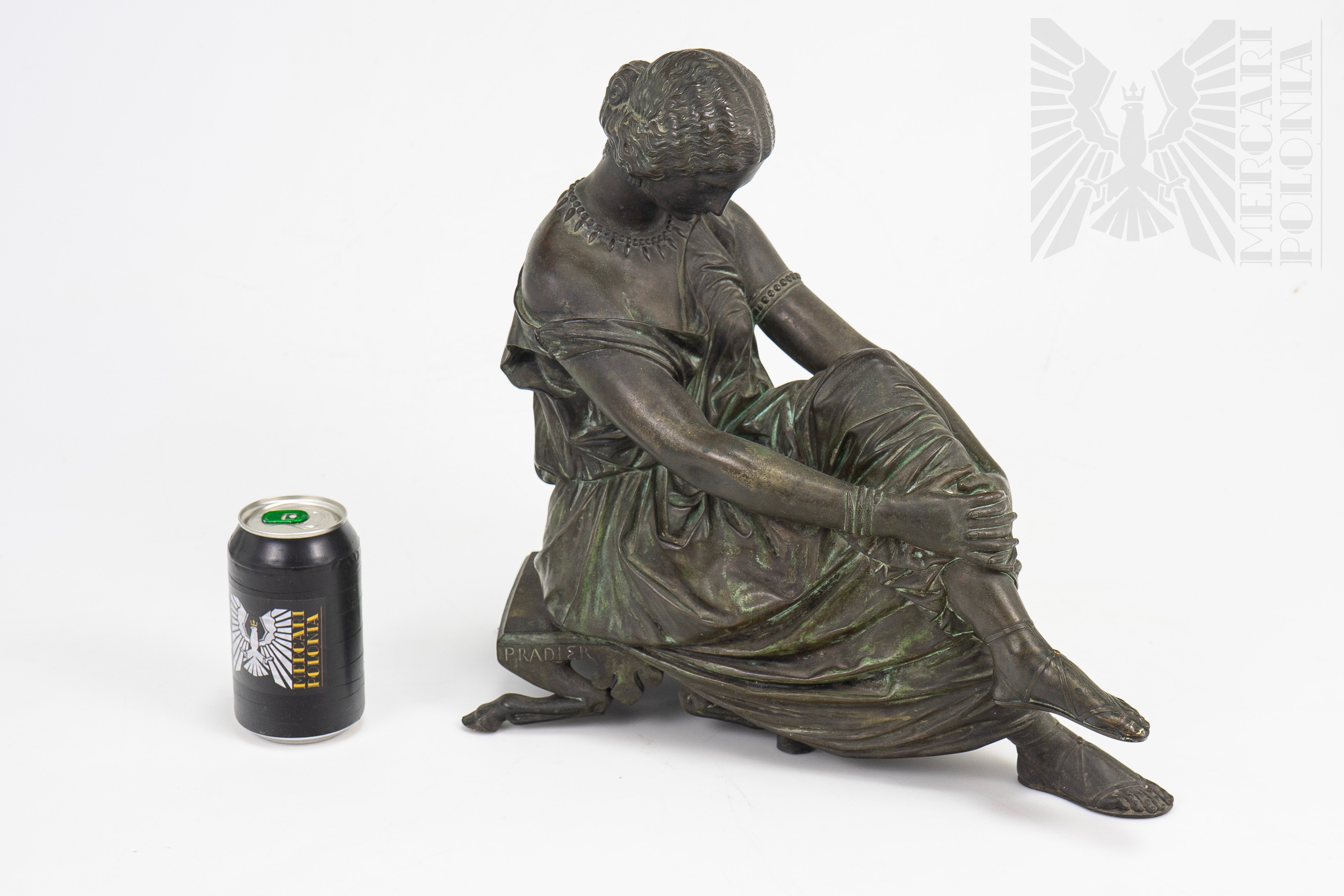
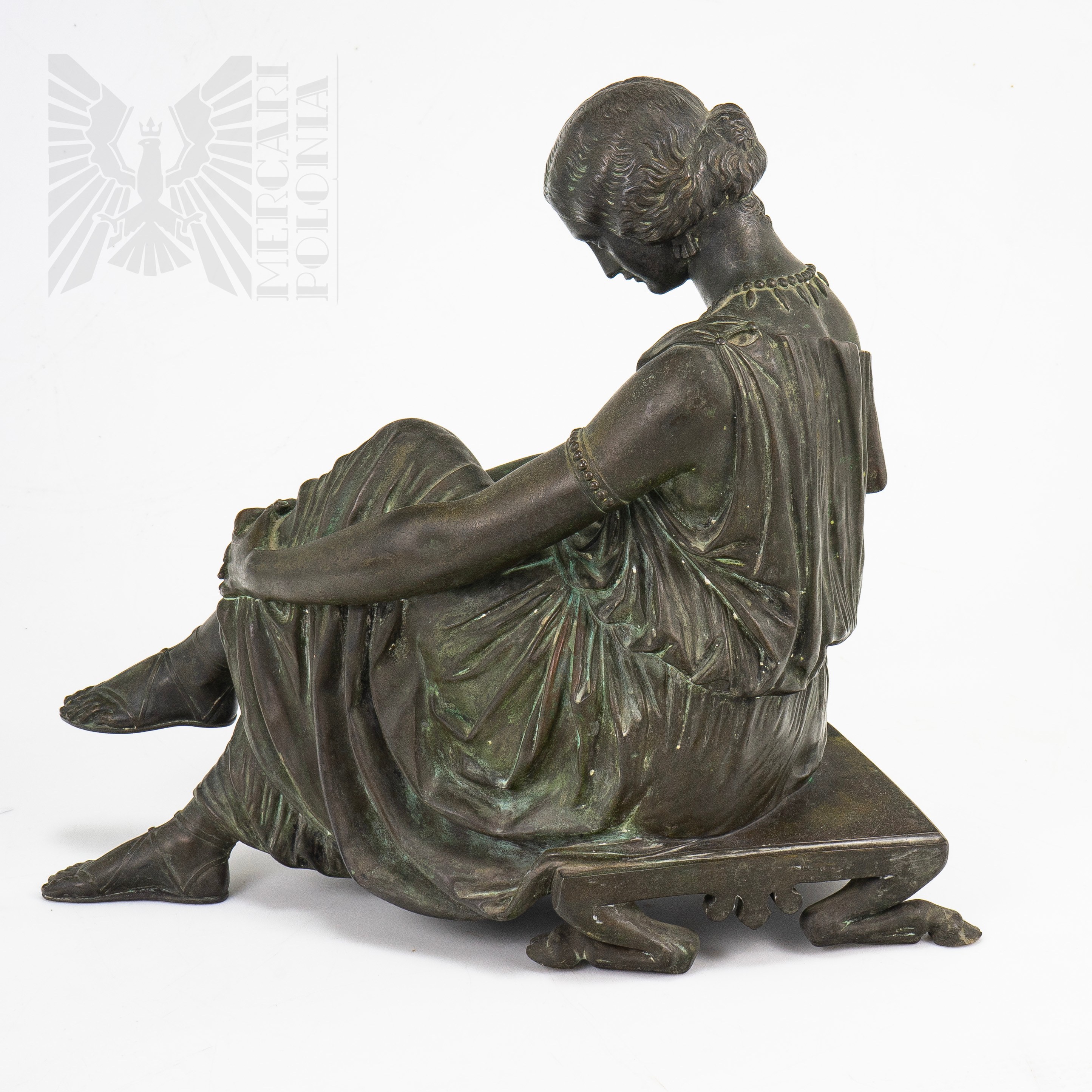
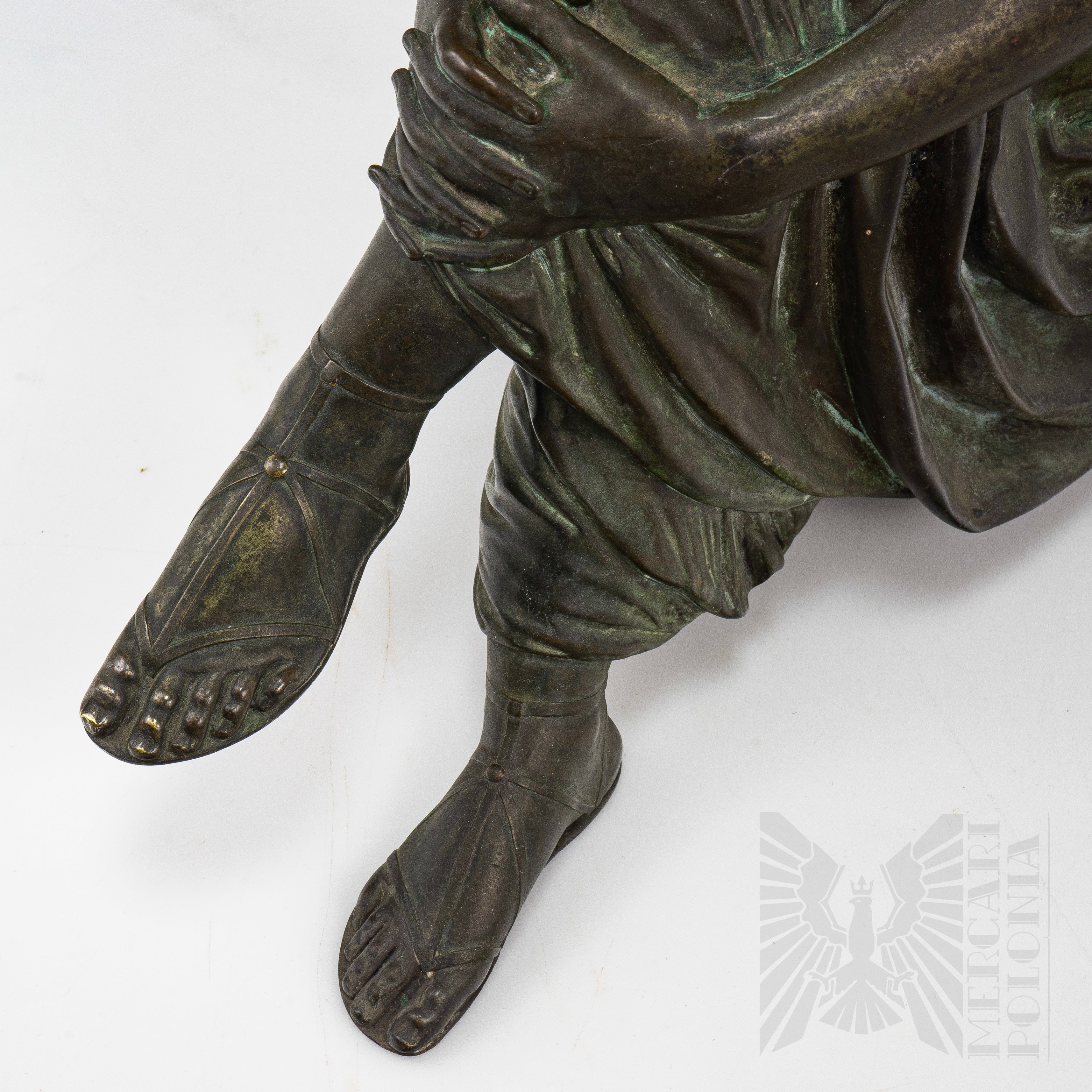
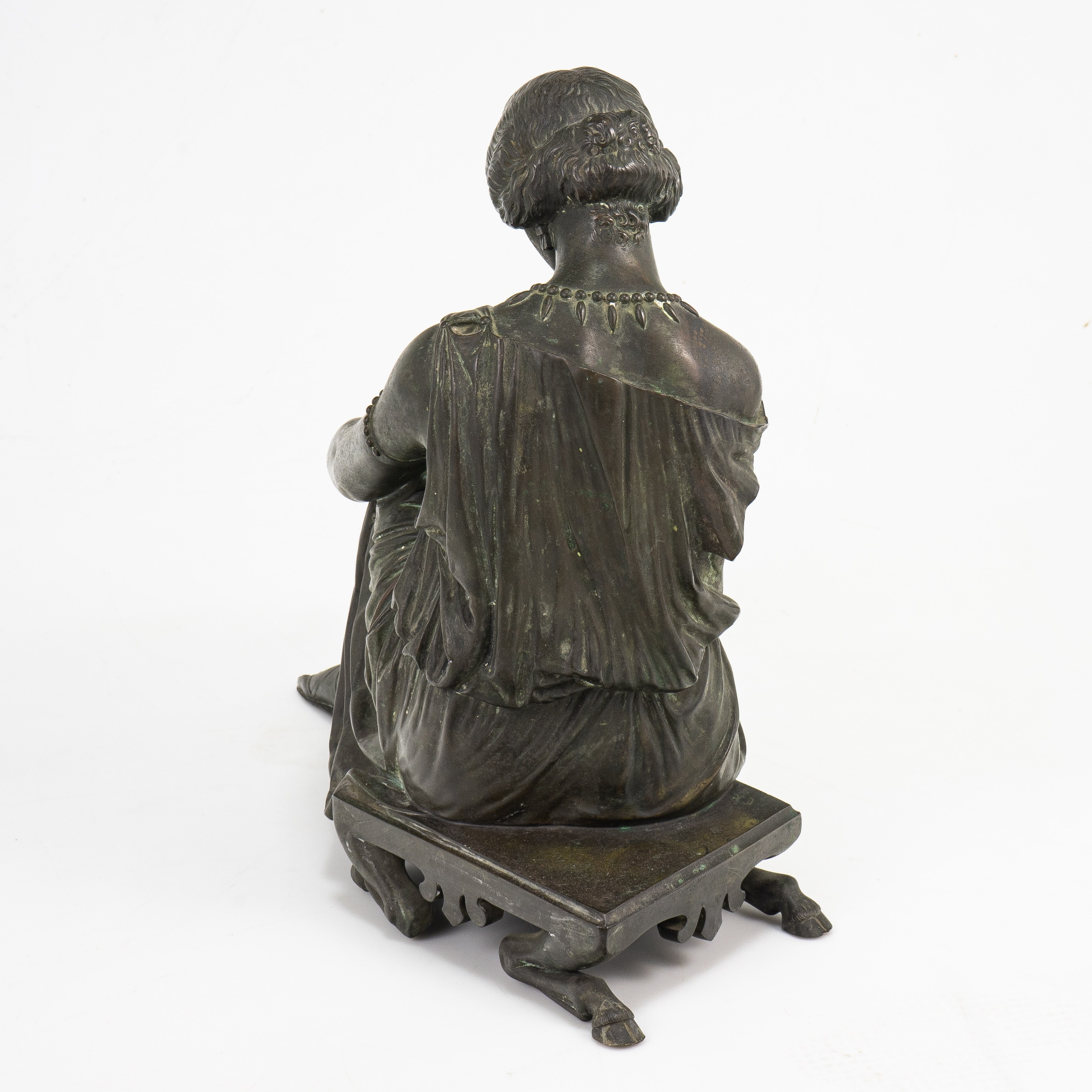
The sculpture depicts a seated female figure captured in a calm, contemplative pose. The figure rests on a low elevation, with her torso slightly tilted and her head facing downward. One hand is leaning casually, while the other may be supporting an attribute or resting on a knee, enhancing the impression of reverie.
The figure is clad in a long, antique-styled robe with soft folds that flow down the body and partially reveal the figure's form. The drapery is elaborated with great subtlety - the folds are fluid, with gentle chiaroscuro transitions. The figure is slender, proportional, with harmonious modeling.
The face has delicate, classical features and a muted, melancholy expression. The hair is framed by a stylized updo inspired by ancient art. The surface of the bronze is covered with a dark, naturally patinated layer, with localized rubbing on the most convex parts. Signed on the seat rim "PRADIER".
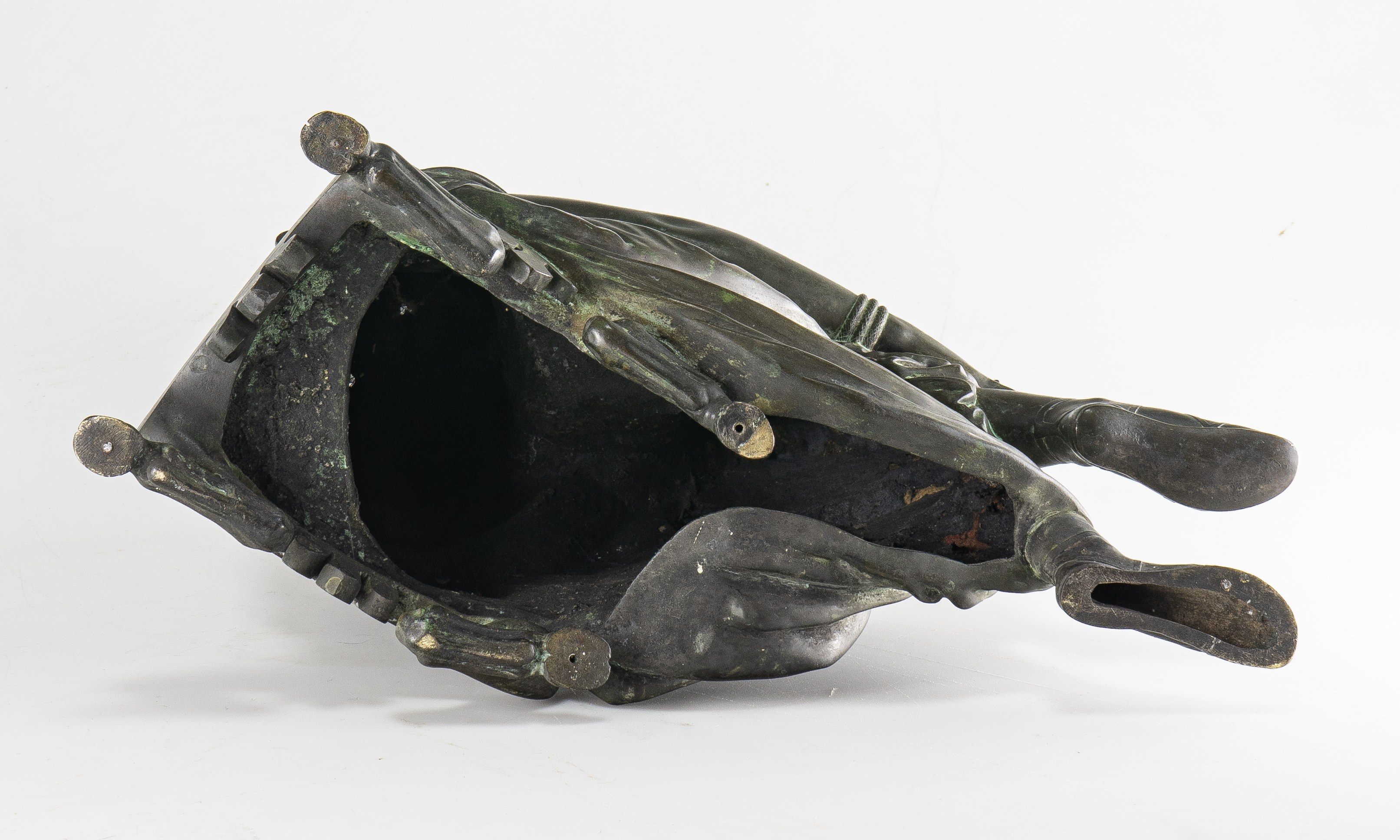
Bronze
Dimensions: 36 x 34, 5 cm
Condition as in the photos
The motif of Safona was particularly popular in neoclassical art, where antique figures conveyed ideals of beauty, harmony and intellectual depth. The work of Jean-Jacques Pradier is part of this trend, combining academic perfection of form with subtle emotional expression.
Sculptures of this type refer directly to the heritage of ancient Greece, interpreted through the prism of 19th-century French aesthetics. The figure of Safona - a symbol of poetry and sensitivity - is shown not as a dramatic heroine, but as a contemplative, focused and tranquil figure.
Works attributed to Pradier were prized in collecting circles for the high quality of the casting and the sophistication of the modeling, as well as for their ability to combine classical inspiration with the elegance of the Empire era. The figure is an example of art intended for formal interiors, highlighting the owner's cultural aspirations and his interest in antiquity.
Jean-Jacques Pradier was born on May 23, 1790 in Geneva and died on June 4, 1852 in Bougival near Paris. He was one of the most prominent French sculptors of the first half of the 19th century, a representative of the neoclassical trend with distinct elements of realism and sensuality. He moved to Paris at a young age, where he studied at the École des Beaux-Arts under prominent sculptors, including François-Frédéric Lemot and Pierre Cartellier. In 1813 he won the prestigious Prix de Rome, which enabled him to stay in Rome for several years (1814-1818). There he studied ancient art and works of the Renaissance, which shaped his classicizing style.
Upon his return to France, he began an intense artistic activity, regularly exhibiting his works at the Paris Salons. He quickly won the praise of critics and the public, especially with his sculptures on mythological and allegorical themes. His works are characterized by harmonious proportions, excellent anatomical development and subtle, often sensual modeling of female figures. In 1827 he became a professor of sculpture at the École des Beaux-Arts in Paris, which confirmed his high standing in the artistic community. He also performed numerous public commissions, creating sculptural decorations for important buildings, including the Arc de Triomphe in Paris and other architectural projects of the era.
Among his best-known works are mythological depictions, such as "Satyr and Bacchantes," "Phryne before the Areopagus," and numerous images of goddesses and nymphs. He was particularly famous for his female nudes, which combined the classical ideal of beauty with a more naturalistic and emotional depiction of the body. Pradier was an artist highly regarded by both academics and private collectors. His work provides an important link between austere neoclassicism and the more expressive tendencies of the later 19th century.