


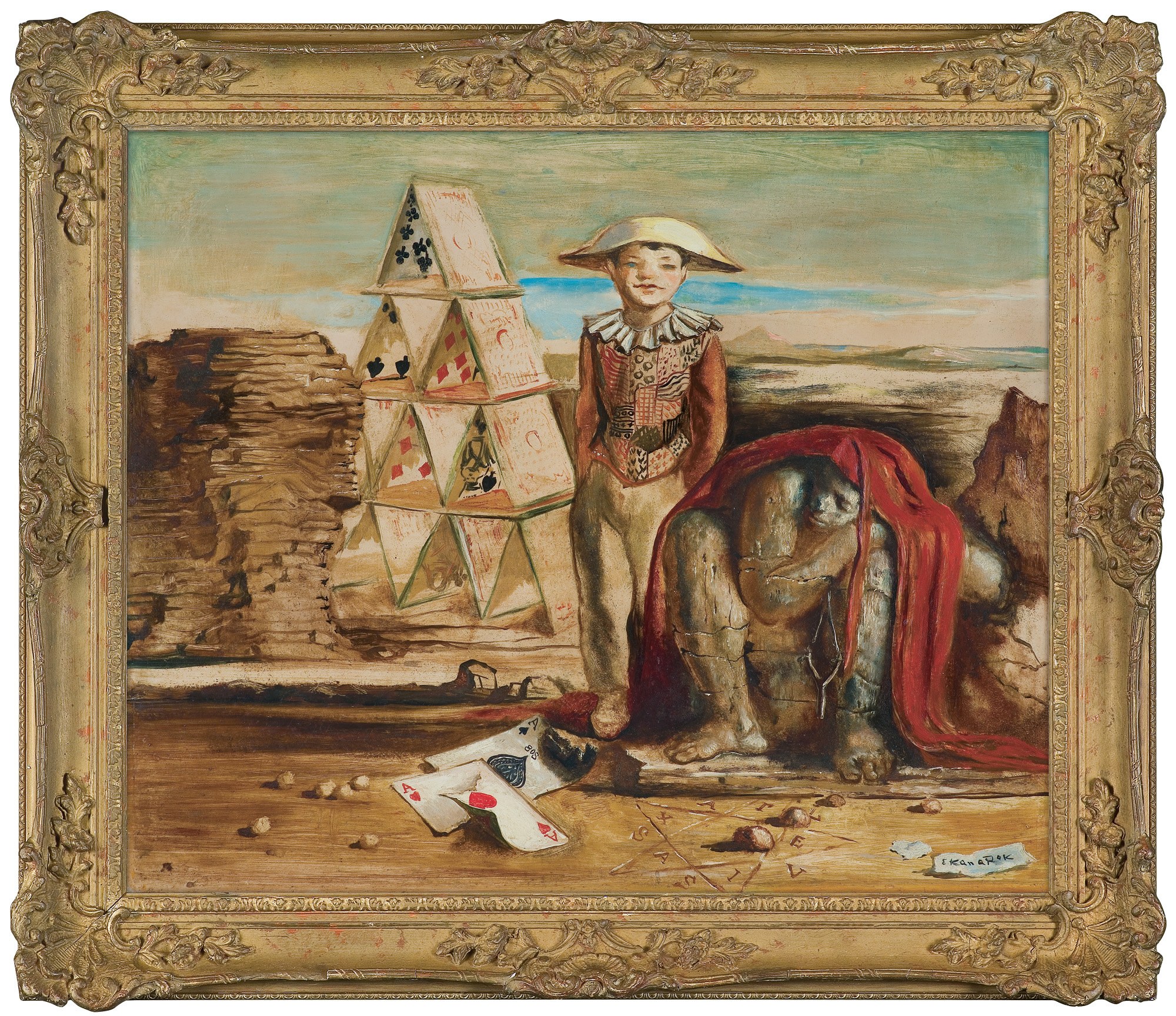

50.8 x 61 cm - oil on fiberboard
signed lower right: E KanaRek
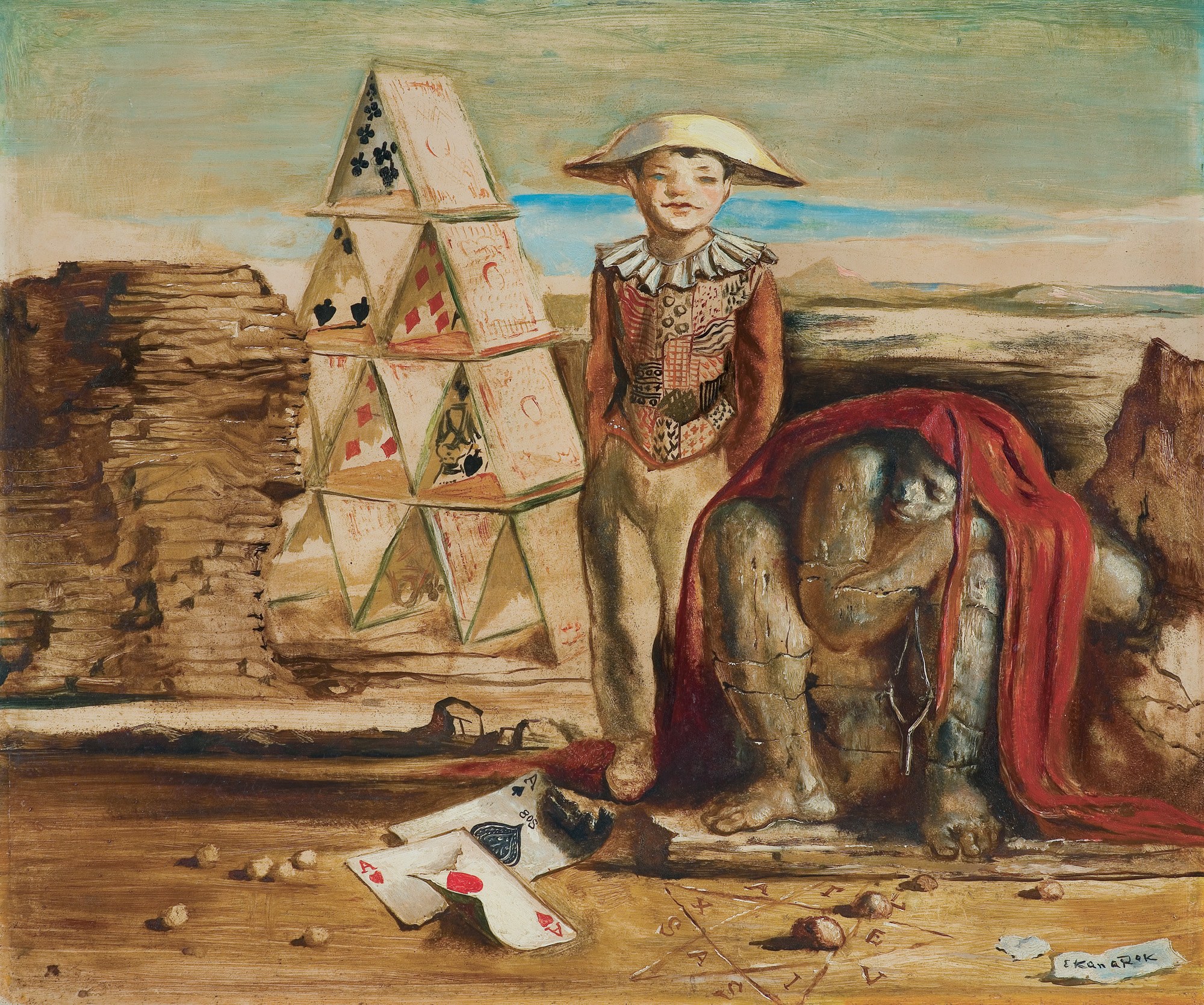
This fantastical scene contains many symbolic elements that can be interpreted as a story of creation, harmony, and a crumbling order. The artist placed Pierrot in the central part of the painting. Traditionally, he is a melancholic loner with a face painted white. He is often a naive hero existing somewhere between comedy and drama. The Golem, positioned in front of him, likely alludes to the famous Prague legend. In the second half of the 16th century, after attacks on Prague’s Jews—who were accused of blasphemous practices and occultism—intensified, To defend himself and others, Rabbi Maharal molded a large human figure out of clay, which he then brought to life through secret rituals and prayers, finally inscribing a parchment with the word that animated it and placing it in the figure’s mouth. According to legend, after defending the Jews against attacks by the local population, the rabbi immobilized the golem by taking the parchment from it and hiding it in the attic of a Prague synagogue. In the painting, we see a piece of parchment lying at the feet of the sleeping golem, who is hidden beneath a red sheet. The sleeping figure holds a sling in his hand, and the stones fired from it lie scattered in the foreground. Several of them obscure a pentagram inscribed with the words “salus” (health) and “ugeia” (Hygieia), which in ancient Greece symbolized the harmony of body and spirit and represented the golden ratio and perfection. Behind the main characters stretches a desolate, inhospitable landscape. It is dry and rocky, and the partially visible ruins of a brick wall, along with a scorched and torn piece of paper, evoke the image of a post-apocalyptic landscape. This creates the atmosphere of a world devoid of normal life. Behind the wall stands a house of cards—a temporary structure that could easily collapse from the slightest tremor or a gentle breeze.
The painting may therefore be the artist’s attempt to depict the unstable postwar reality. We can interpret the sleeping Golem as a defender of humanity—gently asleep, yet with a slingshot in hand, ready for the next battle. In the postwar reality, humanity—depicted as Pierrot—is torn between the desire for happiness and the drama surrounding it. The house of cards likely refers to the fragile peace that, during the Cold War, could collapse at any moment.
Eliasz Kanarek (Skowierzyna or Warsaw, 1901 – Washington, D.C., 1969), a painter from the circle of the so-called “Pruszkowiaks”—students of Tadeusz Pruszkowski—began his studies at the Warsaw School of Fine Arts under Pruszkowski’s guidance in 1923. He was a member of the “Brotherhood of St. Luke”—founded in 1925—and, together with his professor and colleagues, would travel to Kazimierz on the Vistula for summer plein air painting sessions. He participated in the Brotherhood’s exhibitions and also exhibited with the Blok ZAP group at the IPS in Warsaw and abroad, including at the Venice Biennale (1934) and the Carnegie Institute in Pittsburgh (1937). As an illustrator, he contributed to the satirical magazine *Szpilki*. In 1938, together with Pruszkowski and colleagues from the Brotherhood, he worked on a series of seven historical paintings intended for the World’s Fair in New York (120 x 200 cm; tempera on panel). In March 1939—together with Bolesław Cybis—he sailed on the *Batory* to the U.S. to oversee the setup of the Polish Pavilion (which opened on May 3, 1939) at the exhibition. The war found him there, and he never returned to his homeland afterward. Kanarek, like all members of the “Łukaszowcy” group, placed great emphasis on technical perfection. He painted portraits, still lifes, landscapes, and figural scenes, including religious ones (Children’s Crusade, ca. 1928; National Museum in Warsaw). His earlier works are rendered in dark tones, while his later ones—painted with a lighter color palette—approach the Colorism movement. At times, he incorporated elements of humor, the grotesque, stylization, or even the deformation of figures (Idyll, 1932, Jewish Historical Institute Museum). The artist also had experience in film: he appeared as an actor in the amateur film *The Happy Hangman, or California in Poland*, shot by the “Pruszków group” in Kazimierz (1926), and as a set designer, he collaborated on the film *Dzikie pola* (Wild Fields), directed by Jerzy Lejtes (1932). Note: Information regarding the artist’s place of birth (Skowierzyna)—as well as the place and date of his death (generally estimated to be around 1970)—is taken from: J. Maśnicki. K. Stepan, *Pleograf: A Biographical Dictionary of Polish Film, 1896–1939*, Kraków 1996.













Utoljára megtekintett
A tételek listájának megtekintéséhez jelentkezz be
Kedvencek
A tételek listájának megtekintéséhez jelentkezz be