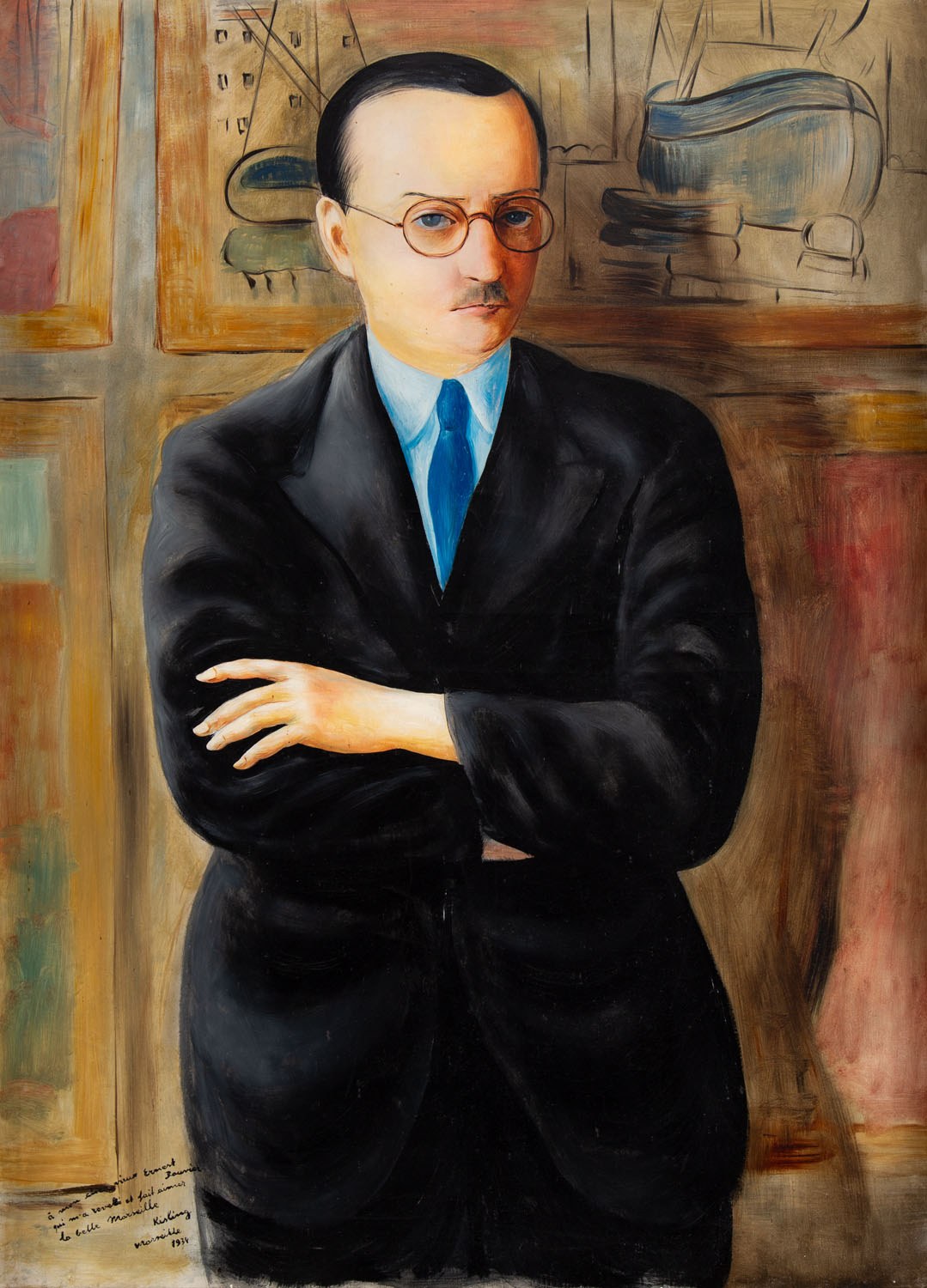


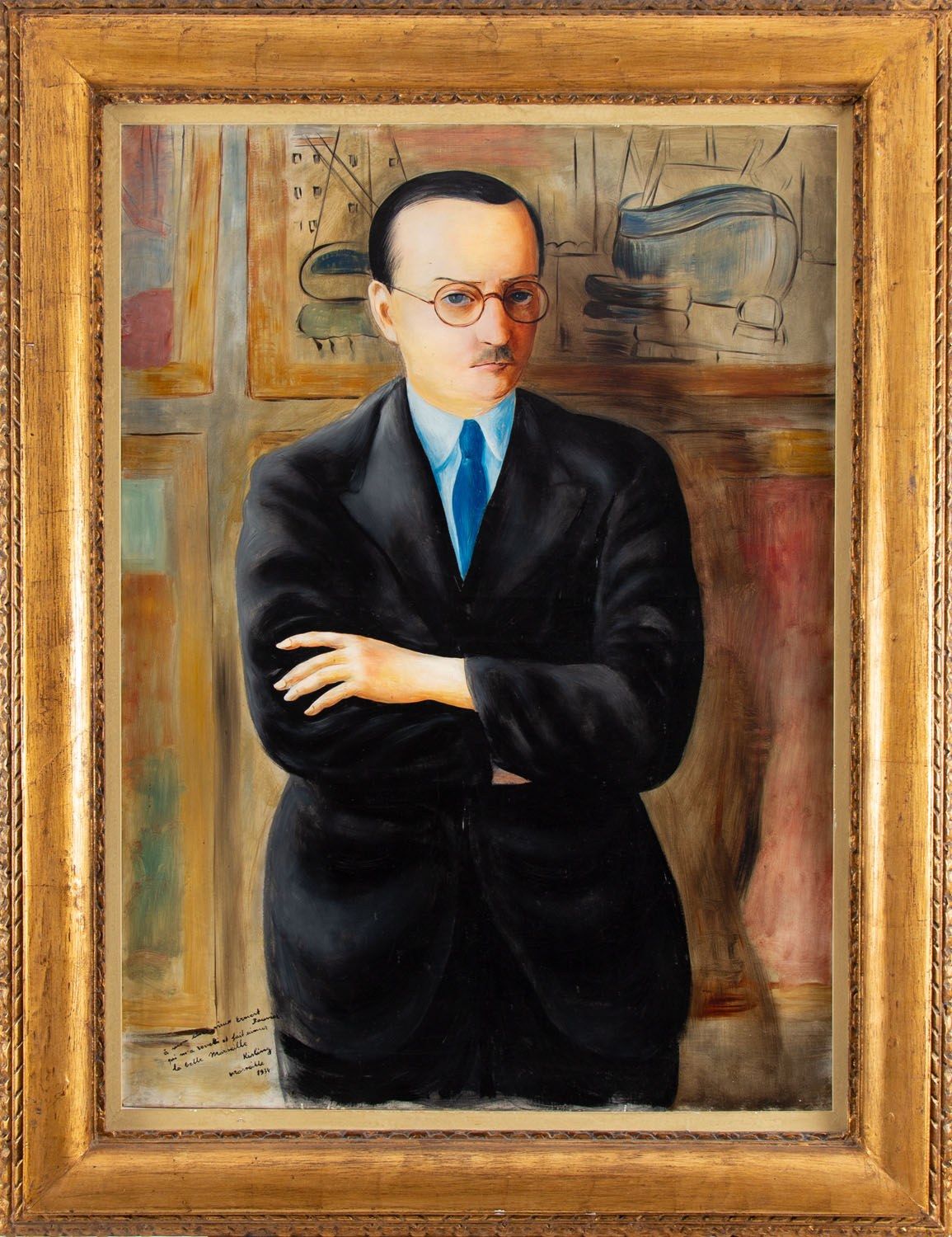


Dimensions: 100 x 75 cm
signed, dated and inscribed l.d.: à mon cher vieux Ernest | Rouvier | qui m'a révélé et fait aimer | la belle Marseille | Kisling | marseille | 1934'.
Origins
Rouvier family collection
Galerie Alexis Pencheff, Marseille
private collection, France
DESA Unicum, December 2020
private collection, Poland
Exhibited
Montparnasse Atelier du Monde. Ses Artistes venus d'Ailleurs, Hommage à Kisling, Palais de la bourse, Marseille, June 1992-January 1993
Rétrospective Kisling, Grande Galerie Odakyu, Tokyo, The Miyazaki Prefectural Institution, Galerie d'Art Daimaru, Osaka and Kobe, May 18-October 2, 1984
Literature
Montparnasse atelier du monde. Ses artistes venus d'ailleurs, hommage à Kisling, exhibition catalog, Forum des arts, Palais de la Bourse, Marseille 1992, no. 110, p. 89 (il.)
Rétrospective Kisling, Tokyo 1984, no. 63, p. 92 (ill.)
Biography
In 1907-11 he studied painting at the Academy of Fine Arts in Cracow with Jozef Pankiewicz. On his advice, together with Szymon Mondszajn, he went to Paris for further studies. There the critics André Salmon and Adolf Basler became interested in his work, and he also received a scholarship from an anonymous patron from Russia. He was called "the Duke of Montparnasse" because of his social colligations and financial success. He had friendly relations with Polish artists Tadeusz Makowski, Eugeniusz Zak, Ludwik Markus, Roman Kramsztyk and Mela Muter. He was awarded French citizenship for his participation in the fighting of the Foreign Legion during World War I. Wounded during the Battle of Clarency, he convalesced in Spain in 1916. During World War II, he joined the French army. In 1940, via Spain and Portugal, he left for New York. After the war, around 1946, he returned to Sanary-sur-Mer. He was one of the most prominent representatives of the Ecole de Paris of the interwar years. He had many solo exhibitions, and often participated in group exhibitions abroad as a Polish artist. He was one of the leading representatives of the École de Paris bringing together artists of Jewish origin who came from Central and Eastern Europe and Russia. "In the early phase of Kisling's work from 1912-18, his fascination with the art of Cezanne found expression; in his still lifes and landscapes, the artist synthesized and geometrized solids, piled up compositional plans, introduced an elevated point of view tightening the pictorial space. (...) Influenced by his contacts with the Cubists, he painted southern French landscapes with a geometrizing style borrowed from the paintings of Picasso and Braque from around 1909. He sought a formula of decorativeness in which synthesized architectural solids interact with the organic forms of nature. (...) In landscapes, he captured shapes in silhouette, while he gave colors an intensity comparable to a Fauvist palette. In 1917-18, in addition to views of Saint-Tropez, which were characterized by a bleached palette and ethereality, there were landscapes of deepened expression evoked by a range of sharp, strong, contrasting colors; these compositions, bordering on abstraction, concentrated in expression, were painted impasto, with diagonal brushstrokes. Some views of harbors with sailboats and a deserted waterfront alluded to the poetics of "metaphysical painting." In his landscapes, Kisling also alluded to 16th-century compositional schemes, depicting sweeping landscapes, built up behind the scenes, with suggestively rendered spatial depth." - Irena Kossowska