


Height x width: 31 x 25.5 cm
tempera on panel
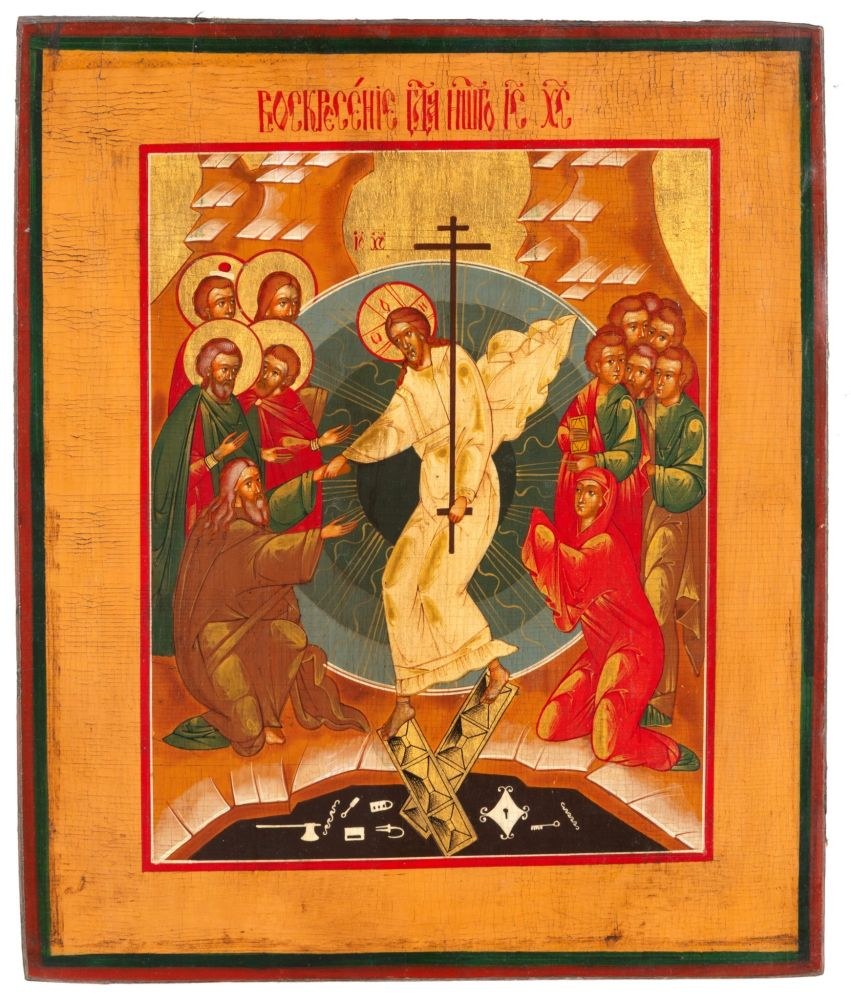
Icon painted on a wooden panel depicting the Descent into Hades (Anastasis), traditionally regarded in the Orthodox Church as the Resurrection of Christ, one of the most important and solemn representations of the Paschal cycle.
The composition portrays the triumphant Christ who, following the Crucifixion, descends into the realm of the dead to liberate humanity from the bondage of death. At the centre of the scene, Christ, clothed in a radiant white garment, emerges within a large blue-grey mandorla illuminated by delicate rays of divine light. With His right hand He firmly grasps Adam, kneeling at His left, while with His left He holds the long processional cross, the symbol of His victory over death and sin.
At the Saviour's feet lie the shattered bronze gates of Hades, depicted diagonally beneath Him together with broken locks, keys, hinges, and chains scattered across the dark abyss, in accordance with the traditional Byzantine and Russian iconography symbolizing the definitive triumph over death and the underworld.
To Christ's left appears the assembly of the Righteous of the Old Testament, led by Adam and accompanied by numerous patriarchs, kings, and prophets, identifiable through their traditional physiognomies and gilded halos. On the opposite side stands a second group of saints and patriarchs gathered in reverence as they witness the triumph of the Redeemer.
In the foreground, Eve is shown kneeling at Christ's feet, wearing the traditional red maphorion as she receives salvation. The two groups of figures converge harmoniously towards the Risen Christ, emphasizing the universal significance of Redemption.
The background is dominated by high stylized rocky cliffs symbolically defining the entrance to Hades. The extensive use of gold leaf lends exceptional luminosity to the composition, enhancing the contrast between the deep central mandorla and the vibrant red, green, and ochre tones of the surrounding figures.
The Church Slavonic inscription at the top clearly identifies the subject as the "Resurrection of Our Lord Jesus Christ," according to the traditional Orthodox liturgical designation.
The iconography of the Descent into Hades (Anastasis) constitutes the principal representation of the Resurrection in the Byzantine and Russian traditions, differing fundamentally from the Western depiction of the Resurrection showing Christ emerging from the tomb.
Between the second half of the nineteenth century and the early twentieth century, the principal workshops of Moscow, Mstëra, Palekh, and Kholuy produced numerous icons intended for private devotion, distinguished by a conscious revival of seventeenth-century Russian iconographic traditions, reinterpreted through a more refined and academic pictorial language.
Item condition grading: **** good.
The lot is in a good state of preservation with the normal wear and defects commensurate with its age and use over time. The painted surface is in good overall condition, displaying widespread age-appropriate craquelure affecting both the ground and paint layers, consistent with the age of the work. Minor surface abrasions, localized wear along the margins, and a few small areas of paint loss—particularly concentrated in the lower section of the composition—are present but do not compromise the overall legibility of the image.
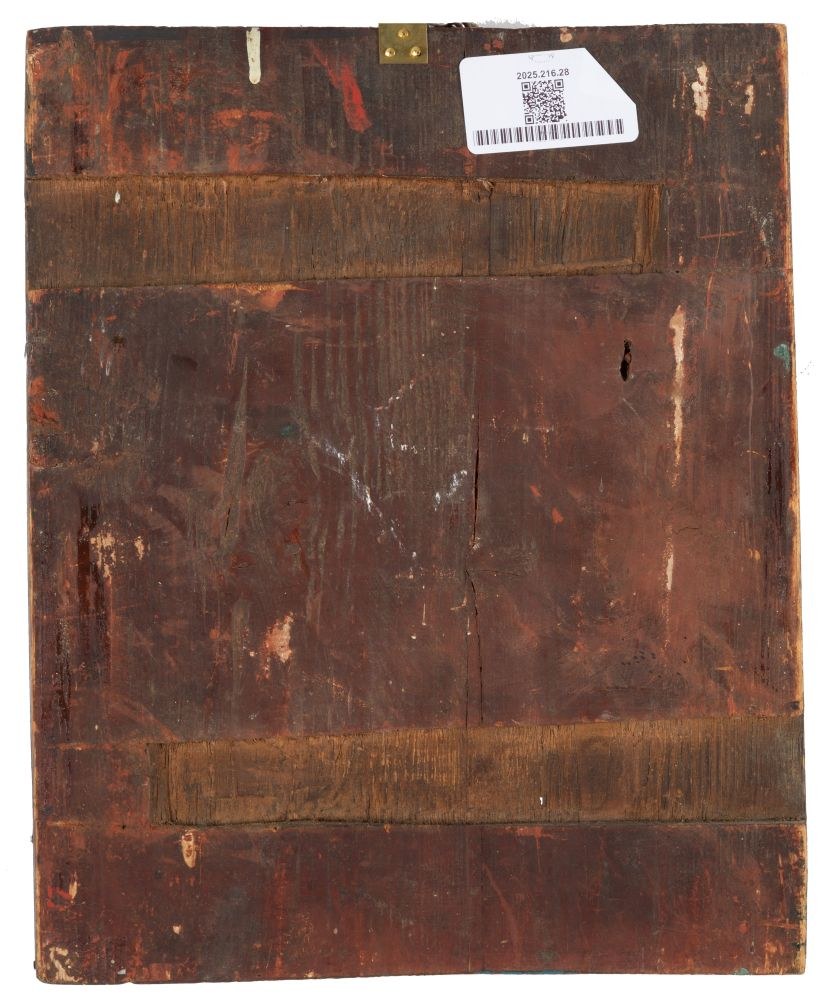
The wooden support appears stable and consistent with traditional construction techniques, retaining its original rear battens and showing no evidence of significant invasive structural restoration.









Utoljára megtekintett
A tételek listájának megtekintéséhez jelentkezz be
Kedvencek
A tételek listájának megtekintéséhez jelentkezz be